When the abdomen is innocent: recognizing lumbar radiculopathy as a cause of chronic abdominal pain
Published in Neuroscience and Biomedical Research
Explore the Research
Diagnosis and treatment of abdominal pain of spinal origin: a case report
Background
Chronic abdominal pain is commonly attributed to gastrointestinal, genitourinary, or gynecologic disorders. However, spinal pathology may produce referred visceral pain through complex neuroanatomical and autonomic pathways. Because this phenomenon is uncommon, abdominal pain of spinal origin is frequently misdiagnosed.
The Case
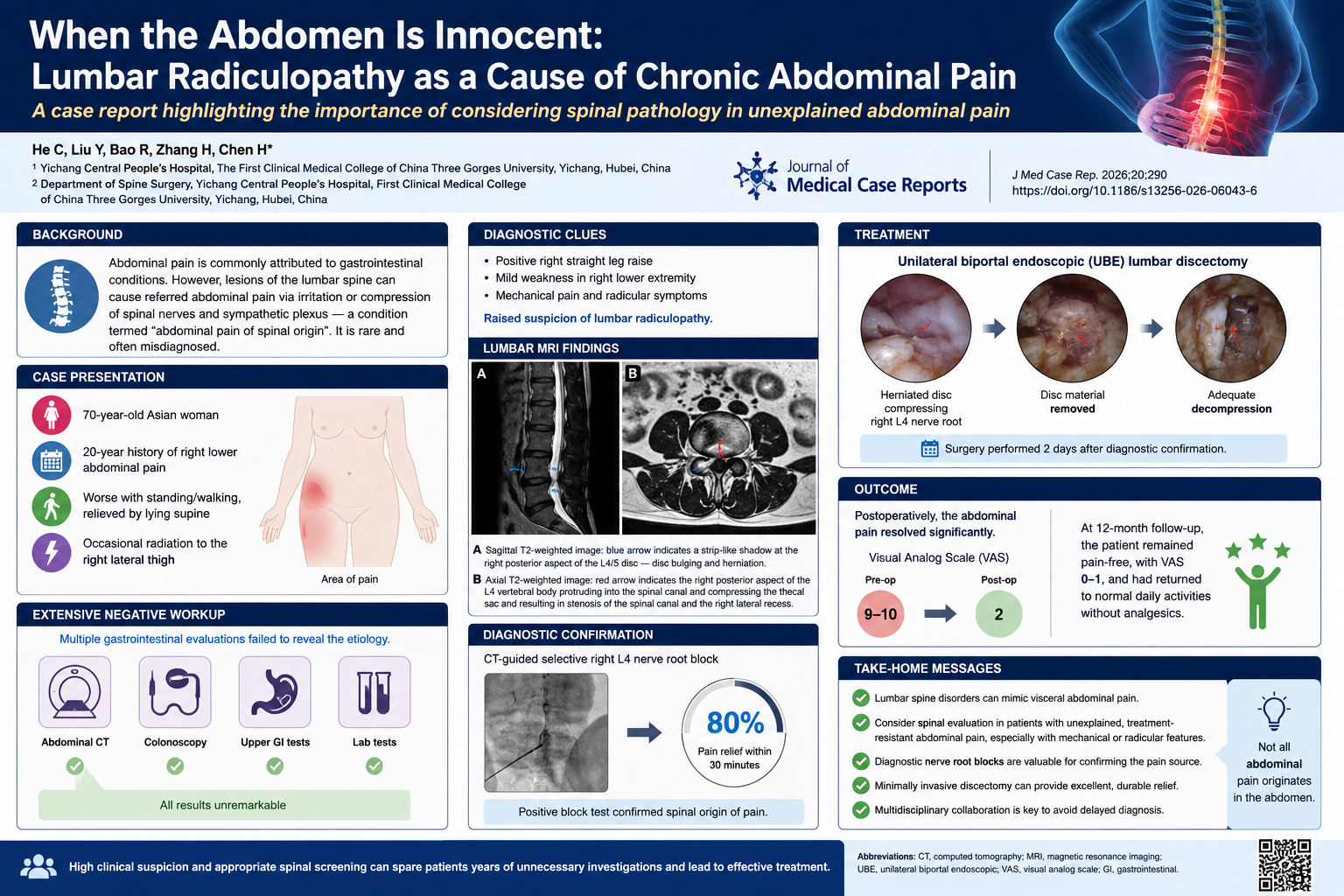
A 70-year-old Asian woman presented with a 20-year history of persistent right lower quadrant abdominal pain. Symptoms were worsened by prolonged standing and walking and partially relieved when supine. She occasionally experienced radiation to the right thigh.
Repeated gastrointestinal evaluations, including abdominal computed tomography and colonoscopy, failed to identify a cause. Multidisciplinary assessment eventually prompted lumbar imaging, which demonstrated degenerative changes and a right L4–L5 disc herniation with stenosis of the right lateral recess.
Physical examination revealed positive straight-leg-raising and mild right lower-extremity weakness. These findings raised suspicion for lumbar radiculopathy presenting as referred abdominal pain.
Diagnostic Reasoning
A CT-guided selective right L4 nerve root block produced approximately 80% pain relief within 30 minutes, strongly supporting a spinal origin. The dramatic response to the diagnostic block established the relationship between nerve root compression and the patient's longstanding abdominal symptoms.
This case illustrates an important principle: unexplained abdominal pain, particularly when influenced by posture or accompanied by back pain or radicular symptoms, should prompt consideration of spinal disease.
Treatment
Two days after confirmation of the diagnosis, the patient underwent unilateral biportal endoscopic lumbar discectomy. Intraoperatively, a migrated L4–L5 disc herniation causing significant compression of the right L4 nerve root was identified and removed.
Postoperatively, abdominal pain improved markedly, with reduction of the visual analog score to 2. At 12 months, the patient remained symptom-free without analgesics and had resumed normal activities.
Why This Case Matters
Lumbar disc disease is classically associated with low back pain and sciatica, yet atypical presentations can mimic visceral disorders. Referred abdominal pain likely results from viscerosomatic convergence and autonomic pathways linking lumbar nerve roots with abdominal sensory networks.
This report underscores several important lessons:
- Chronic abdominal pain may occasionally originate from the spine.
- Mechanical symptoms and associated radicular complaints are important diagnostic clues.
- Diagnostic nerve root blocks can help establish the source of pain.
- Minimally invasive decompression surgery may provide durable relief when conservative approaches fail.
- Multidisciplinary collaboration can prevent prolonged diagnostic delays.
Clinical Take-Home Message
Not all abdominal pain originates within the abdomen. In patients with unexplained, treatment-resistant abdominal pain—particularly when symptoms vary with posture or coexist with back pain or sciatica—lumbar radiculopathy should be considered. Recognition of this uncommon presentation can spare patients years of unnecessary investigations and lead to effective treatment.
Reference
He C, Liu Y, Bao R, Zhang H, Chen H. Diagnosis and treatment of abdominal pain of spinal origin: a case report. Journal of Medical Case Reports. 2026;20:290. https://doi.org/10.1186/s13256-026-06043-6.
Journal of Medical Case Reports is the world’s first international, PubMed-listed, medical journal devoted to publishing case reports from all medical disciplines and will consider any original case report that expands the field of general medical knowledge, and original research relating to case reports. The journal is open access, and strongly endorses the CARE guidelines for case reports, requiring authors to submit populated CARE checklists with submissions to improve transparency in reporting.

Richard Alan Rison is the interim Editor-in-Chief of Journal of Medical Case reports. He is also an associate neurology editor (editorial board) for BMC Neurology, and the former lead editor for case reports of BMC Research Notes (currently on the editorial board). His scholarly work focuses on medical case reporting, reporting standards, and editorial methodology. Dr. Rison participated in the development and dissemination of the CARE guidelines for clinical case reporting and has authored numerous publications addressing both neurological disorders and the role of case reports in advancing medical knowledge. Dr. Rison practices general neurology and served as the founding medical director of the PIH Health Hospital-Whittier Stroke Program and the PIH Health Hospital-Whittier Non-Invasive Vascular Laboratory, is a clinical assistant professor of neurology at the University of Southern California Keck School of Medicine and Los Angeles County Medical Center, and is a Fellow of the American Academy of Neurology, the American Neurological Association, and the American Association of Neuromuscular and Electrodiagnostic Medicine. Dr Rison is board-certified by the American Board of Psychiatry and Neurology in neurology and vascular neurology, and neurocritical care and neuroimaging by the United Council of Neurologic Subspecialties. He is also board-certified by the American Board of Electrodiagnostic Medicine in electrodiagnostic medicine. Dr. Rison is a former president of the Los Angeles Neurological Society.
Follow the Topic
-
Journal of Medical Case Reports
This journal will consider any original case report that expands the field of general medical knowledge, and original research relating to case reports.

Your space to connect: The Psychedelics Hub
A new Communities’ space to connect, collaborate, and explore research on Psychotherapy, Clinical Psychology, and Neuroscience!
Continue reading announcement




Please sign in or register for FREE
If you are a registered user on Research Communities by Springer Nature, please sign in