Where does the energy come from? Rethinking the drivers of extreme rainfall over China
Published in Earth & Environment

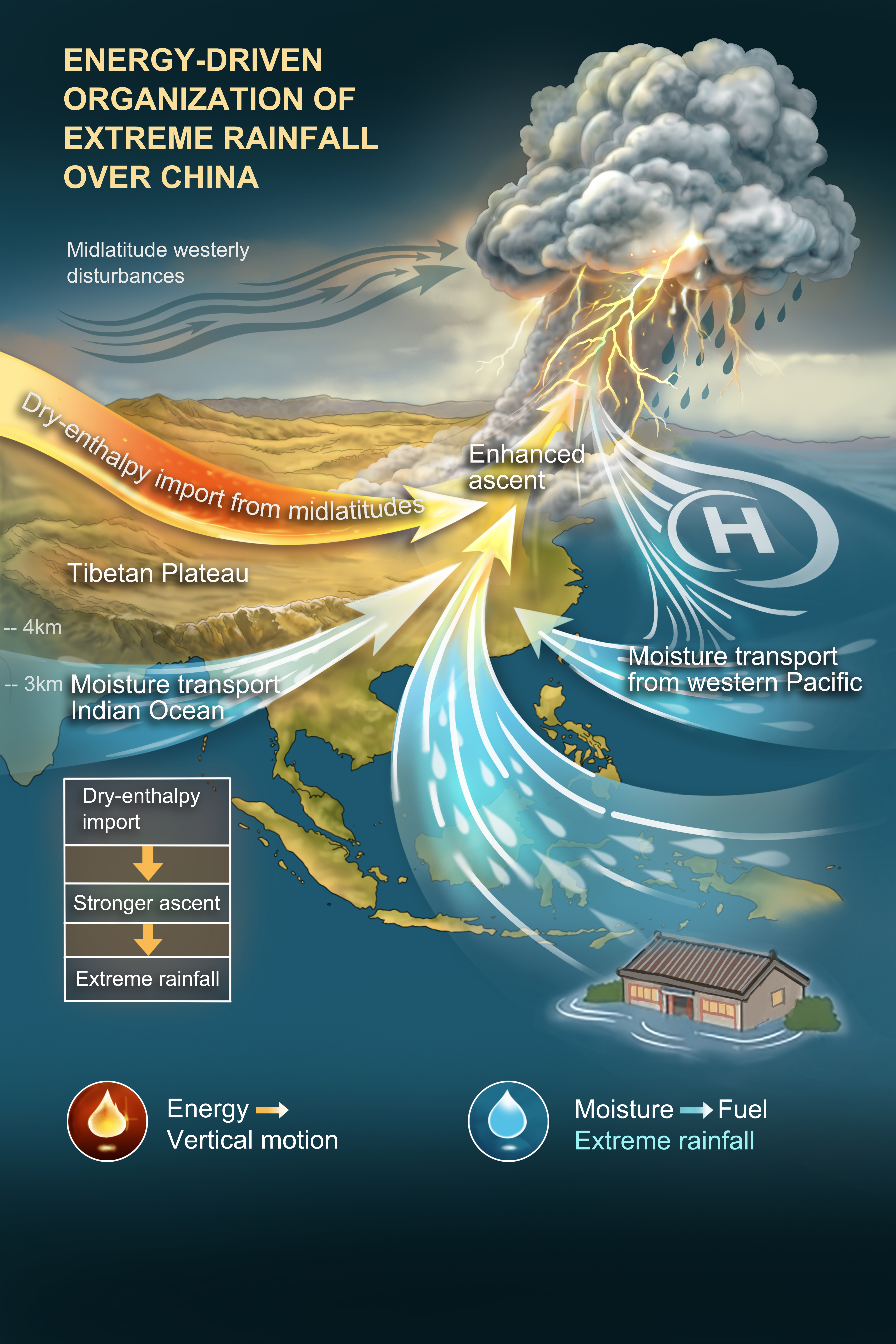


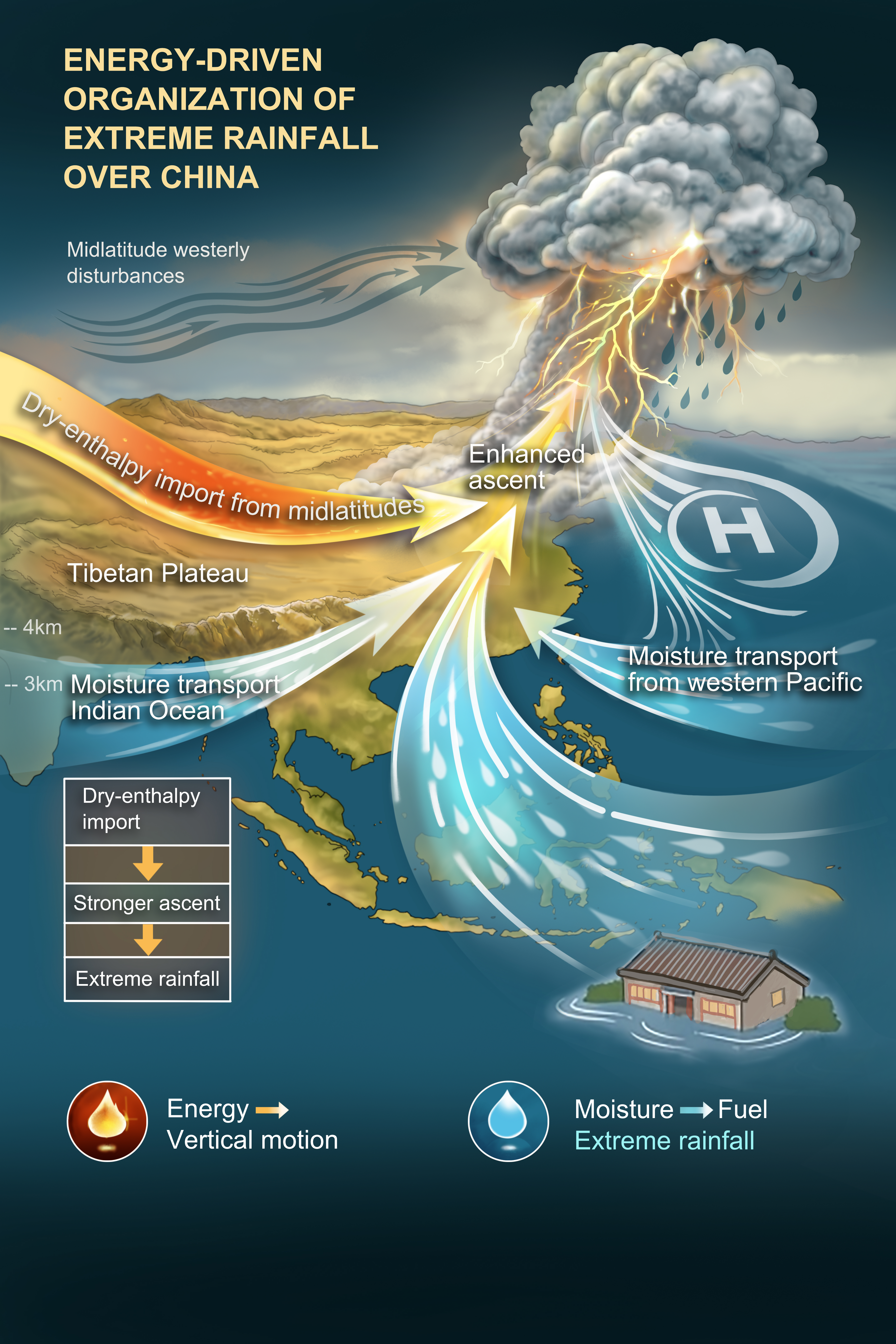
Behind the Paper: Energy, not just moisture, drives extreme rainfall
Every summer, extreme rainfall events across China lead to devastating floods, especially over the Yangtze River basin and southern coastal regions. These events are becoming more frequent and intense, raising an urgent scientific question:
What sustains the strong upward motion required for extreme rainfall?
At first glance, the answer seems straightforward: more moisture leads to more rain. However, this explanation is incomplete. Rainfall does not simply depend on how much water vapor is available—it also depends on whether the atmosphere can sustain persistent upward motion. And that requires energy.
A shift in how moisture is transported
Using ERA5 reanalysis and a detailed moisture budget decomposition, we found that the direction of moisture transport does not fundamentally change between normal and extreme rainfall. In both cases, vertical moisture advection dominates.
However, what does change is who controls that vertical motion:
- During normal rainfall, ascent is mainly driven by the background mean circulation
- During extreme rainfall, it is dominated by transient weather systems (eddies)
In other words, extreme rainfall is not simply a stronger version of the mean monsoon—it is a dynamically reorganized system, where synoptic disturbances take control.
A surprising result: radiation is not the energy source
A common assumption is that clouds and radiation feedbacks provide additional energy to fuel extreme convection. But our results show something unexpected:
- Over land, net atmospheric energy input does not increase during extreme events
- In fact, it often decreases due to enhanced cloud shading
This raises a key question:
If local energy input is not increasing, how is the stronger ascent sustained?
The key mechanism: energy imported from afar
Our analysis reveals that extreme rainfall operates under a transport-constrained energetic regime.
Instead of being powered locally, the atmosphere is fueled by:
Horizontal transport of moist enthalpy into the monsoon region
In particular, the dominant contribution comes from:
- Transient-eddy transport of dry enthalpy from midlatitudes
This process brings warm energy into the region, strengthening instability and sustaining upward motion.
A coupled picture: moisture and energy working together
Our results point to a coordinated mechanism behind extreme rainfall:
-
Moisture supply
Strengthened southwesterly winds, associated with a westward-extended western Pacific subtropical high, transport water vapor from the ocean -
Energy supply
Midlatitude disturbances transport dry enthalpy into the region, sustaining ascent
These two processes act together:
Moisture provides the fuel, but energy transport sustains the engine.
Why this matters
This study shifts the perspective on extreme rainfall:
- It is not simply controlled by local thermodynamic conditions
- It is fundamentally a circulation-controlled energetic process
This has important implications:
- Changes in midlatitude circulation may strongly affect extreme rainfall
- Future projections must consider energy transport pathways, not just moisture increases
- Extreme rainfall may intensify through dynamical reorganization, even without stronger local heating
Looking ahead
Our study focuses on present-day mechanisms, but key questions remain:
- Will climate warming enhance horizontal energy transport?
- How will synoptic disturbances evolve in a warmer climate?
- Can high-resolution models reproduce these transport-driven processes?
Answering these questions will be critical for improving predictions of future extreme rainfall.
One key takeaway
Extreme rainfall is not simply a result of “more moisture in a warmer world”—it is fundamentally shaped by how the atmosphere transports energy across regions.
Learn more
This post provides a simplified overview of our findings. For the full analysis, including methods and detailed diagnostics, see our paper:
Yuan, X., Su, B., Liu, B., Liu, J., Zhang, Y., Li, Z., Peng, D., Sun, Y*. Transport-constrained eddy–mean energetics sustain extreme rainfall over China. Commun Earth Environ7, 443 (2026). https://doi.org/10.1038/s43247-026-03547-3
Follow the Topic
-
Communications Earth & Environment
An open access journal from Nature Portfolio that publishes high-quality research, reviews and commentary in the Earth, environmental and planetary sciences.

Related Collections
With Collections, you can get published faster and increase your visibility.
Ecological resistance and resilience under global change
Publishing Model: Open Access
Deadline: Apr 07, 2027
Hazards in Mountain Regions
Publishing Model: Open Access
Deadline: Nov 02, 2026

