Who I am? Identity Conflicts of Independent Professionals and Freelancers on Social Platforms
Published in Social Sciences, Arts & Humanities, and Business & Management



Introduction
The research study is in the interface of research on social media, digitisation, and platform economies, on the one hand, and solo-self-employment, independent professionals, and freelancers, on the other hand.
The study asks how one(wo)men-firms operate their websites and how do they orchestrate the content being delivered on social media. Social media serves as a kind of business card to relevant others. What do I present to the public, and how far is the professional business side separated from the private (social) side of the businessmen? Our research is explorative starting with a qualitative study design that may be replicated quantitatively by follow-up research.
What led you to pursue this study?
Solo entrepreneurs often do not receive the attention they deserve in entrepreneurship discussions. UnlikSe innovative entrepreneurs, who are frequently celebrated for their cutting-edge ideas or groundbreaking technologies, solo entrepreneurs tend to operate more quietly. Their experiences are often overlooked. Our study sought to change this by focusing solely on solo entrepreneurs from diverse professional backgrounds. We were particularly interested in their use of social media – vital for business success. For solo entrepreneurs, social media offers tremendous benefits for visibility and growth but also raises questions about personal and professional boundaries. How do they separate their private lives from their business personas? Where do they draw the line, and what topic do they feel comfortable sharing? These identity-related questions were central to our research development.
Our curiosity was sparked by observing influencers on social media who often blur personal and professional lines – promoting products while sharing details of their children, homes, and daily lives. We wondered if solo entrepreneurs adopt similar approaches. Does showing private aspects help their business, or does it complicate matters?
We understood how solo entrepreneurs navigate this space by focusing on their social media strategies. What content do they share, and how do they balance authenticity with professionalism? We hope our findings help to bring solo entrepreneurs to the forefront of the conversation and provide insights to empower them in the digital age.
Why is this research valuable?
The research is guided by the seminal ideas of the US American sociologist Erving Goffman, who studied interactionism starting in the 1950s. Goffman developed impression management ideas, which are strategic behaviours people implement to improve their reception, look, and sales in society. Impression management is a selling of the self.
The authors adopt Goffman`s idea that the self is orchestrated and apply the discussion to people's strategies in the business world. We ask how solo entrepreneurs, freelancers and independent professionals operate digitally and how private and commercial needs and aspects are balanced. We ask if the intimacy of private concerns and the public's need to sell the small company and its owners come into conflict. Do we have multiple identities at work, and if yes, how do they separate or interact?
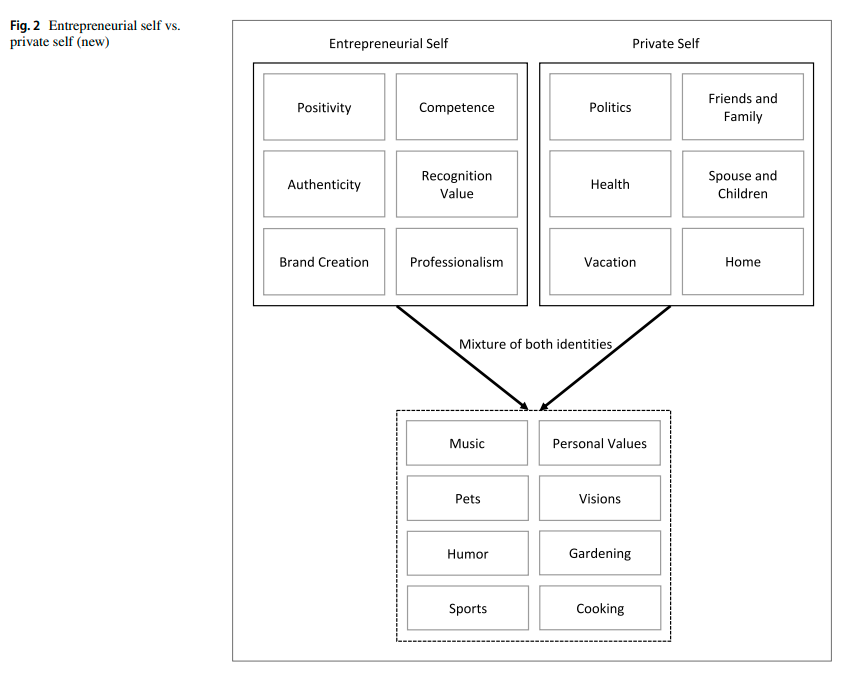
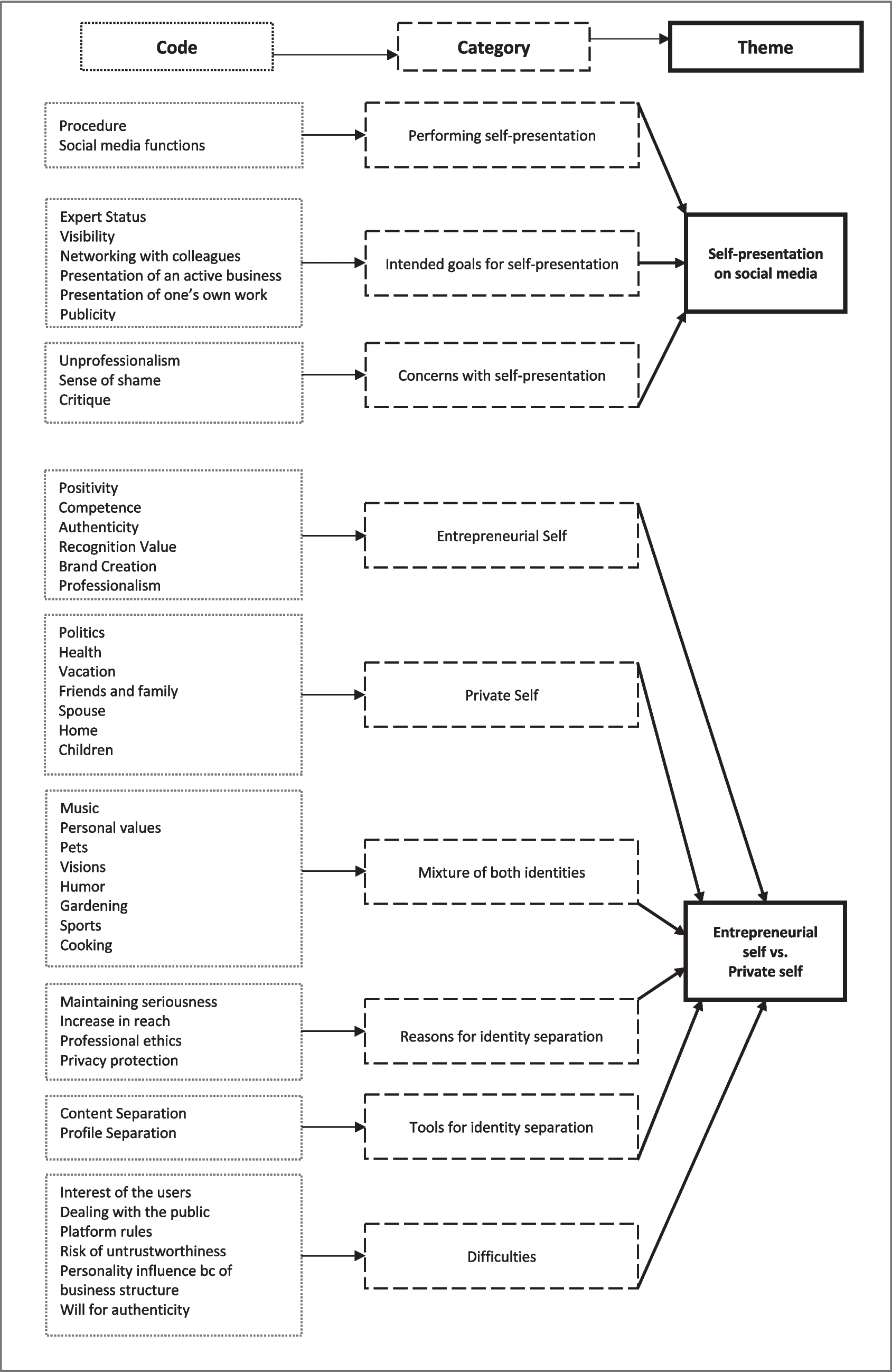
The results of our study have shown the goals the interviewed solo entrepreneurs are pursuing with the use of social media, such as gaining expert status or presenting their work. Secondly, the study also explored the other side of the coin, the concerns of solo entrepreneurs when presenting themselves on social media. Concerns mentioned were appearing unprofessional, feeling ashamed while presenting themselves and receiving criticism. Thirdly, the study discovered several aspects with which solo entrepreneurs prefer to present themselves on social media and topics they avoid in their self-presentation. These aspects can be assigned either exclusively to the private self (e.g. politics, health, family) or to the public self (e.g. brand creation, competence, professionalism), as well as themes that mix both identities (e.g. music, personal values, humour). Fourthly, reasons for the identity separation, tools used for it, and difficulties in this process were discovered.
What did the authors do?
To explore solo entrepreneurs ‘use of social media, we adopted a qualitative research approach. This topic had not been addressed before, so we conducted semi-structured interviews to uncover new insights. Developing the interview questions was a meticulous process. We integrated perspectives from sociology, entrepreneurship, psychology, and media studies to ensure a comprehensive framework.
Our study focused on solo entrepreneurs from Carinthia, a rural region in Austria. This setting allowed us to investigate how entrepreneurs in less urbanized areas engage with social media – whether their remote context makes it more or less vital for their business. The Carinthian Chamber of Commerce assisted us in finding interview partners, who agreed to online interviews via Zoom during the Covid-19 pandemic.
Data analysis was conducted through qualitative content analysis, enabling us to identify how solo entrepreneurs approach self-presentation on social media. We uncovered both their intended strategies and their concerns, examining how they perform self-presentation, differentiate their professional and private identities, and navigate the challenges of blending these roles. We also explored the reasons behind identity separation, the tools they use, and where they encounter difficulties.
One story that stood out was Elena, a small hotel owner in Carinthia. While she genuinely enjoys gardening, she emphasized it far more on social media, crafting it as a key part of her entrepreneurial identity. After winning a gardening award, she highlighted this achievement extensively through her entrepreneurial self-presentation on social media. This is a notable example of solo entrepreneurs mixing both personal and professional identities in their self-presentation on social media, blending personal interests with their professional identity to connect with their audience.
Through these interviews, we initially understood how solo entrepreneurs balance authenticity with strategic self-presentation.
Implications
A series of research questions led to the study. Centrally, the question guided us on how and to what extent solo entrepreneurs present themselves on social media platforms and how the entrepreneurial self differs from the private self. Do solo entrepreneurs have an entrepreneurial identity, or do they have different shades of entrepreneurial identities? What is the nucleus of these identities? Following these questions, we arrived at a differentiated understanding in which we learned that entrepreneurs use and are used by new digital platforms and that they are individually related to business formation. We can undoubtedly link many of our insights to discussing the social embeddedness of small firms and solo entrepreneurs and their needs, hazards and complexities.
In principle, we found the methodological need to balance different aspects of social science and areas commonly addressed as socioeconomics. Businesses, society, and actors are always treated the same. What appears to be a single entity is not always treated as such in the organisation and development of academia. Instead, in academic practice, business and society are often separated, as if they belonged to different spheres with different scientific responsibilities. Impression management strategies, as introduced by Erving Goffman, can be applied and researched in commercial settings and – especially as practised in our study – applied to the area of digital settings where new, historically unknown settings and research questions have emerged.
We attempt to discuss some conceptual pieces of entrepreneurial identity management with empirical findings based on a dozen semi-structured qualitative interviews. Doing this kind of empirical research with selected cases taken out of one region is exemplary research to shed light on social and economic phenomena and their inherent social rationalities. Those rationalities are almost hidden when working with massive datasets since the social sense of the life worlds and identity constructs can only be deciphered when going to the inner and unanticipated processes of people’s life philosophies and interpretations. So far, our study operates with cases that turn into ideal cases of rationality expressing systematic clues of identity management.

Follow the Topic
-
Journal of Global Entrepreneurship Research
This journal publishes peer-reviewed original articles on Entrepreneurship from a global perspective.

Related Collections
With Collections, you can get published faster and increase your visibility.
Entrepreneurship: Shaping the Future
NEW: On submission, please indicate that your manuscript is considered for this Collection by selecting “Entrepreneurship: Shaping the Future” from the drop-down menu. You may also wish to mention the Collection in your cover letter.
Guest-Edited by Diego Matricano, this Multi-Journal Collection is a cross-disciplinary resource for researchers, practitioners, and policymakers interested in entrepreneurship as a way to address paramount global issues, with an emphasis on the expected and realized changes as well as the implications related to entrepreneurship phenomena.
Papers featured here investigate the impact of entrepreneurship with an eye toward how it can shape the future, utilizing micro, meso, and macro levels of analysis.
Publishing Model: Hybrid
Deadline: Ongoing
Economic, Social and Political Development in Developing Countries
A selection of Springer journals within the business, economics, and social science disciplines are inviting submissions for a new collection on Development in support of the Sustainable Development Goal for Decent Work and Economic Growth (SDG 8).
The Collection on Economic, Social, and Political Development in Developing Countries is interdisciplinary and includes development research from political, economic, sociological, and anthropological perspectives. The Collection aims to synthesize and integrate research experience, activism, and alternative thinking in the development space, thereby promoting sustainability.
The Collection welcomes papers rooted in any field, including (but not limited to): development, economics, finance, social policy, politics, sociology, political science, anthropology, development studies, decentralization, urbanization, management, and sustainability. This Collection will gather varying perspectives, theories, policies, and research on evidence-based practice in one place to further support SDG 8 to be utilized by both researchers and practitioners.
We encourage the submission of research and review articles on the following topics:
- Expanding access to banking and financial services
- Trade support for developing countries
- Sustaining economic growth in developing countries
- Economic development in the global south
- Community economic development
- Decentralization and development
- Sustainable consumption
- Early social development and schooling
- Social protection
- Political, social, economic, and environmental change in local, national, and international contexts
- Urbanization and decent employment
- Information and Communications Technology (ICT) and their socio-economic effects
- Global health and economic outcomes
We are also interested in receiving submissions on research discussing the post-pandemic world. Some of the key questions are:
1. What are the directions in which society will be moving in the 'new normal' in the post-pandemic world?
2. What aspects of the economy should receive more attention in the new normal process of development?
3. Is there a dynamic process for the evolving policy of developing countries? What forces guide such political developments?
Interested authors are invited to submit to the collection through the submission portal of their selected participating journal, in accordance with that journal’s submission guidelines. To ensure a paper is considered for the collection, reply “yes” when asked during submission whether it is intended for a special issue, and select “Economic, Social and Political Development in Developing Countries” from the drop-down menu.
Submitted manuscripts must be original and must not be under consideration for publication elsewhere. All submissions are subject to a rigorous peer-review process, per the standard evaluation process of the selected journal. Please refer to the submission guidelines of the selected journal for more detailed information on the peer review process.
Accepted papers will be published in the journal to which they were submitted and included in this cross-journal collection.
Publishing Model: Hybrid
Deadline: Ongoing