Can we engineer the sign structure of an Alcubierre warp bubble in the lab ?
Published in Physics

From warp drives to the laboratory : a question of signs
The Alcubierre metric is one of the most striking solutions in general relativity. Proposed in 1994, it describes a spacetime bubble that contracts space ahead and expands it behind which allowing apparent faster-than-light displacement without violating local causality. The physics is interesting but the price is steep : the bubble wall requires exotic matter, a region of negative energy density that violates the null energy condition (NEC).
For decades, this requirement has been treated as either a fatal flaw or a distant theoretical problem. This paper takes a different approach : rather than asking whether a warp drive is buildable, I ask a more precise and testable question. Indeed, can we engineer and measure the sign structure that an Alcubierre-type geometry encodes in a subluminal and horizon-free laboratory setting ?
The key separation
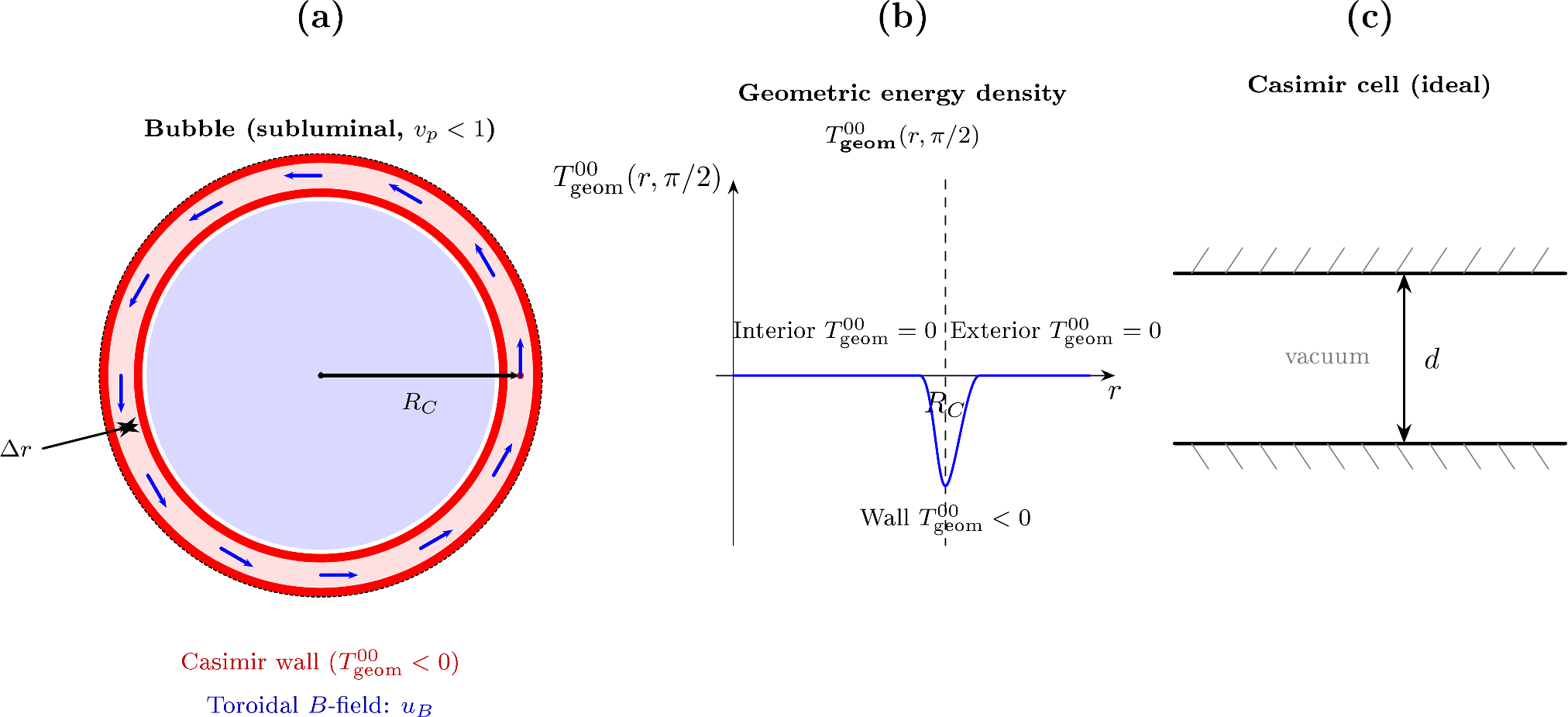
The central conceptual move of this work is a strict separation between 2 things that the literature often conflates : geometric diagnostics derived from a prescribed metric and laboratory energy budgets from real physical systems. The negative wall indicator T⁰⁰geom is a geometric diagnostic of the prescribed subluminal line element not a claim about spacetime curvature. The Casimir and plasma sectors are introduced only as independently measurable laboratory sign carriers. This separation eliminates a conceptual confusion that has plagued the warp-drive literature for years.
The hybrid construction
I prescribe a modified Alcubierre metric with a normalized double-tanh shaping function fC(r), which is unity inside the bubble and vanishes outside, ensuring regularity, no horizons and finite coordinate-time crossing for all null rays. For subluminal speeds (vp < 1), gtt = −1 + v²p f²C is strictly negative everywhere meaning no stationary-limit surface, no event horizon, signals can freely enter and exit.
The sign structure is then engineered using two physical systems :
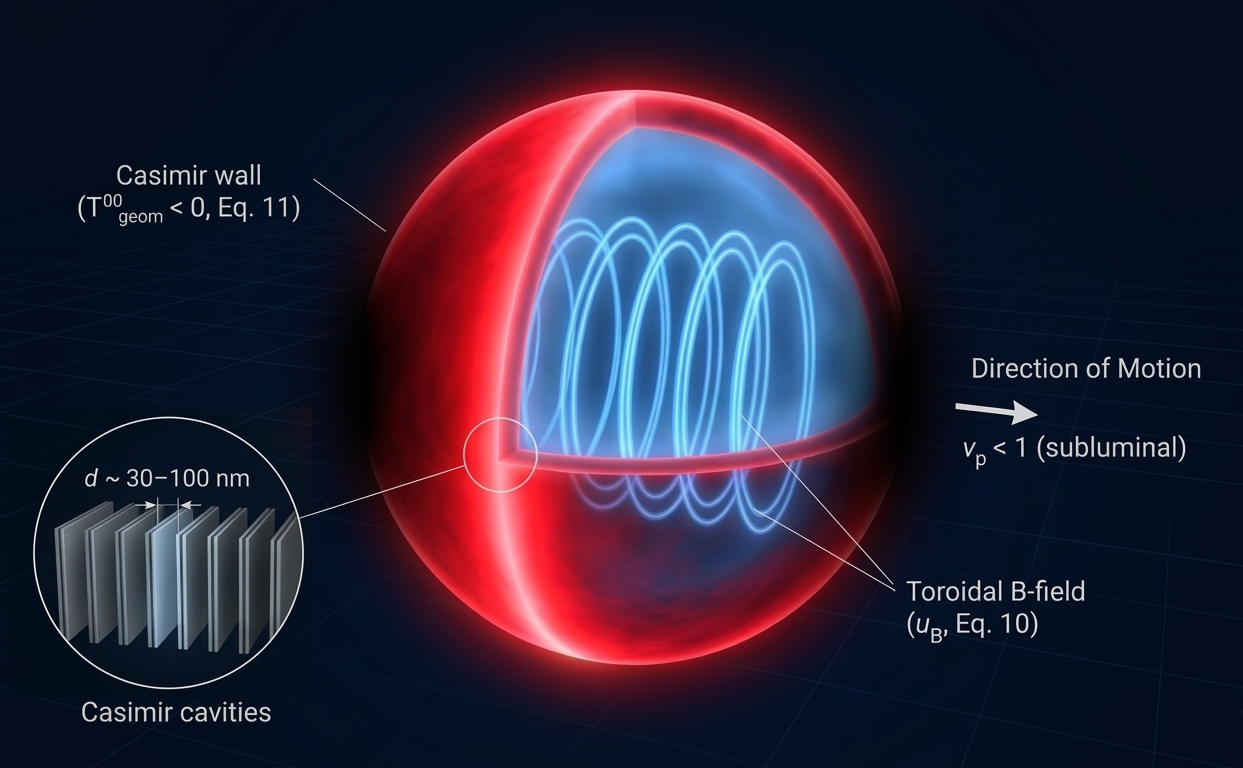
- Casimir cavities (30–100 nm gap arrays) provide a localized, boundary-induced negative stress/energy signature, experimentally established since Lamoreaux 1997.
- Magnetized plasma with a co-located toroidal B-field (1–10 T) provides an independently diagnosed positive electromagnetic energy background, quantified by standard diagnostics (B-dot coils, Faraday rotation, photon time-of-flight).
3 concrete results
The paper delivers 3 analytic advances : (i) an explicit angle-resolved expression for T⁰⁰geom(r,θ), showing that NEC violation is confined to the bubble wall and peaks at the equator; (ii) a proof that the subluminal causal structure is horizon-free for all vp < 1; (iii) a compact thin-wall scaling rule tying the integrated geometric negativity to design parameters (RC, σ, vp), providing a clean baseline for experimental benchmarking.
2 experimental roadmaps
I outline 2 testbeds : a tabletop Casimir-plasma setup accessible with current technology and a facility-scale Z-pinch platform. Neither aims to produce measurable curvature. Both target photon transit-time and phase diagnostics across the engineered wall to validate the sign contrast.
The aim is sign engineering and metrology, a first, rigorous step toward testing the physical ingredients of Alcubierre-type geometries in the laboratory.
Reference : Zejli, H. "Engineering stress-energy signs in a subluminal Alcubierre analog using Casimir cavities and magnetized plasma". Eur. Phys. J. Plus 141, 460 (2026).

Follow the Topic
-
The European Physical Journal Plus
This journal encompasses all aspects of fundamental and applied physics, including energy, environment, cultural heritage, research infrastructures and citizen science, and welcomes in particular interdisciplinary topics.