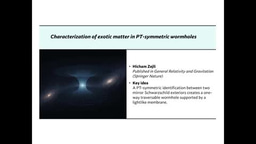
The geometric bridge between Einstein and Bohr : how spacetime topology explains quantum entanglement

A century-old tension
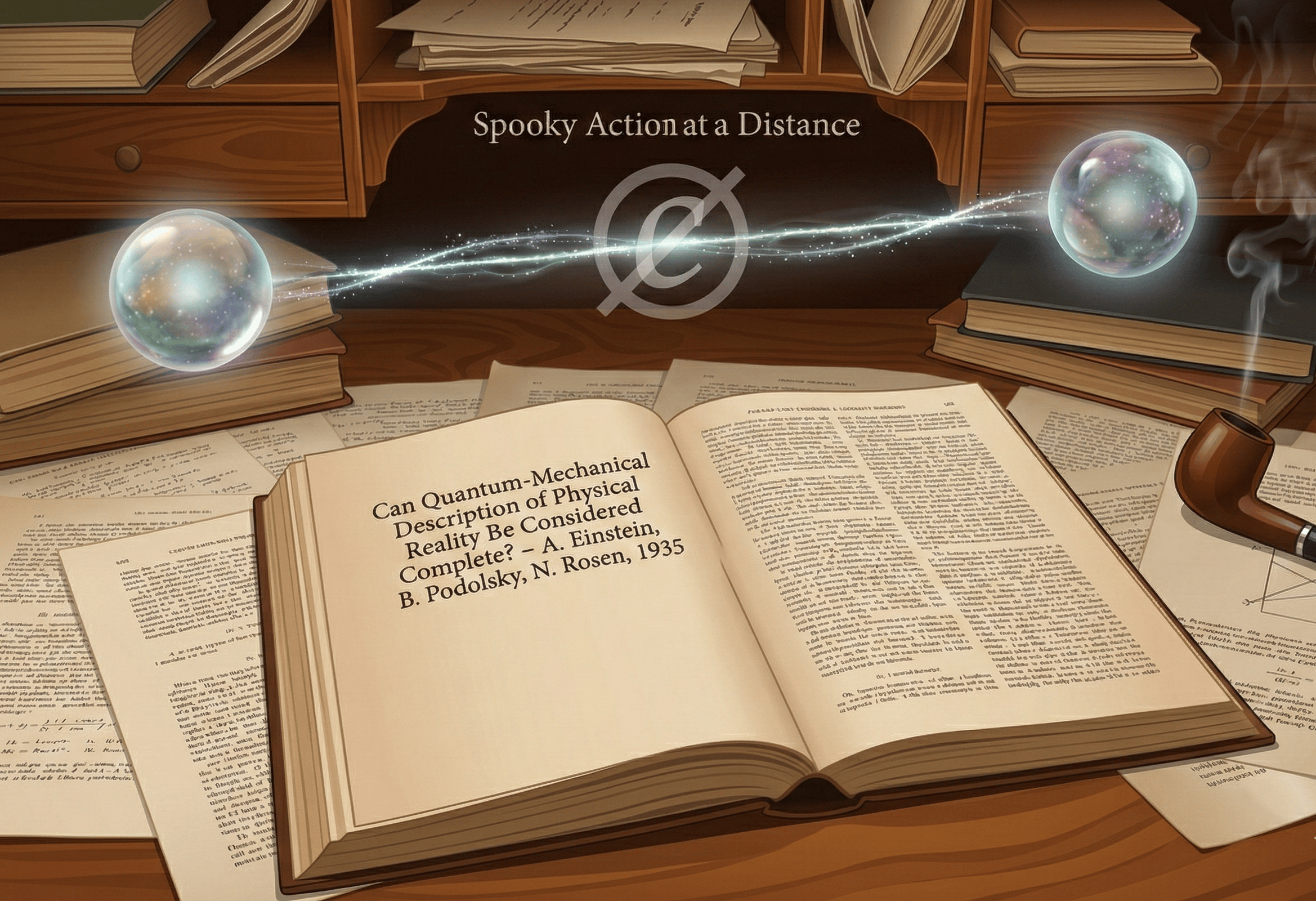
In 1935, Albert Einstein, Boris Podolsky and Nathan Rosen published a paper that would haunt physics for nearly a century. They described a situation in which two particles, once they have interacted and then been separated, seem to remain mysteriously correlated : measuring one instantly determines the outcome of a measurement on the other, no matter how far apart they are. Einstein famously dismissed this as “spooky action at a distance”, convinced that quantum mechanics must be incomplete. Niels Bohr disagreed, arguing that quantum mechanics was a complete and self-consistent theory. The debate appeared irreconcilable.
Decades later, experiments confirmed that the correlations are real. In 1982, Alain Aspect and colleagues demonstrated the violation of Bell inequalities, proving that no theory based on local hidden variables can reproduce quantum predictions. The 2022 Nobel Prize in Physics, awarded to Aspect, Clauser and Zeilinger, cemented entanglement as a fundamental feature of nature.
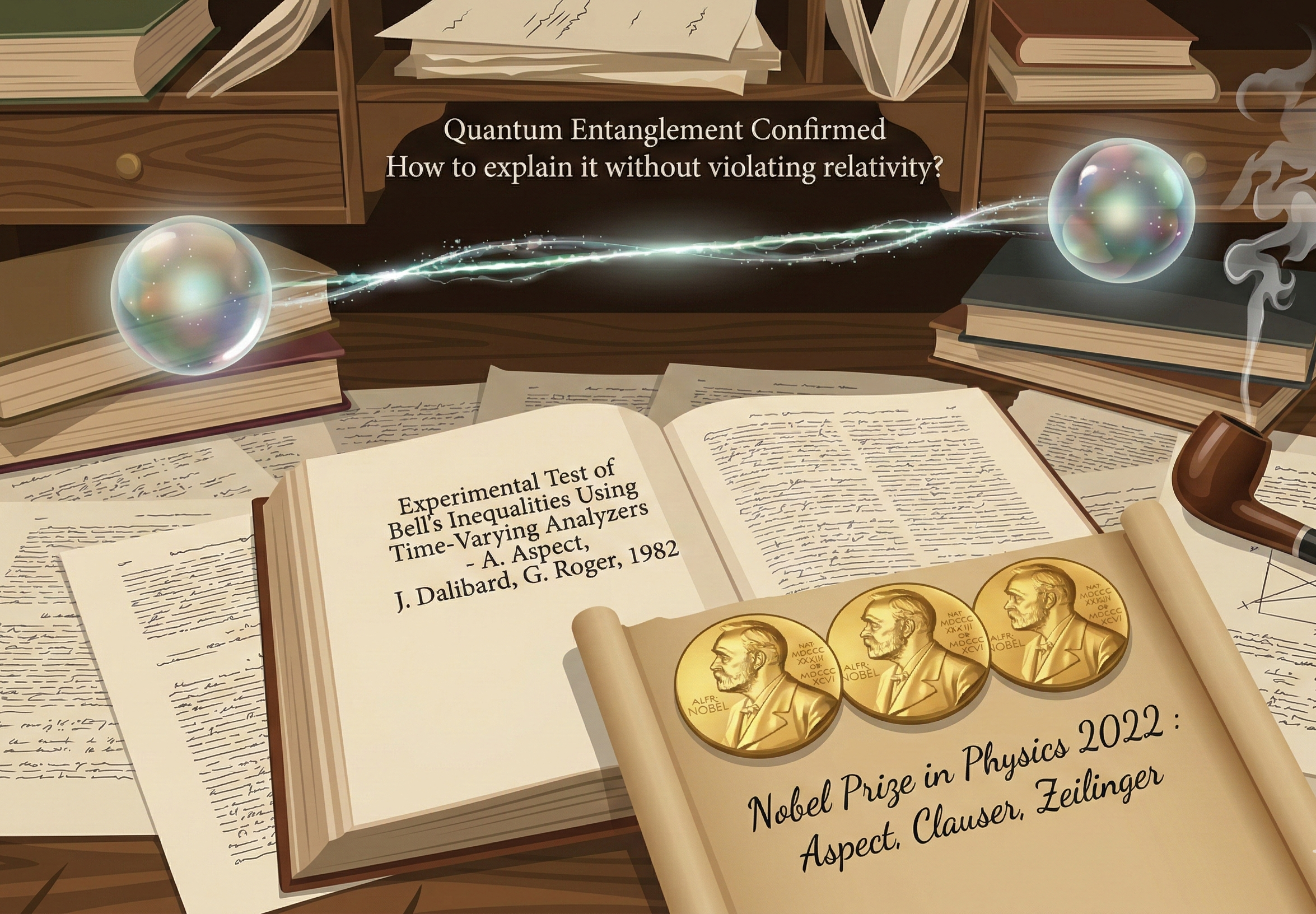
But the conceptual puzzle remained : how can these correlations exist without violating Einstein’s relativity, which forbids any signal from traveling faster than light ?
A geometric resolution
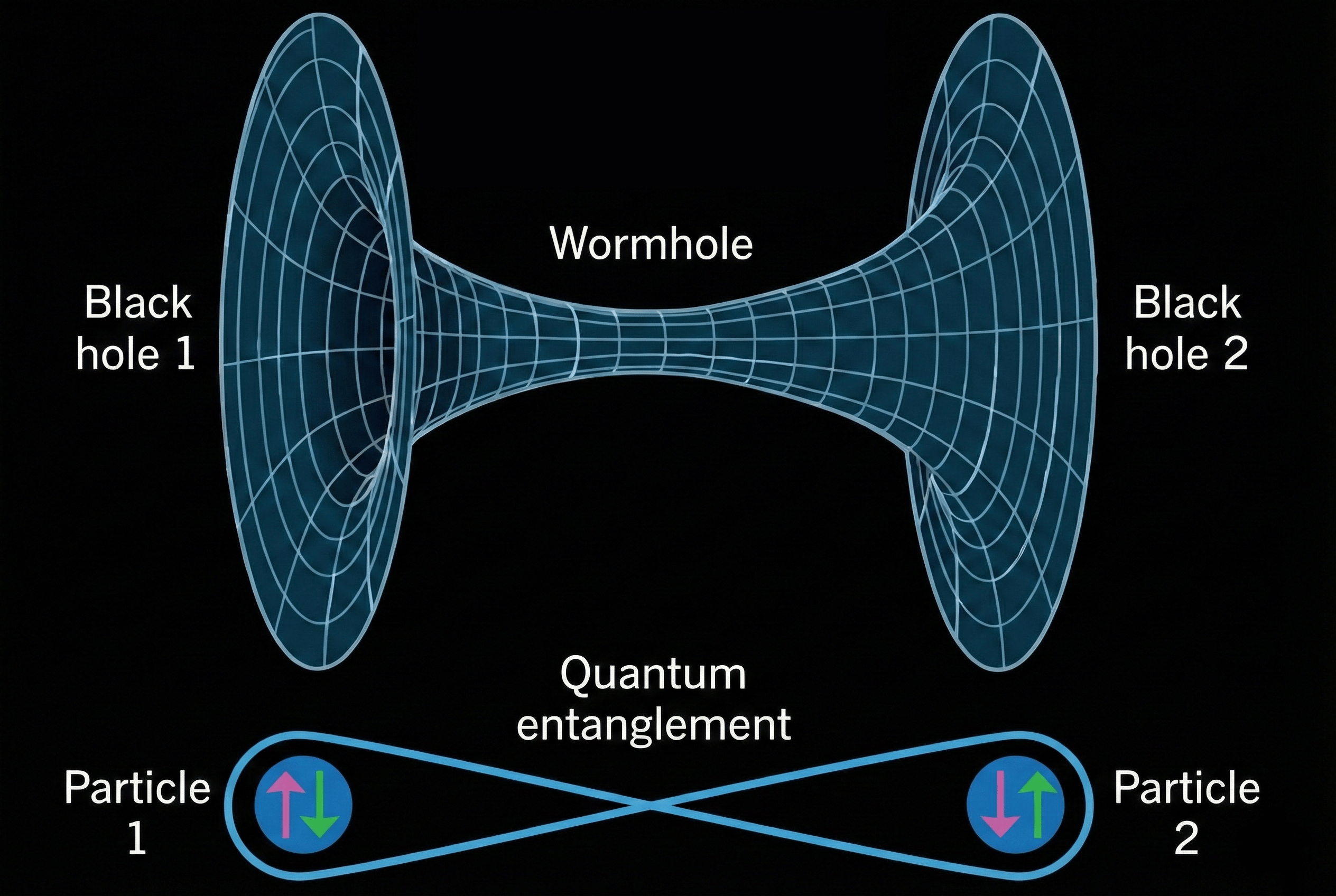
In a paper recently published in General Relativity and Gravitation, I propose a framework in which entanglement is not a mysterious nonlocal link, but rather the natural consequence of the topology of spacetime itself. The starting point is a celebrated conjecture by Juan Maldacena and Leonard Susskind, known as ER = EPR, which suggests that every pair of entangled particles (EPR) might be connected by a wormhole, an Einstein-Rosen bridge (ER). My work takes this idea from conjecture to calculation.
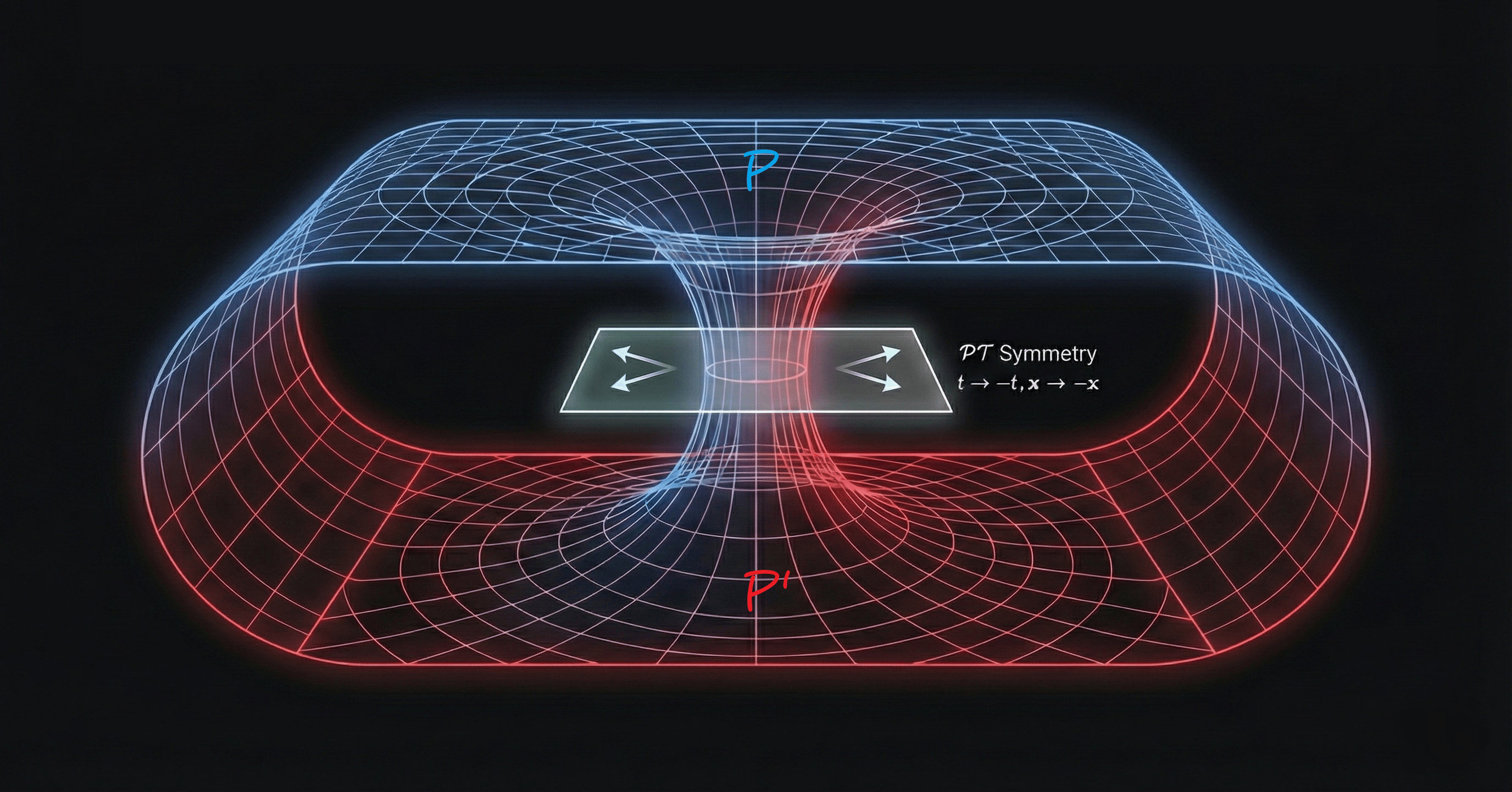
My model uses a two-sheeted spacetime : imagine a sheet of paper folded in half. The top face represents our observable spacetime, called M+ and the bottom face is a conjugate spacetime, M-. Both two sheets are glued at the throat r = α by a PT-symmetric map ΦPT: (t, x) → (−t, −x), which extends as a global topological identification between any point P ∈ M+ and its twin P’ ∈ M- supported at the throat by a lightlike thin shell satisfying the Israel junction conditions. This is not a connection between two separate objects, it is a recognition that they are the same event viewed from two geometric perspectives.
Quantum entanglement as topological identification
The central result of the paper is that what appears as quantum entanglement on a single sheet is, in the extended spacetime, the effect of a geometric identification. Two particles do not communicate across space, they are geometrically identified through the PT-symmetric structure of the wormhole throat, much like the two faces of a single coin. The distinction between “two particles” is an illusion created by observing from only one sheet.
This geometric picture yields three rigorous results.
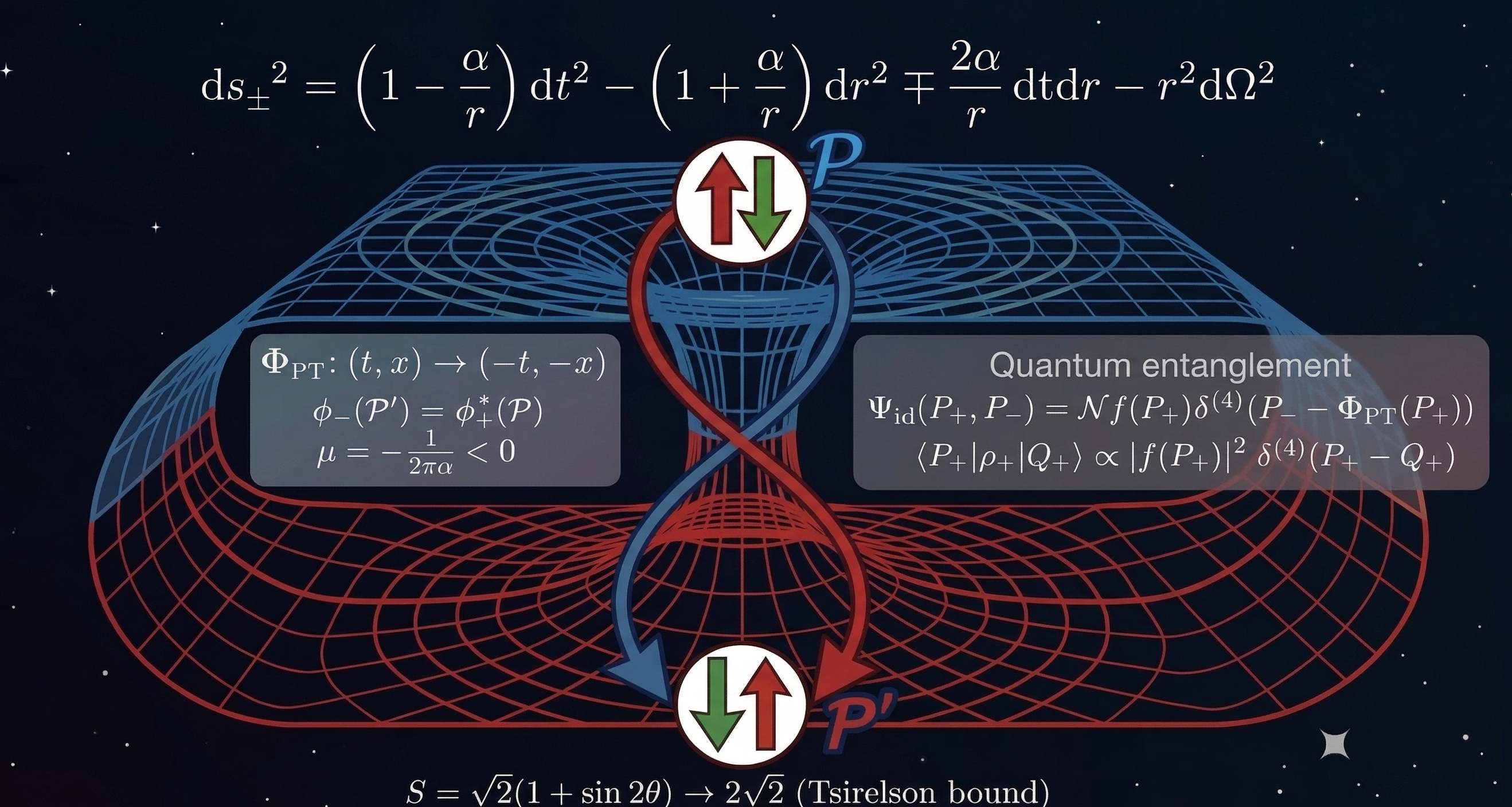
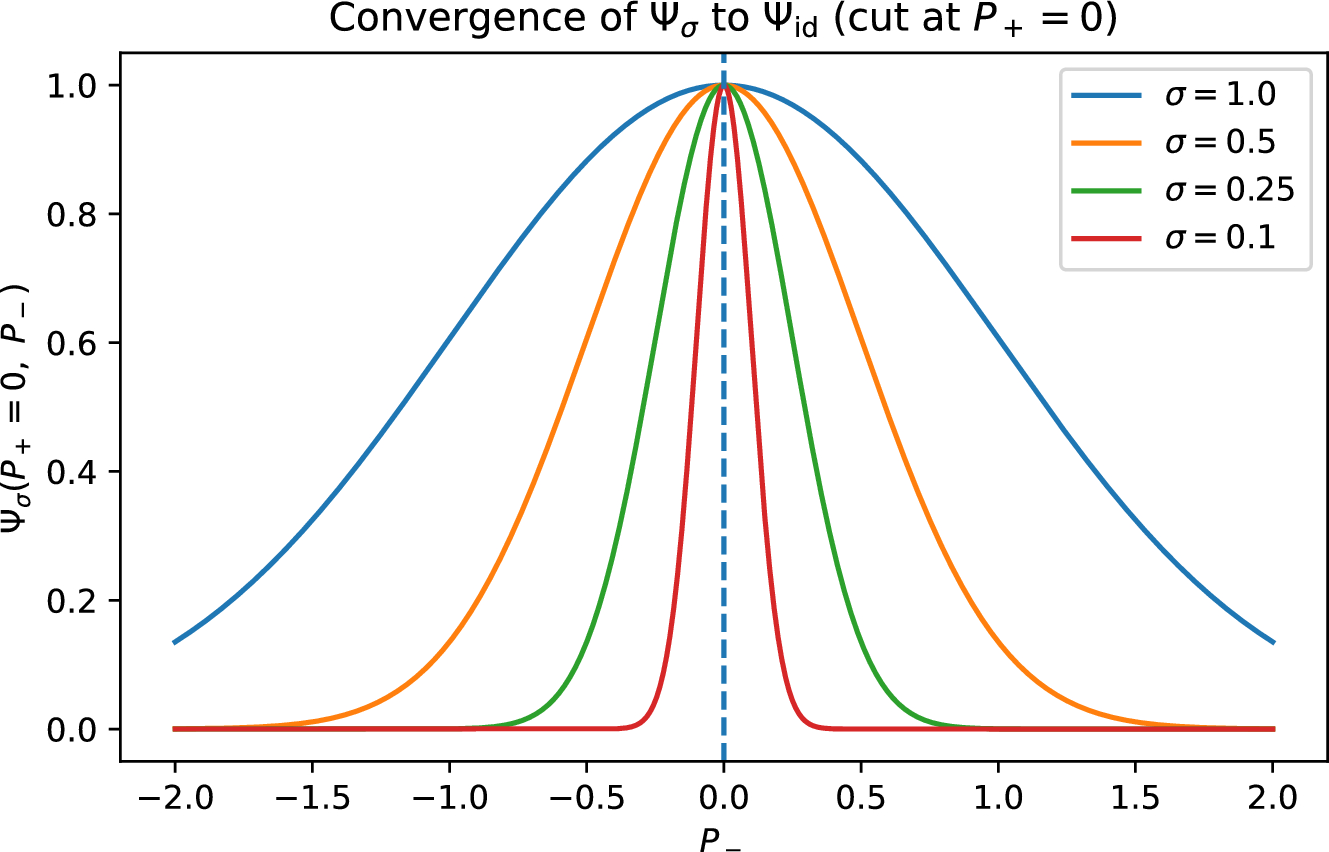
First, the entangled state is explicitly constructed as a bilocal wavefunction supported on the submanifold where P′ = ΦPT(P), enforcing the topological identification. Second, the reduced density matrix on a single sheet is proven to be diagonal, which mathematically guarantees that no protocol can exploit entanglement to send a superluminal signal. Einstein’s causality is preserved. Third, an explicit CHSH test is constructed and shown to reach the Tsirelson bound of 2√2, the maximum violation allowed by quantum mechanics. Bell inequalities are violated to the fullest extent, confirming that no local hidden variable theory can account for these correlations. Bohr’s completeness is vindicated.
Einstein and Both were both right
The framework thus reconciles the two great physicists by enlarging the geometric arena. Einstein was right to insist on locality : in the extended two-sheeted spacetime, correlations arise from a local geometric identification, not from any action at a distance. Bohr was right that quantum mechanics is complete : the Bell violation is maximal and no hidden variables are needed. The bridge between Einstein and Bohr turns out to be purely geometric.
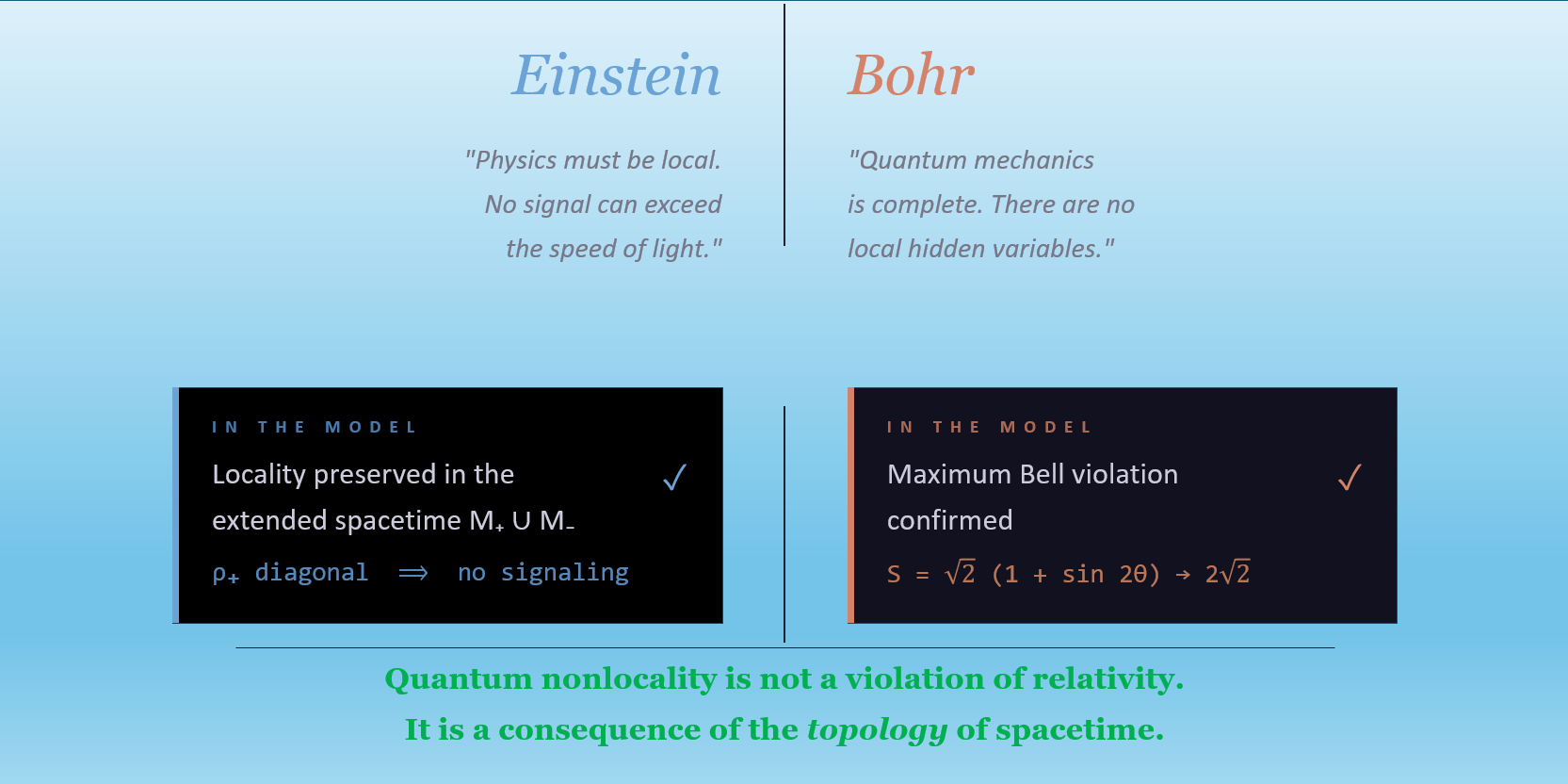
An important nuance should be noted : geometric locality in the extended spacetime should not be conflated with Bell locality on a single sheet. The former holds globally across both sheets, while the latter must be violated to reproduce EPR-type correlations. The reconciliation operates by enlargement of the geometric framework, not by restoring classical locality.
A broader research program
This work is part of a broader research program on PT-symmetric wormholes. In a previous paper published in the Annals of Physics, the foundational bimetric one-way wormhole model was introduced. A subsequent study in the International Journal of Modern Physics D extended the framework to generate closed timelike curves in a causally consistent way. The exotic matter supporting the wormhole throat was then rigorously characterized in General Relativity and Gravitation, where a lightlike membrane with negative surface energy density and positive tangential pressure was identified, in accordance with the Barrabés-Israel null-shell formalism. The present paper completes this arc by extending the geometric framework to quantum physics.
The next steps consist in fully solving the quantum field modes near the throat under PT junction conditions and in estimating the exotic energy cost required to stabilize the traversable structure.
Reference : H. Zejli, “Quantum entanglement as a PT-symmetric identification in a bimetric spacetime”, Gen. Relativ. Gravit. 58, 31 (2026).

Follow the Topic
-
General Relativity and Gravitation
General Relativity and Gravitation is a journal devoted to all theoretical and experimental aspects of modern gravitational physics.

Related Collections
With Collections, you can get published faster and increase your visibility.
Geometry of Classical and Quantum Space-Times (Jerzy Lewandowski Memorial Conference)
Based on contributions from the Jerzy Lewandowski Memorial Conference, held from September 15–19, 2025, at the Banach Center in Warsaw, this collection of peer-reviewed articles intends to include review papers as well as original research honoring his memory and continue scientific discussions in the areas that were central to his research passion.
All speakers, as well as selected poster presenters, are invited to submit their papers for peer review to the journal General Relativity and Gravitation. Publication under the subscription model is free of charge, open-access is offered for a fee or under the terms of Springer's institutional agreements.
Publishing Model: Hybrid
Deadline: Dec 31, 2026
Science with Space-Based Gravitational-Wave Detectors
This collection has evolved from the earlier series on "LISA: Science with the Laser Interferometer Space Antenna" and now aims to include White Papers, Invited Reviews, and Original Research on general space-based GW science from multiple research groups.
Publishing Model: Hybrid
Deadline: Ongoing