Closing the phosphorus cycle by producing fertilizer from wastewater: what we know and what we need to go further
Published in Agricultural & Food Science



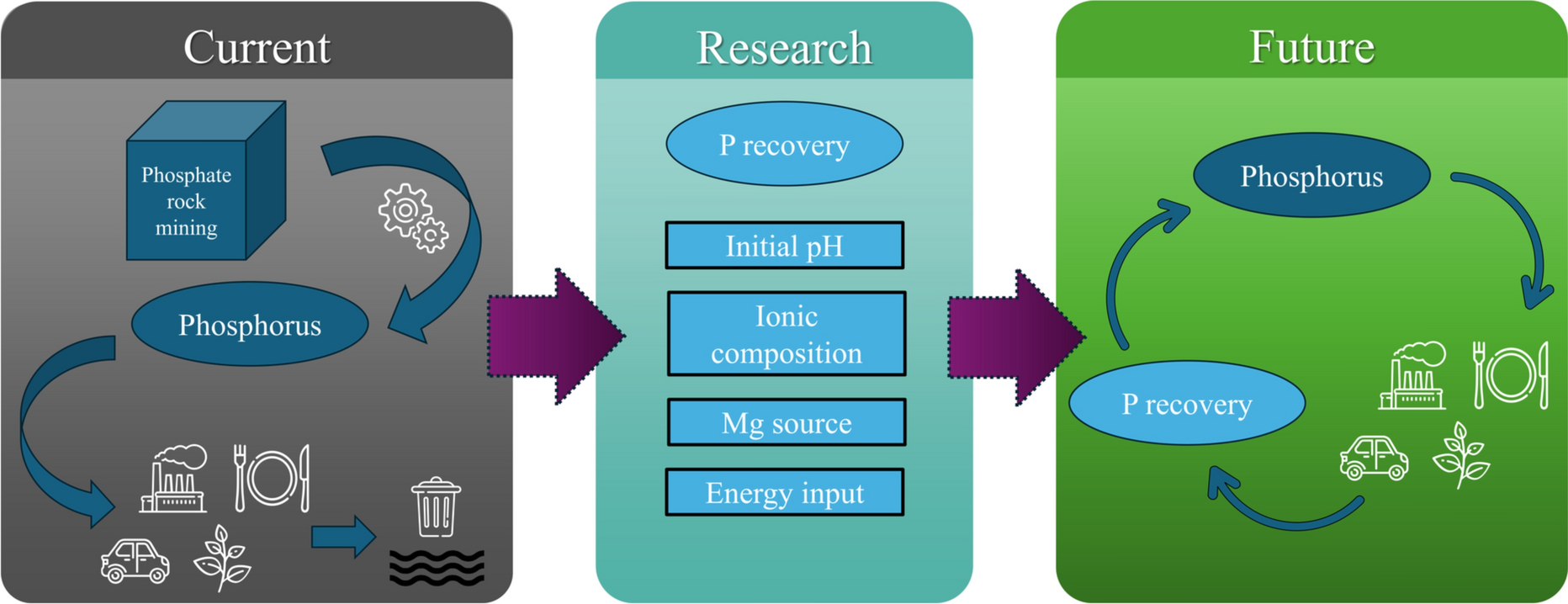

In 2022, the last year of my B.Sc. in Industrial Chemistry at the University of Beira Interior, I had to choose a topic for my undergraduate thesis. I joined the Environmental Electrochemistry Laboratory, which is part of the Fiber Materials and Environmental Technologies (FibEnTech) research unit, to conduct my research on electrochemical phosphorus recovery from wastewater. I once read a book called “Sapiens – A Brief History of Humankind”, by Yuval Noah Harari, where I learned about the critical effect of the First Agricultural Revolution (10,000 – 8,000 BCE) on human population growth. Likewise, the beginning of fertilizer synthesis in the 20th century was also relevant, since it allowed increasing agricultural production, so I thought that this was a nice topic. Indeed, fertilizers are very needed worldwide. Some of the key components are nitrogen and phosphorus: nitrogen is taken from atmospheric air, but phosphorus is sourced from phosphate rock, an abundant ore in Morocco. Beyond the well-known fact that phosphate rock mining contributes to water contamination by phosphorus and heavy metals, concerns about the eventual depletion of this non-renewable resource gained prominence in the late 20th century, raising the question of when the reserves might be exhausted. Projections vary widely, with estimates spanning from 2043 to 2450. This prompted intensified interest in identifying alternative phosphorus sources, and, as a result, phosphorus recovery from waste streams emerged as a practical strategy for sustaining fertilizer production.
My first task was to learn about the topic, which I did by reading two excellent review articles: one from Yicheng Wang and co-authors published in Water Research (vol. 209, 2022, article 117891), the other from Yifan Ren and co-authors published in Environmental Functional Materials (vol. 1, 2022, pages 10 – 20). These papers were my first contact with phosphorus recovery topic and were extremely helpful for me. I also remember wondering how challenging it should be to write good review articles like those. Some months later, I successfully defended my thesis, and after that, I started the Ph.D. in Chemistry at the same university. I preferred to continue my work on phosphorus recovery, so it was time to conduct a literature review – more robust than that conducted during the undergraduate thesis – in order to well define the main objectives of my work. I followed my advisor’s suggestion of well organizing the review process, so it would be possible to publish a review article.
The aims of the review were to consolidate the current knowledge on phosphorus recovery and to identify research gaps – I should select which of them I would like to address during my Ph.D. We have found a wide range of technologies developed to enable the effective recovery of phosphorus from wastewater. Compared to biological processes, chemical and electrochemical methods offer several advantages, including higher recovery efficiencies, faster operation, lower sensitivity to environmental variability, and the possibility of implementation in modular configurations that require less space. Therefore, we focused the discussion on these approaches, with particular attention to how operational parameters influence process performance. We then select four main parameters: initial pH, critical ion concentration, magnesium source, and applied current or voltage. Regarding the research gaps, we have identified some points that, if addressed, could significantly advance phosphorus recovery technologies. Among them, two stand out as especially relevant to phosphorus precipitation: the application of electrochemical methods using liquid magnesium sources (such as seawater) and the development of affordable magnesium anodes.
Struvite (magnesium ammonium phosphate hexahydrate) is a slow-release fertilizer that can be obtained from phosphorus and nitrogen in wastewater. Because these nutrients are key drivers of eutrophication, their simultaneous removal is a major advantage of struvite-based recovery. However, struvite precipitation requires an adequate supply of magnesium, which is typically insufficient in wastewater. As a result, external magnesium dosing is needed, accounting for up to 75% of total recovery costs. Seawater offers a low-cost source of magnesium, making it an attractive option for coastal areas. Yet, its application generally requires adjusting the bulk pH to 9.0–9.5, the optimal range for struvite formation. An electrochemical approach could circumvent this need by increasing the pH locally at the cathode, thereby promoting struvite precipitation directly on its surface. The key question is whether raising the local pH electrochemically is more advantageous than chemically adjusting the bulk pH. Moreover, electrochemical precipitation often yields solids of higher purity due to localized formation, but it remains unclear whether this benefit persists when using seawater. Further investigation is required to address these uncertainties.
Another strategy for inducing struvite precipitation involves the use of magnesium anodes, which may consist of pure magnesium or magnesium alloys, most commonly magnesium–aluminum–zinc alloys. Although pure magnesium anodes offer certain performance advantages, their cost is prohibitive for large-scale phosphorus recovery. Magnesium alloys, in contrast, are cost-comparable to conventional magnesium salts. A promising avenue to further enhance circularity and reduce costs is the development of anodes derived from industrial byproducts, such as magnesite. While this approach has been explored using simulated wastewater, additional studies with real wastewater are needed to clarify its implications for solid purity and long-term operational performance.
A detailed discussion of operational parameters and research gaps can be found in the full open-access article. Some of the research gaps were included in my Ph.D. objectives, while some of them will certainly be investigated by other researchers. Sharing knowledge is the key for converting research ideas into scientific findings and then into real-world applications.

As an Associate Publisher in Life Sciences, Journals at Springer Nature, I oversee a portfolio of journals in aquatic and environmental sciences. I especially value collaborating closely with external editors and research communities to identify best practices and shape strategic development opportunities that strengthen the quality, impact, and sustainable growth of their journals.
Follow the Topic
-
Reviews in Environmental Science and Bio/Technology
Reviews in Environmental Science and Bio/Technology provides accessible, authoritative and balanced views and reviews in the field of environmental science and (bio)technology.

Related Collections
With Collections, you can get published faster and increase your visibility.
Sustainable Development Goal 7: Affordable and Clean Energy
Sustainable Development Goal 7 (SDG 7) is to ensure access to affordable, reliable, sustainable and modern energy for all. One of the indicators for this goal is the percentage of population with access to electricity (progress in expanding access to electricity has been made in several countries, notably India, Bangladesh, and Kenya). Other indicators look at the renewable energy share and energy efficiency. The goal has five targets to be achieved by 2030. Progress towards the targets is measured by six indicators. Three out of the five targets are outcome targets: Universal access to modern energy; increase global percentage of renewable energy; double the improvement in energy efficiency. The remaining two targets are means of implementation targets: to promote access to research, technology and investments in clean energy; and expand and upgrade energy services for developing countries. In other words, these targets include access to affordable and reliable energy while increasing the share of renewable energy in the global energy mix. They also focus on improving energy efficiency, international cooperation and investment in clean energy infrastructure.
Publishing Model: Hybrid
Deadline: Ongoing
Biofilms for Sustainable Development
Biofilms are globally ubiquitous and are present in many different settings in natural and man-made environments. They comprise a diverse range of microbial communities, enclosed in an extracellular matrix. Biofilms play a key role in many different scientific and technological settings, including industry, agriculture, aquaculture, health and environmental biotechnology.
This collection invites reviews which entail outstanding contributions about the state-of-the-art in biofilm research, creating a platform to exchange groundbreaking techniques, tools and technologies employed in the biofilm research domain with the aim of guiding the field towards an enabler to achieve the sustainable development goals (SDGs).
Some examples of topics of review papers relevant to this call include:
• Understanding biofilm composition and functioning, including adhesion, microbial ecology, ecological theory, biofilm modelling and matrixome characterization. Specialised analytical and characterisation methodologies.
• Specialised analytical and characterisation methodologies.
• Application of genomics, proteomics, transcriptomics and metabolomics in biofilm research.
• Advanced biofilm reactor technologies integrating treatment with sustainability, resource recovery and circular economy, e.g. aerobic, anaerobic and algal-bacterial granular sludge reactors; fungal pellet reactors; packed bed reactors and membrane-aerated biofilm reactors. Biofilm-based systems in intensive aquaculture, such as biofloc technology and recirculating aquaculture systems.
• Novel methods to selectively augment desired microorganisms in areas that make use of biofilm bioconversions, e.g. fermentation processes and industrial biotechnology.
• Innovative solutions to prevent, control and eliminate biofilm formation for those areas where biofilm formation is unwanted, e.g. clogging, scaling, biofouling and biocorrosion.
HOW TO SUBMIT? Submit your article to one of the Topical Collection via Snapp – New Editorial Manager or by clicking on the Submit manuscript button on the home page of Reviews in Environmental Science and Bio/Technology During submission select the title of this Topical Collection.
Publishing Model: Hybrid
Deadline: Ongoing