Sustainable processes and effective strategies for waste management, recycling, and degradation of elastomers
Published in Earth & Environment, Materials, and Agricultural & Food Science






What are elastomers?
Within the classification of materials, we find polymers, which include thermoplastics (the most widely used plastics), thermosets, and elastomers. Elastomers are polymers known for their excellent elasticity, chemical stability, and resistance to bending, abrasion, and compression. They include natural rubbers, synthetic rubbers, and polyurethanes, which are versatile materials used in various applications such as latex or nitrile gloves, tires, shoe soles, hoses, coatings, insulation, masks, gaskets and seals, dental and biomedical devices, as well as automotive and engineering parts.
What is the current issue with elastomer waste?
The main problem with these rubber-based materials is that, once they reach the end of their useful life or stop functioning, they are discarded in landfills or dumps, where they accumulate and contribute to environmental pollution. This is because most of them take hundreds to thousands of years to decompose. Additionally, there is no classification system for these elastomers, unlike common plastics such as PET (1), polyethylene (2 and 4), PVC (3), polypropylene (5), or polystyrene (6), which can be sorted and recycled.
Methods for waste management, recycling, and degradation of elastomers
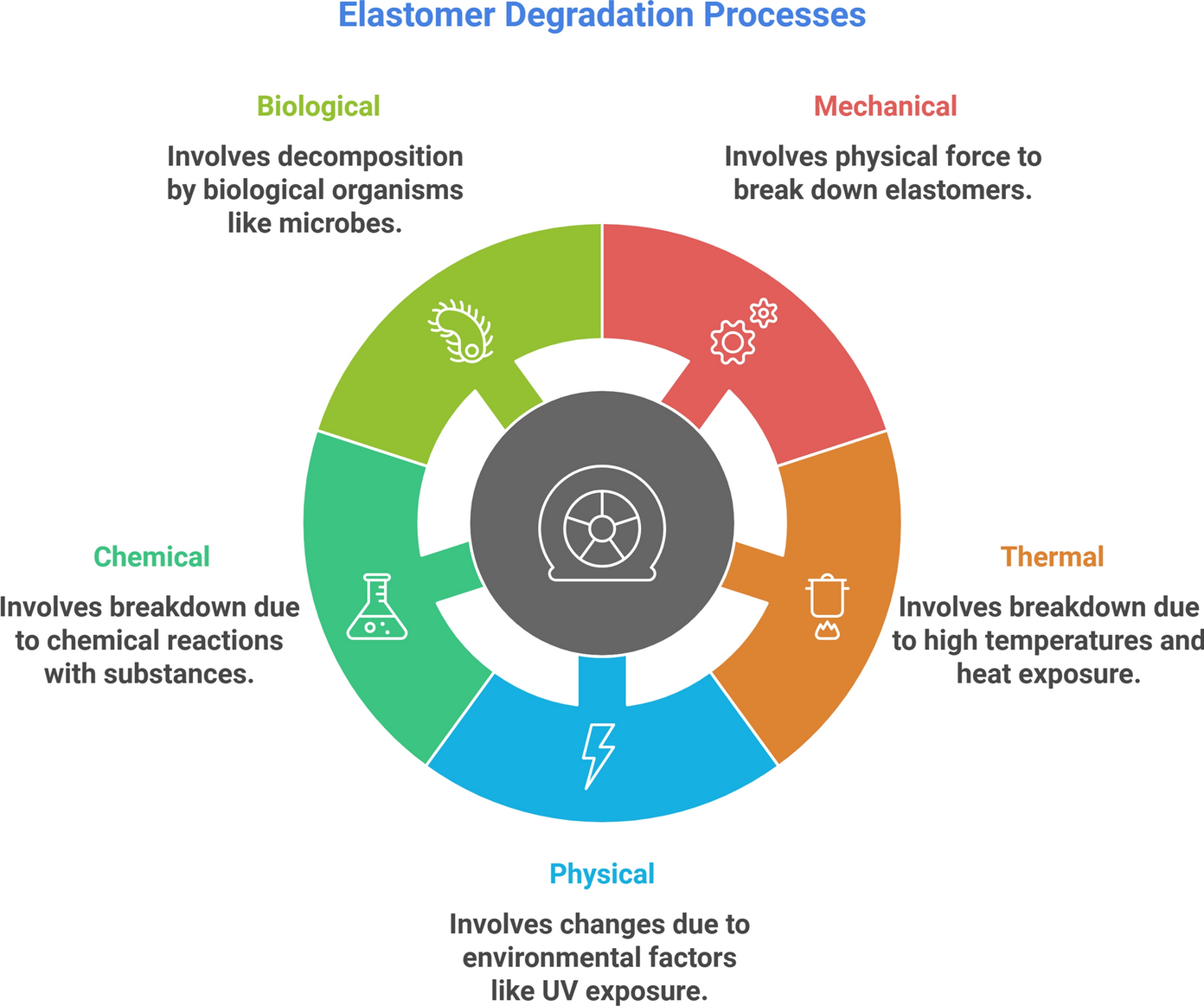
Traditional approaches to rubber waste management mainly involve collecting, incinerating, disposing of in landfills or open dumps, or shredding or grinding the rubber into powder. To address this issue, various degradation processes have been studied in recent decades, including mechanical, physical, thermal, chemical, and biological methods; however, some of these processes—primarily mechanical, physical, and thermal—require specialized equipment, high temperatures, pressure, solvents, or do not fully degrade the material (Figure 1). One of the most promising chemical methods for breaking down elastomers and rubbers is metathesis degradation (metathesis depolymerization). This process is appealing not only because it aligns with sustainable chemistry but also due to its contribution to circularity, as it enables more efficient, controlled reactions under mild conditions, results in complete degradation of the material, and allows for the design and production of new compounds or raw materials for bio-based polymers, non-petroleum polymers, or other new materials.
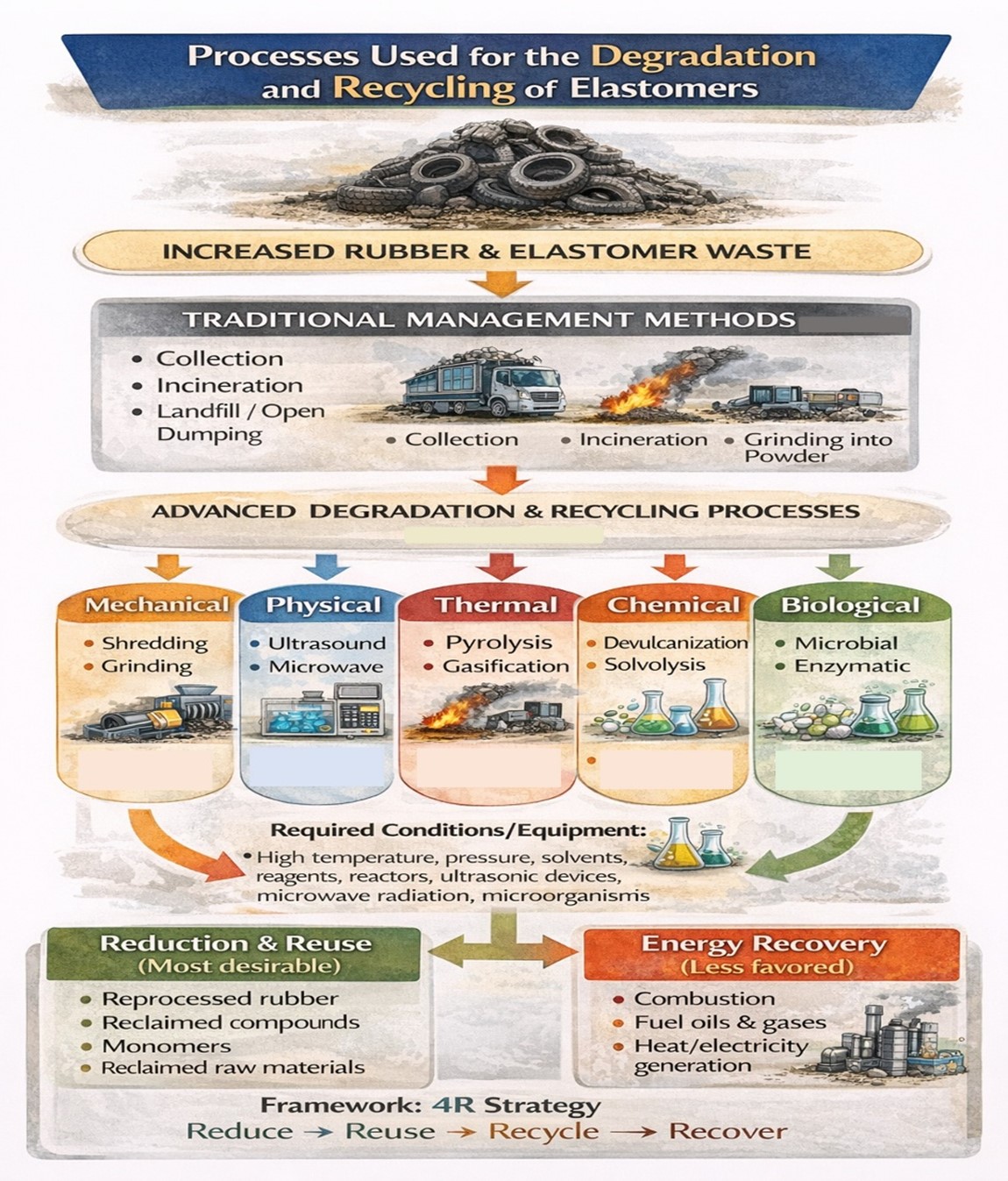
Figure 1. Processes for degrading and recycling elastomers can be used alone or together to reuse, recycle, or recover elastomer waste for energy.
Environmental factors to consider in the recycling and degradation processes of elastomers
- Toxicity: This evaluates the potential damage that degradation products may cause to living organisms, as well as the toxicity of the materials and substances used in the process.
- Persistence: This measures how long degradation products remain in the environment.
- Bioaccumulation: This factor evaluates the extent to which degradation products accumulate in the food chain.
- Microplastic Formation: This measures the potential for degradation processes to produce microplastics, which are small plastic particles (between 1 μm and 5 mm) that can cause environmental and health problems.
- Greenhouse Gas (GHG) Emissions: This factor measures the amount of greenhouse gases released during the degradation process, including carbon dioxide (CO₂), methane (CH₄), nitrous oxide (N₂O), and fluorinated gases.
- Resource Consumption: This evaluates the extra resources needed to handle the degradation process, such as energy or raw materials.
- Waste Generation: This refers to the quantity of waste generated during the degradation process.
- Impact on Soil and Water Quality: This evaluates how degradation products affect soil and water quality.
Among the various degradation processes studied, biological treatments produce the best results in terms of impact; the second-best option is mechanical processes, and the third-best is chemical depolymerization by metathesis. Pyrolysis, a thermal process, is the least recommended option because it requires high process temperatures, long reaction times, and high energy consumption, generates greenhouse gas emissions, and involves high economic and environmental costs. Metathesis depolymerization is highly attractive, not only from the perspective of green chemistry but also of circularity, as it enables more efficient, user-friendly, and environmentally friendly reactions.
Currently, actions are underway to develop effective strategies for waste management, recycling, and the degradation of elastomers
Dr. Manuel Burelo from Instituto Potosino de Investigación Científica y Tecnológica A.C. (IPICYT) in Mexico, in collaboration with the National Autonomous University of Mexico (UNAM) and Tecnologico de Monterrey, has developed a chemical process for depolymerizing elastomers via metathesis. This process is applicable to natural and synthetic rubbers such as NR, IR, BR, SBR, and NBR, as well as industrial waste from rubber or elastomers, including latex, nitrile, and neoprene gloves. This process controls the molecular weight, chemical structure, and functional groups of the resulting products. It produces value-added compounds, including diols, polyols, macrodiols, polyesters, diamines, and polyamides, among others, with various functional groups. These new compounds can be used to develop materials, polymers, and copolymers, serve as raw materials or reaction intermediates, or be employed in fine chemicals, biomedical applications, or polyurethane industries (Figure 2).
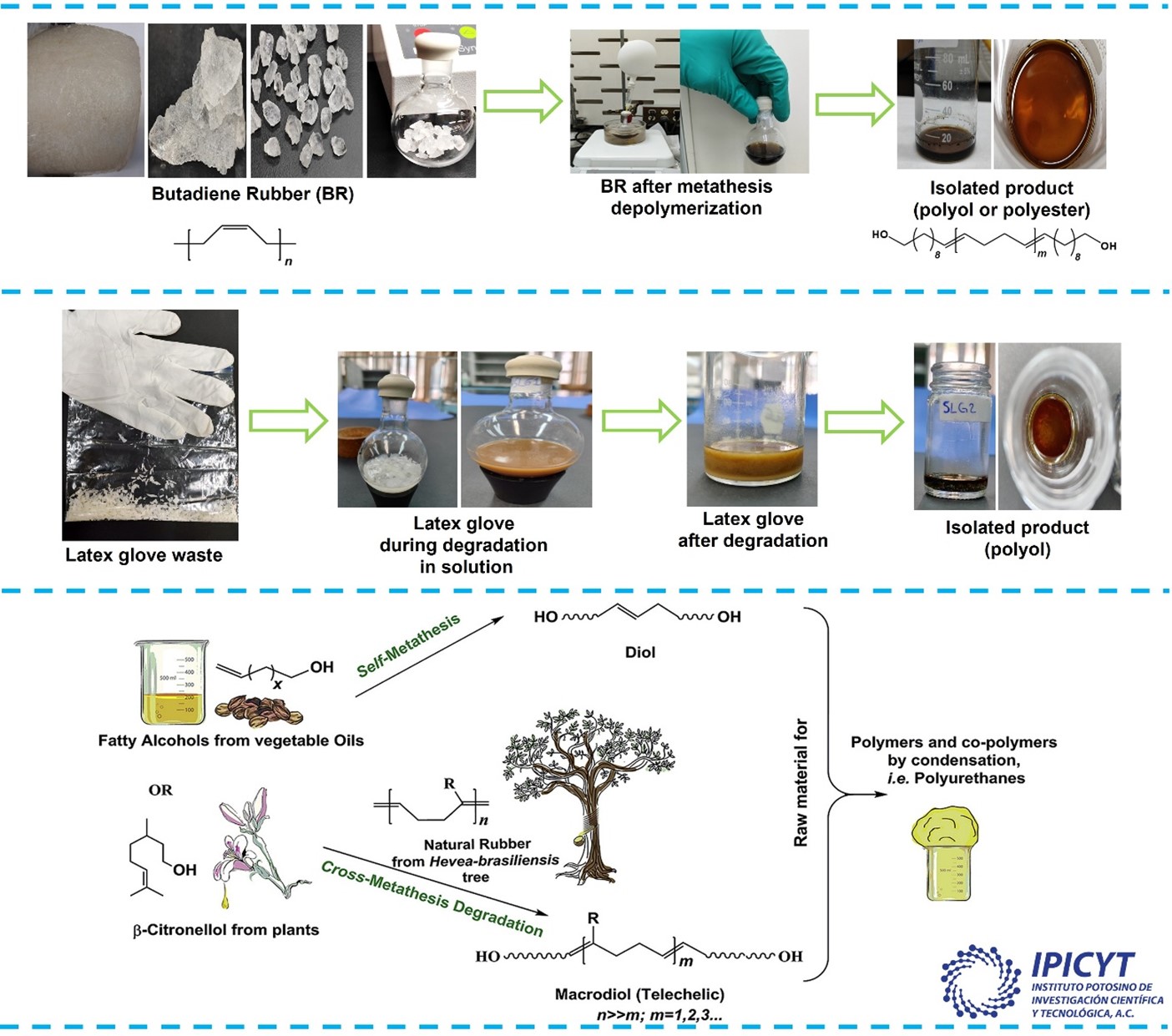
Figure 2. Process for depolymerizing elastomers via metathesis, applicable to natural and synthetic rubbers [3,4].
Manuel Burelo thanks Prof. Piet N.L. Lens, editor of the journal Reviews in Environmental Science and Bio/Technology, for the invitation to publish this blog post. MB also thanks the co-authors of the cited articles for their support in developing this research. Some of the information was obtained from the cited references.
References
- Reviews in Environmental Science and Bio/Technology, 2025, 24, 339–375. https://doi.org/10.1007/s11157-025-09724-8
- Macromolecular Materials and Engineering, 2025, 310, e00147. https://doi.org/10.1002/mame.202500147
- Polymer Degradation and Stability, 2024, 227, 110874. https://doi.org/10.1016/j.polymdegradstab.2024.110874
- Polymer Degradation and Stability, 2019, 166, 202-212. https://doi.org/10.1016/j.polymdegradstab.2019.05.021

As an Associate Publisher in Life Sciences, Journals at Springer Nature, I oversee a portfolio of journals in aquatic and environmental sciences. I especially value collaborating closely with external editors and research communities to identify best practices and shape strategic development opportunities that strengthen the quality, impact, and sustainable growth of their journals.
Follow the Topic
-
Reviews in Environmental Science and Bio/Technology
Reviews in Environmental Science and Bio/Technology provides accessible, authoritative and balanced views and reviews in the field of environmental science and (bio)technology.

Related Collections
With Collections, you can get published faster and increase your visibility.
Sustainable Development Goal 7: Affordable and Clean Energy
Sustainable Development Goal 7 (SDG 7) is to ensure access to affordable, reliable, sustainable and modern energy for all. One of the indicators for this goal is the percentage of population with access to electricity (progress in expanding access to electricity has been made in several countries, notably India, Bangladesh, and Kenya). Other indicators look at the renewable energy share and energy efficiency. The goal has five targets to be achieved by 2030. Progress towards the targets is measured by six indicators. Three out of the five targets are outcome targets: Universal access to modern energy; increase global percentage of renewable energy; double the improvement in energy efficiency. The remaining two targets are means of implementation targets: to promote access to research, technology and investments in clean energy; and expand and upgrade energy services for developing countries. In other words, these targets include access to affordable and reliable energy while increasing the share of renewable energy in the global energy mix. They also focus on improving energy efficiency, international cooperation and investment in clean energy infrastructure.
Publishing Model: Hybrid
Deadline: Ongoing
Biofilms for Sustainable Development
Biofilms are globally ubiquitous and are present in many different settings in natural and man-made environments. They comprise a diverse range of microbial communities, enclosed in an extracellular matrix. Biofilms play a key role in many different scientific and technological settings, including industry, agriculture, aquaculture, health and environmental biotechnology.
This collection invites reviews which entail outstanding contributions about the state-of-the-art in biofilm research, creating a platform to exchange groundbreaking techniques, tools and technologies employed in the biofilm research domain with the aim of guiding the field towards an enabler to achieve the sustainable development goals (SDGs).
Some examples of topics of review papers relevant to this call include:
• Understanding biofilm composition and functioning, including adhesion, microbial ecology, ecological theory, biofilm modelling and matrixome characterization. Specialised analytical and characterisation methodologies.
• Specialised analytical and characterisation methodologies.
• Application of genomics, proteomics, transcriptomics and metabolomics in biofilm research.
• Advanced biofilm reactor technologies integrating treatment with sustainability, resource recovery and circular economy, e.g. aerobic, anaerobic and algal-bacterial granular sludge reactors; fungal pellet reactors; packed bed reactors and membrane-aerated biofilm reactors. Biofilm-based systems in intensive aquaculture, such as biofloc technology and recirculating aquaculture systems.
• Novel methods to selectively augment desired microorganisms in areas that make use of biofilm bioconversions, e.g. fermentation processes and industrial biotechnology.
• Innovative solutions to prevent, control and eliminate biofilm formation for those areas where biofilm formation is unwanted, e.g. clogging, scaling, biofouling and biocorrosion.
HOW TO SUBMIT? Submit your article to one of the Topical Collection via Snapp – New Editorial Manager or by clicking on the Submit manuscript button on the home page of Reviews in Environmental Science and Bio/Technology During submission select the title of this Topical Collection.
Publishing Model: Hybrid
Deadline: Ongoing