Video Abstract: Electro-Driven Membrane Separations for Sustainable Bio-Based Chemical Recovery
Published in Chemistry, Earth & Environment, and Physics
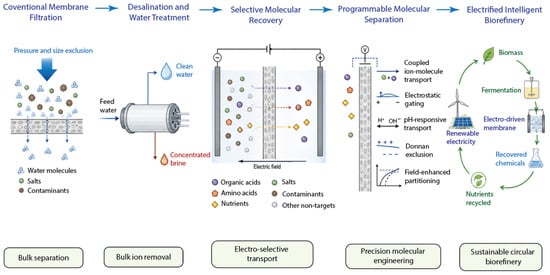

Conventional passive membrane filtration in bio-refinery processes faces fundamental thermodynamic and kinetic constraints, including boundary layer concentration polarization and energetic inefficiency. In my open-access review published in Water (MDPI, 2026), I detail the operational mechanisms of electric-field-assisted membrane separations for targeted chemical recovery.
Key Technical Takeaways:
-
Electromigration Mechanics: Electric potential gradients drive active ion transport, bypassing passive diffusion limitations to reduce energy consumption.
-
Selectivity Engineering: Custom sub-nanometer pore channels enable precise separation of chemically similar bio-based molecules.
-
2D Nano-Channel Kinetics: Graphene and MXene-based membrane architectures minimize hydraulic resistance while maintaining superior permselectivity.
-
Industrial Scale-Up: Advanced stack design optimizes hydrodynamic flow to prevent fouling and support continuous industrial deployment.
🎥 Watch the 1-minute video abstract above for a quick visual breakdown.
Publication Citation:
Oladipo, A. A. Electro-Driven Membrane Separations for Sustainable Bio-Based Chemical Recovery: Energetics, Selectivity Engineering, Scale-Up Challenges, and Industrial Translation. Water (MDPI), 2026, 18(14), 1746.

Dr. Akeem Adeyemi Oladipo is a globally recognized Research Professor of Materials and Environmental Chemistry at Eastern Mediterranean University. Ranked among the world's Top 2% Scientists, his expertise bridges nanotechnology, renewable energy, and electro-analytical chemistry. He specializes in advanced materials synthesis for wastewater treatment, highly sensitive electrochemical biosensors, and solar energy conversion. By integrating machine learning and artificial neural networks, his research drives scalable deep-tech innovations in environmental sustainability and energy storage.