PEDOT:DS co-crystal with hydrogens (an oblique axis)
Published in Bioengineering & Biotechnology, Chemistry, and Materials
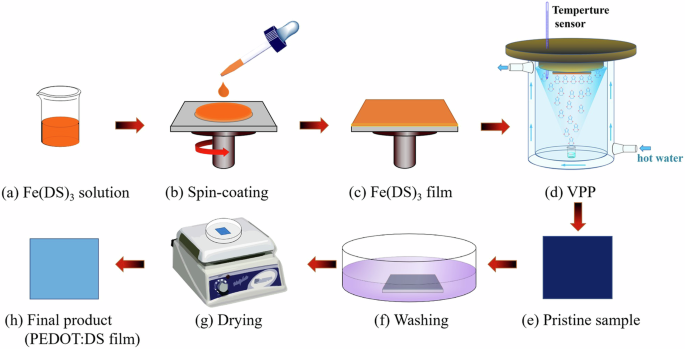

This 3-D model is a PEDOT:DS co-crystal structure proposed in our study and was not published in our article linked here. For reference, our study is summarized as follows:
Iron(III) dodecyl sulfate (Fe(DS)3), a newly introduced growth template and a key factor for a different level of vapor-phase polymerization (VPP) of poly(3,4-ethylenedioxythiophene) (PEDOT), was scrupulously investigated to synthesize a highly conductive, transparent, and mechanically durable film, which is specifically suitable for flexible electronics. PEDOT film polymerized with Fe(DS)3, and then doped with its anions is highly transparent, metallically conductive (avg. ~1.0 x 10⁴ S cm-1), and, mechanically highly durable but still flexible (DR/R0 » 0 % in inner-bending up to half a million cycles for a bending radius of 1 mm and at a rate of 2 Hz. After immersion in an aqueous medium for one month, the PEDOT:DS film was still intact with almost no increase in the resistance. These noteworthy properties of the VPP-PEDOT film exclusively originate from the lamellar superstructure of Fe(DS)3 surfactants playing several fantastic roles at the same time during VPP – a very effective oxidant without side reactions, a highly efficient in-situ dopant, a template for a large-scale crystal growth, and a durability-enhancer. The crystal growth of the PEDOT film is directed by the lamellar planes of the densely packed Fe(DS)3 surfactant molecules to form PEDOT:DS co-crystal domains—hundreds of micrometers wide and long—within the MLV superstructure of the Fe(III) oxidant. These unique and important findings suggest a new direction and insight for the synthesis of more conductive, transparent, robust, as well as more flexible polymer electrode materials through the guidance of better tailored size and structure of an oxidant lamella in the near future.

Proven track records in surface and colloid science as well as in materials science especially including conducting polymers and organic semiconductors. Highly interested in organic electrochemical transistors.
Follow the Topic
-
Nature Communications
An open access, multidisciplinary journal dedicated to publishing high-quality research in all areas of the biological, health, physical, chemical and Earth sciences.

Related Collections
With Collections, you can get published faster and increase your visibility.
Women's Health
Publishing Model: Hybrid
Deadline: Ongoing
Biosensing
Publishing Model: Hybrid
Deadline: Sep 30, 2026



Please sign in or register for FREE
If you are a registered user on Research Communities by Springer Nature, please sign in