Designed a tissue-like bandage for major pelvic nerve injury

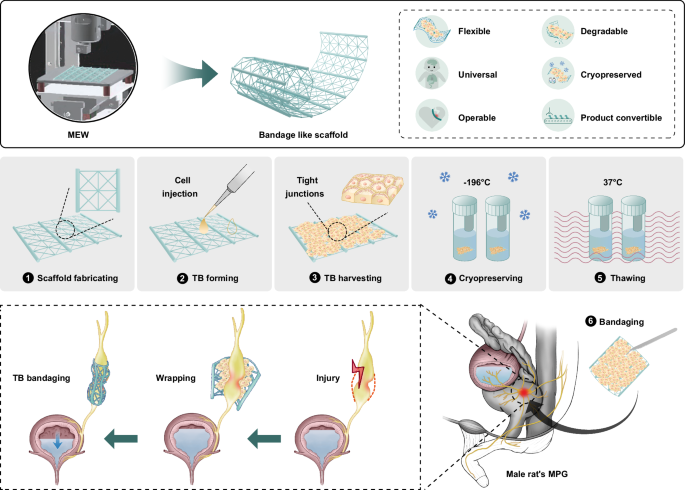
A new study published in Nature Communications reports the development of a tissue-like bandage designed to treat severe pelvic nerve injuries. The bandage was fabricated using melt electrowriting technology and incorporates cell therapy.

Published in Biomedical Research

Like

Share this post

Choose a social network to share with, or copy the URL to share elsewhere

This is a representation of how your post may appear on social media. The actual post will vary between social networks

When the skin sustains an injury, we typically reach for a band-aid to provide essential protection and support healing. But what about nerve injuries? To address this challenge, we developed a tissue-like bandage that employed the melt electrowriting technique to create a bandage-like scaffold with polycaprolactone (PCL). We combined it with cell therapy for treating pelvic nerve injuries. Our goal with this approach is to minimize damage to the pelvic ganglia caused by surgical procedures or traumatic events. We aim to enhance recovery and improve outcomes for patients suffering from nerve injuries.

Please sign in or register for FREE

If you are a registered user on Research Communities by Springer Nature, please sign in

Follow the Topic

Biomedical Research
Life Sciences > Health Sciences > Biomedical Research

Related Collections

With Collections, you can get published faster and increase your visibility.

Women's Health

A selection of recent articles that highlight issues relevant to the treatment of neurological and psychiatric disorders in women.

Publishing Model: Hybrid

Deadline: Ongoing

Tumor Microenvironment Crosstalk and Therapeutic Implications

With this cross-journal Collection, the editors at Nature Immunology, Nature Communications, Communications Medicine and Scientific Reports invite manuscripts that highlight cutting-edge research on TME crosstalk and its therapeutic implications. Topics of interest include immune modulation and checkpoint pathways, cancer-associated fibroblasts and stromal remodeling, angiogenesis and vascular normalization, metabolic reprogramming within the TME, and the role of microbiota in tumor-immune dynamics. We also welcome studies on novel therapeutic approaches that exploit TME vulnerabilities to advance cancer treatment.

Publishing Model: Hybrid

Deadline: Nov 02, 2026