A Closer Look at Tears: Uncovering Why Thyroid Eye Disease Symptoms Linger After a Breakthrough Treatment
Published in Protocols & Methods, General & Internal Medicine, and Immunology




For patients with active, moderate-to-severe Thyroid Eye Disease (TED), the experience can be deeply distressing. The condition, an autoimmune disorder, causes inflammation and swelling in the tissues behind the eyes, leading to eye bulging (proptosis), double vision, and significant pain and pressure. For years, treatment involved a long and arduous journey of steroids, radiation, and often, multiple disfiguring surgeries.
Then came a breakthrough: teprotumumab (TMB). As the first FDA-approved drug for TED, it was a game-changer. In our clinic at the Stanford Byers Eye Institute, we witnessed its remarkable success firsthand. Patients who had suffered for years saw their eye-bulging and inflammation dramatically improve, restoring not just their vision and appearance, but also their quality of life.
But amidst these incredible successes, a puzzling clinical question emerged. Even after their proptosis and inflammation were controlled, many patients continued to complain of persistent dry eye symptoms—grittiness, irritation, and chronic discomfort. Their eyes looked better, but they didn't always feel better.
This disconnect was the driving force behind our study. We wanted to look "behind the scenes" at the molecular level to understand: What is happening on the surface of the eye, and why do these symptoms persist even after a successful treatment?
Tears as a Molecular Window
To answer this question, we turned to a powerful and surprisingly informative source: human tears.
Tears are far more than just saltwater. They are a complex biological fluid, a rich soup of thousands of proteins that protect, lubricate, and nourish the ocular surface. Think of the tear film as a "liquid biopsy" of the eye's health. By analyzing its protein composition, we can get a high-resolution snapshot of the biological processes—both healthy and pathological—happening on the front lines of the eye. This field of study is called proteomics: the large-scale study of proteins.
Our approach was simple in concept, but complex in execution. We collected tear samples from patients with active TED just before they started their first teprotumumab infusion, and again after their treatment course was complete. We then used a powerful technique called mass spectrometry to identify and quantify thousands of proteins in each sample, comparing them to tears from healthy individuals. This paired, before-and-after design is incredibly powerful because each patient serves as their own control, allowing us to precisely track the changes induced by the therapy.
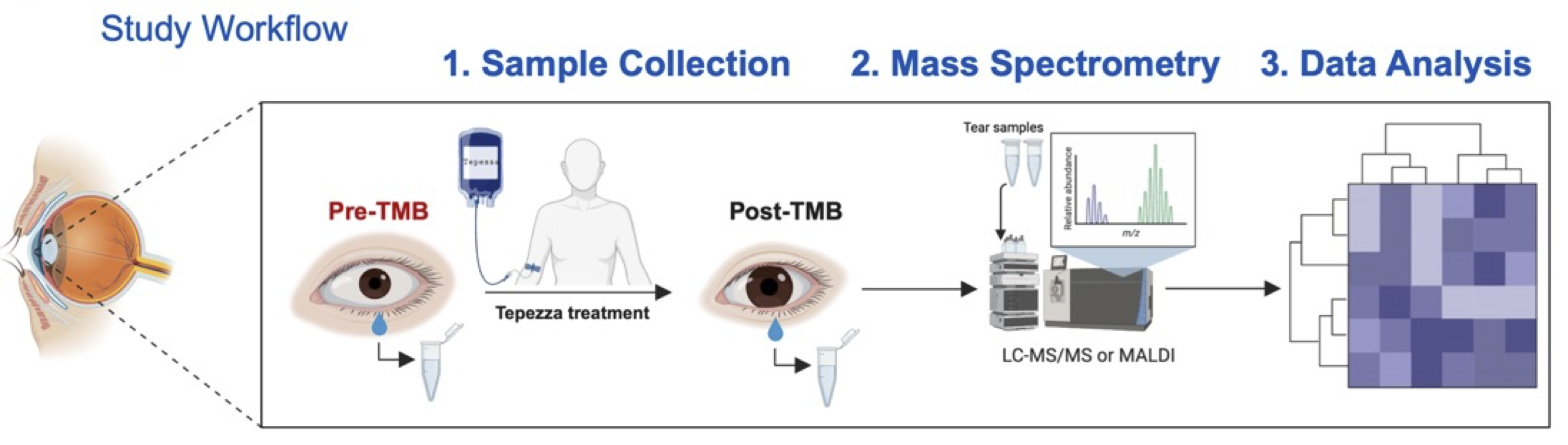
Our workflow for analyzing the thousands of proteins present in a single tear sample from a Schirmer strip to mass spectrometry analysis. ( Figure 1d from the paper)
The Surprise Finding: A New, "Post-Treatment" State
We expected one of two outcomes: either the treatment would have no effect on the tear proteome, or it would cause the tear protein profile to return to a normal, healthy state.
What we found was far more interesting. As we analyzed the data, our unsupervised computer models, which group samples based on their molecular similarities without any prior instructions, revealed a striking pattern. The tear profiles of healthy controls, pre-treatment TED patients, and post-treatment TED patients all clustered into three distinct groups.
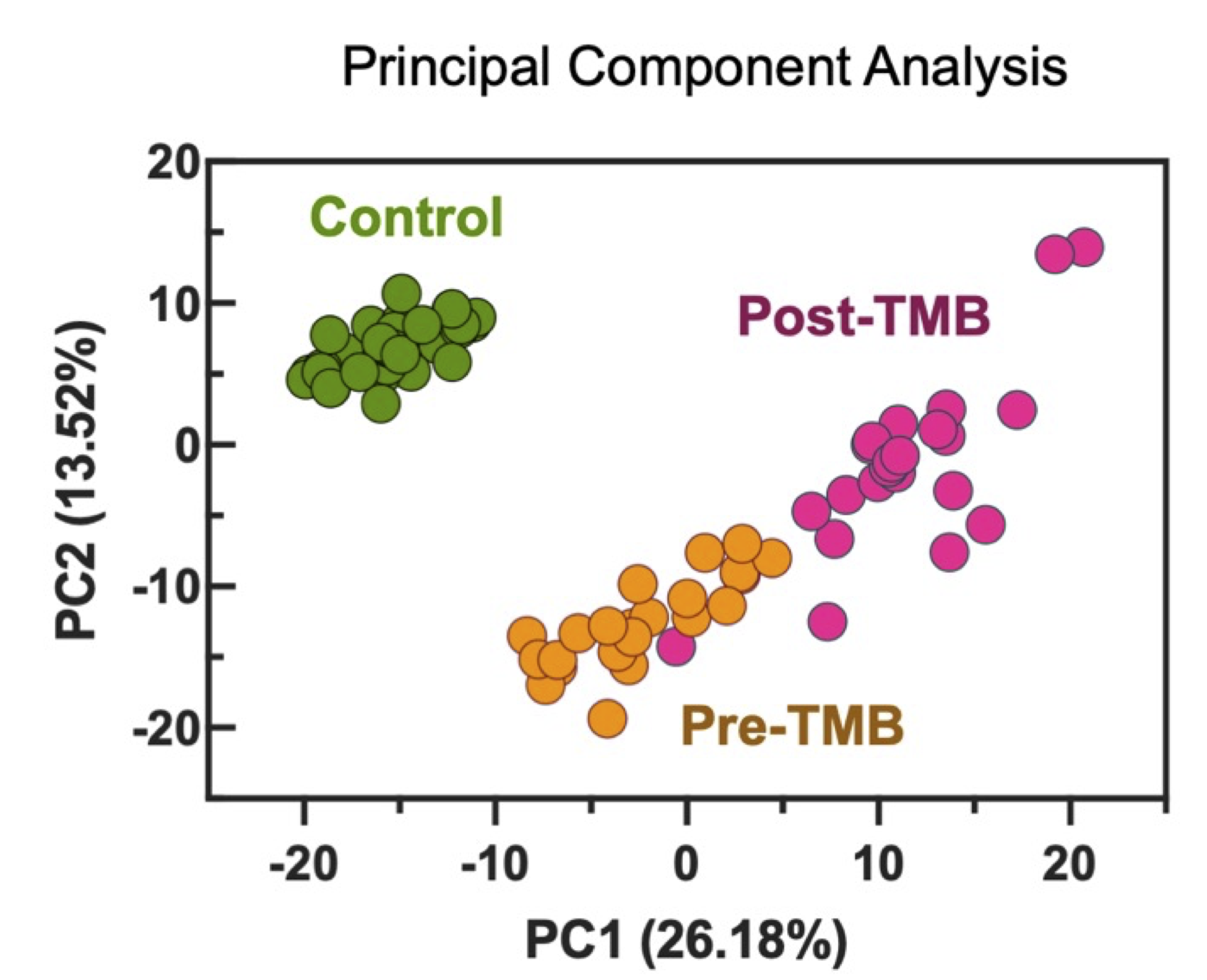
Our analysis showed that the tear protein profiles of post-treatment patients (pink) did not revert to a healthy state (green), but instead formed a new, distinct third group, separate from their pre-treatment baseline (orange). (Figure 2A from paper)
When we dug into the specific proteins, the story became clearer. On the one hand, there was good news. Teprotumumab helped normalize proteins crucial for tear film stability, such as MUC5A and perlecan. This likely contributes to some of the ocular surface improvement patients feel.
But on the other hand, a huge number of proteins involved in inflammation, cellular stress, and immune system activation remained persistently abnormal. Pathways related to neutrophil degranulation (an inflammatory process) and oxidative stress were still running hot. This provides a clear biological explanation for why patients continue to experience symptoms. The deep orbital "fire" of TED had been quenched by teprotumumab, but a smoldering inflammatory ember remained on the ocular surface.
From Discovery to Action: A Blueprint for Future Treatments
This finding is more than just a scientific curiosity; it validates the experience of patients and provides a roadmap for clinicians. It suggests that treating TED may require a two-pronged approach: teprotumumab for the deep orbital disease, and a separate, targeted therapy for the residual ocular surface disease.
And that’s where our study took its most exciting turn. We didn’t just want to identify the problem; we wanted to find potential solutions.
We took our list of persistently abnormal proteins and fed it into a "Drug-Gene Interaction Database." This powerful tool scans databases of existing, FDA-approved drugs to find medicines that are known to target specific proteins. This is a form of drug repositioning—finding new uses for old drugs.
Our analysis generated a curated blueprint of potential therapies. It highlighted several promising types: (1) Targeted anti-inflammatory eye drops (like NSAIDs) that could help quell the specific type of inflammation we saw. (2) Drugs targeting the complement cascade, a part of the immune system that was persistently activated. (3) Systemic immunomodulators like methotrexate and anti-TNF biologics, which our data suggest could counteract some of the specific inflammatory pathways that remained dysregulated.
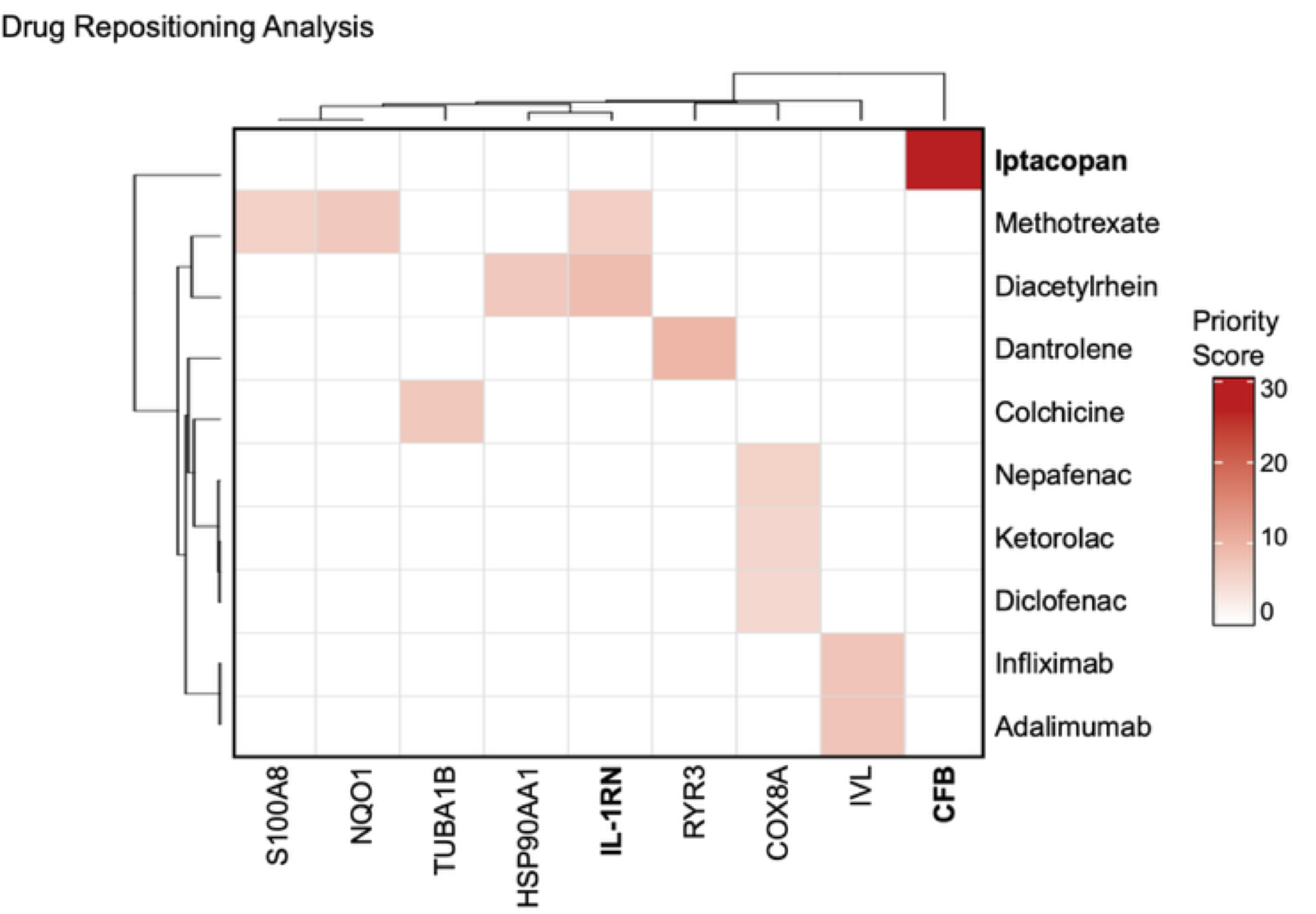
By matching persistently abnormal proteins to drug-target databases, we created a blueprint of existing, FDA-approved drugs that could be repositioned to treat the lingering ocular surface disease in TED. (Figure 6a from the paper)
The Path Forward
Our study, though conducted with a small group of patients, provides the first longitudinal map of the tear proteome’s response to teprotumumab. It demonstrates that the ocular surface is a partially independent battleground in TED that isn’t fully conquered by IGF-1R inhibition alone.
The future of TED management will likely involve more personalized and multi-faceted strategies. By using non-invasive tools like tear proteomics, we can move beyond simply looking at a patient's eye-bulging and start tailoring therapies to their specific molecular profile. Our work provides the foundational evidence and a list of high-priority candidates for the clinical trials that will make that future a reality. Our new tear proteomics method, “TEARDROP”, will provide even more molecular details.
For patients and clinicians, our message is one of hope and validation. The discomfort you feel is real, it has a biological basis, and we are now one step closer to designing targeted treatments to fix it.
("The tear proteome" watercolor painted by MaryAnn Mahajan)
Follow the Topic
-
Communications Medicine
A selective open access journal from Nature Portfolio publishing high-quality research, reviews and commentary across all clinical, translational, and public health research fields.

Related Collections
With Collections, you can get published faster and increase your visibility.
Diagnosis and Care of Sepsis
Publishing Model: Open Access
Deadline: Jan 27, 2027
Exercise and Physical Activity in Health and Disease
Publishing Model: Open Access
Deadline: Dec 03, 2026