A Crystal That Refuses to “Breathe” Even Under Large Temperature Swings


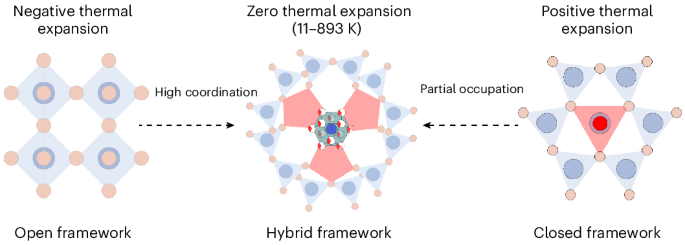

Imagine a material that stays almost exactly the same size from near absolute zero to several hundred kelvin. This “breathe-free” response to temperature, known as zero thermal expansion (ZTE), is highly desirable for manufacturing high-precision instruments. In the real world, temperature changes cause most materials to expand or contract, which can lead to tiny yet potentially catastrophic errors in precision equipment such as space telescopes, satellite navigation systems, and chip lithography machines.
For years, scientists have been seeking an ideal ZTE material that works over a wide temperature range while remaining good physiochemical property in an isotropic manner. The challenge is fundamental. Atomic vibrations always exist in solids, and their anharmonic nature means that the bond length change with temperature, causing the material to expand or contact. Certain mechanism, including transverse vibrations, rigid unit modes, magnetovolume effect, and ferroelectrorestriction, can shorten the effective bond lengths and produce negative thermal expansion (NTE). To achieve overall ZTE, the positive thermal expansion (PTE) from some atomic groups must precisely cancel the NTE from others, so that the macroscopic size remains unchanged. This balancing act is extremely difficult, especially at high temperatures, where bond-stretching vibrations intensify and can easily overwhelm the NTE contribution. Consequently, most isotropic ZTE materials operate only within narrow temperature window, typically less than 400 K.
To address this challenge, we have proposed a general strategy: introducing fractionally occupied units into a sodalite-cage-like close-framework structure. The sodalite-cage structures are known to exhibit ZTE below room temperature but become PTE at higher temperature. Our idea was to increase the flexibility of the groups inside the cages, thereby dynamically expand the cavities. This approach can preserve and even enhance the transverse vibrational modes (TVMs) essential for NTE, allowing them to effectively counterbalance the intrinsic PTE and achieve ZTE at higher temperatures. We implemented this strategy in a sodalite-cage crystal, Cd4Al6O12(SO4) (CASO), which crystallizes in a cubic space group and therefore exhibits isotropic physical properties. Its uniqueness lies in its internal architecture. The sturdy cages are built from aluminum and oxygen atoms. Inside each cage, we placed the interstitial [CdO4] groups and cage-centered [SO4] groups. Importantly, the oxygen atoms in these groups are not fixed in place. Instead, they exist in a "fuzzy" or fractionally occupied manner, which gives them additional vibrational flexibility.
Experimental results show that CASO maintains nearly perfect isotropic ZTE performance across a wide temperature range, from 11 K to 893 K. The crystal also remains structurally stable without decomposing at temperatures as high as 1,100 K. Combined first-principles calculations and variable-temperature Raman spectroscopy reveal the mechanism behind this remarkable behavior. In a normal closed framework, heat would soften the structure and suppress the NTE effect, causing the material to expand. In CASO, however, heat energizes the "fuzzy" oxygen atoms within the disordered interstitial groups. Their vibrations become more intense, effectively pushing the adjacent cadmium atoms and creating additional space inside the rigid cage. This extra space allows the key TVMs of the bridged oxygen atoms, the very modes that drive NTE, not only to survive but also to amplify as temperature rises. This amplified NTE continues to counteract the PTE, resulting in net zero expansion at high temperatures. As an illustrative analogy, this mechanism is like a rigid building frame equipped with smart, adaptive shock absorbers inside. When wind (heat) tries to shake the building, the shock absorbers dynamically adjust to absorb the energy, ensuring that the building as a whole remains perfectly still (neither expanding nor contracting).
In addition to its thermal stability, CASO also exhibits favorable optical properties. It is transparent across a broad spectral range, from deep ultraviolet to near-infrared, and its optical properties show little dependence on temperature. The temperature variation rate of its transparent window is at least two times lower than that of other known optical materials. This means that optical components made from CASO can maintain stable performance even under significant temperature changes, without signal distortion. These features suggest that CASO may be useful for optical applications where temperature stability is critical, such as high-energy laser systems, lithography equipment for chip manufacturing, and optical windows for deep-space environments.
Beyond presenting CASO as a promising candidate for precision applications, this work establishes fractional atomic occupancy as a useful and general design principle for developing next‑generation functional materials suited for extreme environments.

Follow the Topic
-
Nature Chemistry
A monthly journal dedicated to publishing high-quality papers that describe the most significant and cutting-edge research in all areas of chemistry, reflecting the traditional core subjects of analytical, inorganic, organic and physical chemistry.