A Lifeline, Not a Finish Line: What Happens to Refugee Graduates After University?
Published in Social Sciences, Arts & Humanities, and Law, Politics & International Studies


Humanitarian scholarships have transformed access to Australian universities for refugee and asylum-seeker students. But access has rarely been the hardest part. This post explores what happens to graduates once the scholarship, and the support that came with it, ends.
Ask a university about its refugee scholarship program and you’ll usually hear about access: students enrolled, fees waived, doors opened. These are real achievements. Humanitarian scholarship programs emerged in Australia in the early 2010s and expanded significantly from 2015, designed specifically because refugee and asylum-seeker students are ineligible for government loans or subsidised places, and would otherwise be charged international fees for a degree. For a student arriving with little, a fee waiver and a mentor can be the difference between having a future and having none.
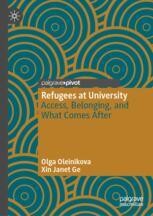
What you rarely hear about is what happens two, five, eight years later. This is the question behind my forthcoming book with Xin Janet Ge, Refugees at University: Access, Belonging, and What Comes After[1], the first systematic study of the long-term outcomes of humanitarian scholarship graduates in Australia.
I came to this somewhat sideways. I am Ukrainian, and over recent years I’ve watched people close to me become refugees themselves, discovering that the hardest part rarely arrives in the dramatic first weeks but in the long, quiet years afterward, once the world has moved on. Seeing a growing number of Ukrainian students entering Australia’s scholarship programs struck a deeply personal chord. I’d also spent years researching forced displacement and migration governance and knew the literature on getting refugee students into university well. What struck me was how little knowledge existed about the life of refugees after graduation. We knew how to get people in; we had almost no idea what we’d built for them once they left.
So this research went back to graduates years after their scholarships ended and asked how things had actually gone. The findings split into two stories.
The first is a genuine success: meaningful gains in income, employment connected to their degrees, improved English, and a real sense of belonging many didn’t feel on arrival. For many, the scholarship changed their life’s direction, and the wraparound support (mentoring, peer community, career coaching) is named as the most valuable part of the program.
The second is harder to tell, because it complicates a narrative everyone wants to be simple. Many describe a cliff edge: mentoring and coaching end precisely when the degree does. Networks built inside a structured program don’t automatically convert into the informal connections that determine who hears about the next opportunity. Mental health difficulties tied to displacement don’t resolve on graduation day, but the support that helped manage them usually does. Several spoke of returning, in effect, to the precarity they’d left; now with a degree, but without the structure that had understood it.
This is the distinction the book holds onto: access is not integration. Universities have become sophisticated at the first. We’ve built almost nothing for afterward, for the years when a graduate is no longer a “student” but a young professional still carrying displacement’s consequences while building a career from a standing start. A scholarship producing a graduate but not a sustained career is an unfinished investment in people who will help shape Australia’s workforce for decades.
Humanitarian scholarships are, without question, one of the genuinely good things Australian universities have built over the past decade, and this research only strengthens that case. The argument here isn’t against scholarships; it’s for extending the same generosity and intentionality further: alumni mentoring that continues past graduation, structured introductions into professional networks, mental health support that doesn’t expire with enrolment, and longitudinal tracking of outcomes. What limited these graduates was rarely capability, it was a system designed to deliver excellent support up to a finish line, with little thought for what should come after it.
Education is not just a pathway to a better career. It is a lifeline. It restores agency, dignity, and hope. This is exactly why what happens after it should matter as much as what happens during it. Australia is not alone in running humanitarian scholarship programs, similar schemes exist across the UK, Canada, Germany, and the Netherlands. However, the Australian case is distinctive in its scale, its decade-long track record, and the fact that it operates within a migration system that ties visa status closely to education access in ways that amplify both the value of a scholarship and the precarity that follows its end. My hope is that this research contributes to better, more sustained support across higher education more broadly, not only at the institutions where these programs were born, but as a reference point for universities and policymakers internationally who are asking the same question: what do we owe students once the scholarship ends?
This question (what happens once the crisis has passed and the world stops watching) is also why I recently founded the Global Institute of Emerging Human Mobilities (GIEHM) at UTS. Displacement research has long centred on conflict and asylum, but the forces displacing people are diversifying. GIEHM centres on two areas that raise strikingly similar questions: reproductive mobility, where people cross borders for fertility treatment or surrogacy unavailable at home, and climate displacement; slower-moving and less legally recognised than war, but no less life-altering. Across each, the same pattern recurs: we build infrastructure to get people somewhere new, and assume the job is done. Refugees at University (Palgrave, 2026) is a case study in why that assumption deserves closer scrutiny. It is also, more broadly, the kind of question social science research is uniquely equipped to answer. Not just by documenting what went wrong, but by making visible the systems, assumptions, and policy choices that shape millions of lives in ways that rarely make headlines. The value of this work lies not in the book itself, but in what it might change: how universities design support, how policymakers measure success, and how we decide what we think education is actually for.
References
Oleinikova, O. & Ge, XJ. (2026) Refugees at University. Palgrave Pivot.
Ge,X J. and Oleinikova, O. (2025) 'Opening doors: Life after the UTS Humanitarian Scholarship', University of Technology Sydney. Available at: https://www.uts.edu.au/case-studies/life-after-humanitarian-scholarship
[1] https://link.springer.com/book/9789819234660
Dr Olga Oleinikova is Associate Professor of Migration in the Faculty of Design and Society at the University of Technology Sydney, and Founding Director of the Global Institute of Emerging Human Mobilities (GIEHM). Her research spans forced displacement, migration governance, and emerging forms of human mobility, including reproductive migration and climate displacement.

Dr Olga Oleinikova is Associate Professor of Migration in the Faculty of Design and Society at the University of Technology Sydney, and Founding Director of the Global Institute of Emerging Human Mobilities (GIEHM). Her research spans forced displacement, migration governance, and emerging forms of human mobility, including reproductive migration and climate displacement.
Follow the Topic
-
Palgrave Macmillan
Palgrave Macmillan is a world-class publisher of books and journals with more than 175 years’ experience in the Humanities and Social Sciences.

Introducing the Palgrave Macmillan Campaign for the Humanities
At Palgrave Macmillan we publish cutting-edge humanities research that has real-world impact. This research community brings together the voices of our authors and editorial team to highlight and publicize the value of the humanities and humanities research in our world today.
Continue reading announcement