A New Window on Global Ozone: First Results from the FengYun-3F OMS-N Hyperspectral Sensor

First global ozone observations from FengYun-3F OMS-N are now available. High-resolution, well-validated total ozone products demonstrate strong consistency with international benchmarks, opening new opportunities for operational ozone monitoring and climate research.

Published in Earth & Environment

A New Window on Global Ozone: First Results from the FengYun-3F OMS-N Hyperspectral Sensor
Like

Share this post

Choose a social network to share with, or copy the URL to share elsewhere

This is a representation of how your post may appear on social media. The actual post will vary between social networks

Explore the Research

SpringerLink
SpringerLink SpringerLink

First total ozone column observations from the Ozone Monitoring Suite-Nadir (OMS-N) onboard China’s FengYun-3F satellite - Science China Earth Sciences

The Ozone Monitoring Suite-Nadir (OMS-N), a state-of-the-art hyperspectral ultraviolet-visible (UV-VIS) sensor onboard China’s FengYun-3F (FY-3F) satellite, was launched in August 2023. Designed for a morning orbit, OMS-N represents a significant advancement in global atmospheric composition monitoring, offering an unprecedented spatial resolution of 7 km×7 km. The total ozone column (TOC) product derived from OMS-N is critical for climate modeling and UV radiation assessment. This study presents the first TOC retrievals from OMS-N, utilizing an adapted Differential Optical Absorption Spectroscopy (DOAS) algorithm. The retrieval algorithm overcomes traditional DOAS limitations by incorporating key innovations, including optimized radiative transfer calculations and refined a priori information on surface properties and ozone profiles, which are derived directly from OMS-N spectra rather than relying on external datasets or climatologies. Validation against ground-based measurements from Brewer, Dobson, and SAOZ instruments at 33 sites demonstrated strong agreement, with correlation coefficients mostly greater than 0.9. Comparisons with other well-established satellite instruments, including TROPOMI and GOME-2B, showed that OMS-N can consistently capture global seasonal ozone patterns, with biases typically within 2% across hemispheres and seasons. These results establish OMS-N as a reliable tool for high-resolution dynamic ozone monitoring, significantly enhancing our ability to address climate and environmental challenges.

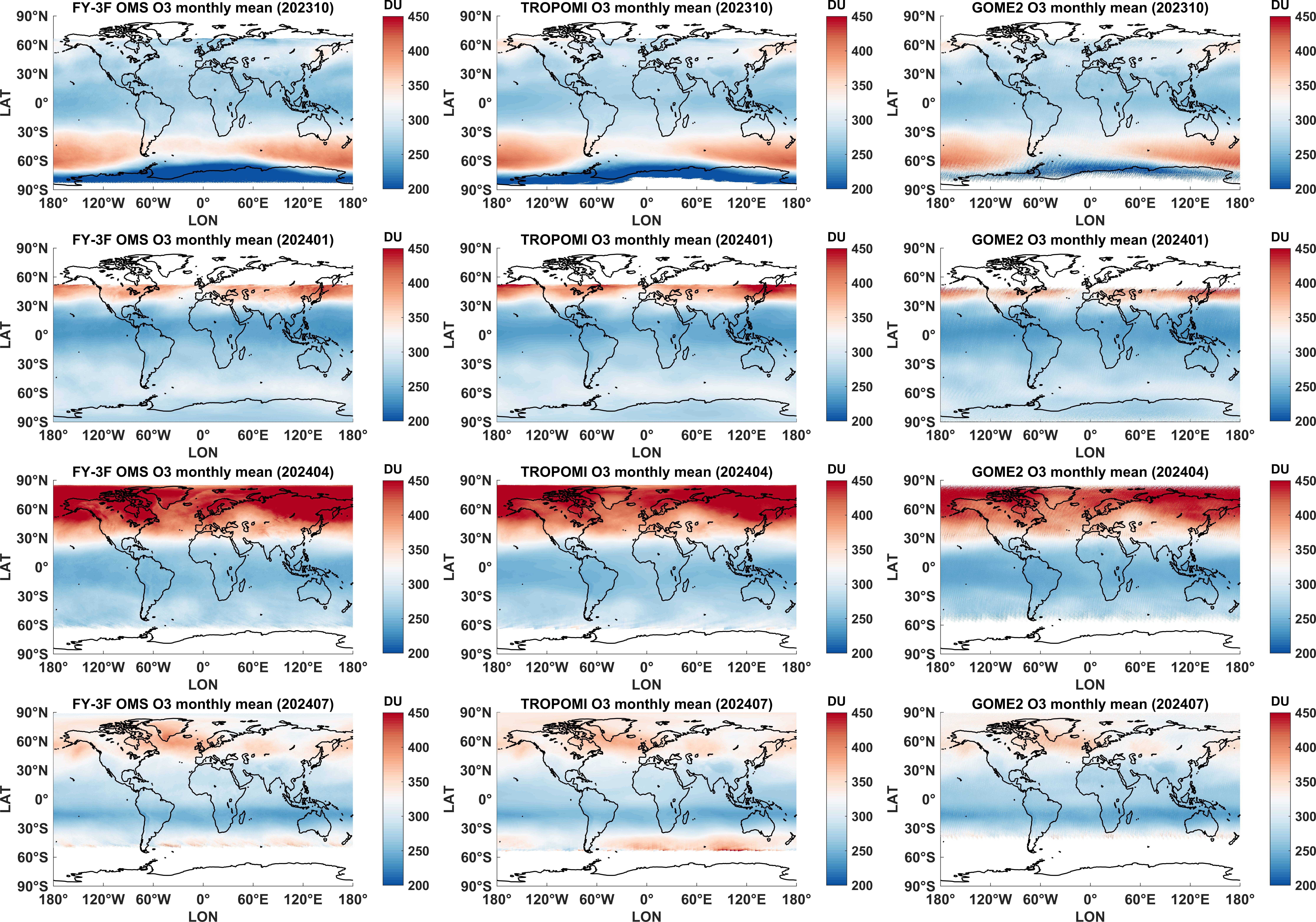
This study presents the first global total ozone column (TOC) retrievals from the Ozone Monitoring Suite–Nadir (OMS-N) onboard China’s FengYun-3F satellite, launched in August 2023. Designed for morning-orbit observations, OMS-N provides global TOC measurements at an unprecedented spatial resolution of 7 km × 7 km, enabling improved characterization of ozone variability from regional to global scales.

A physically consistent retrieval framework was developed and applied to OMS-N measurements, and the resulting TOC products were systematically evaluated using multiple independent datasets. Validation against 33 quality-assured ground-based stations shows strong agreement, with correlation coefficients exceeding 0.9 for most sites. Inter-satellite comparisons with established ozone products from TROPOMI and GOME-2B further confirm the reliability of OMS-N, with global mean biases typically within 2% across different seasons and hemispheres.
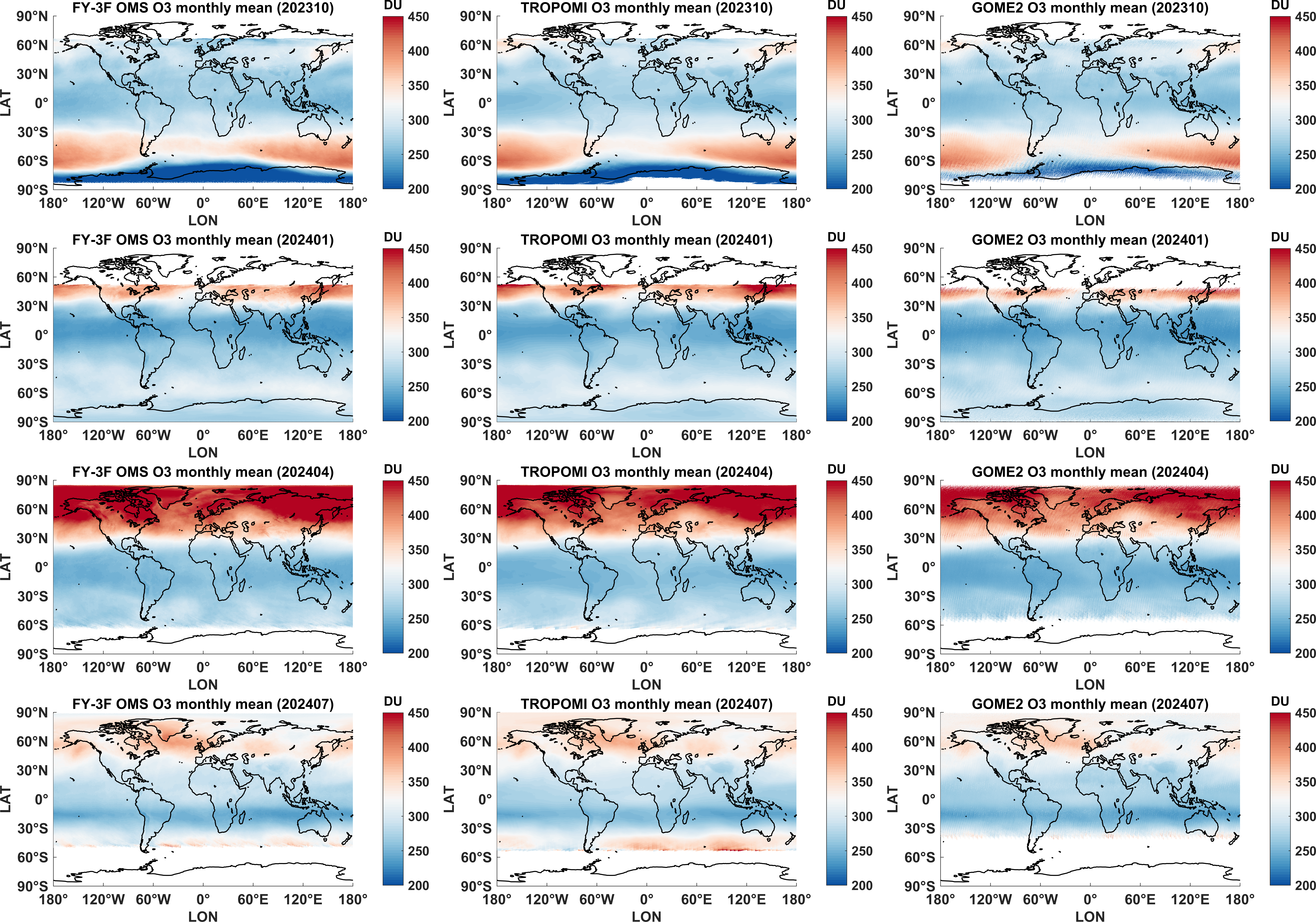
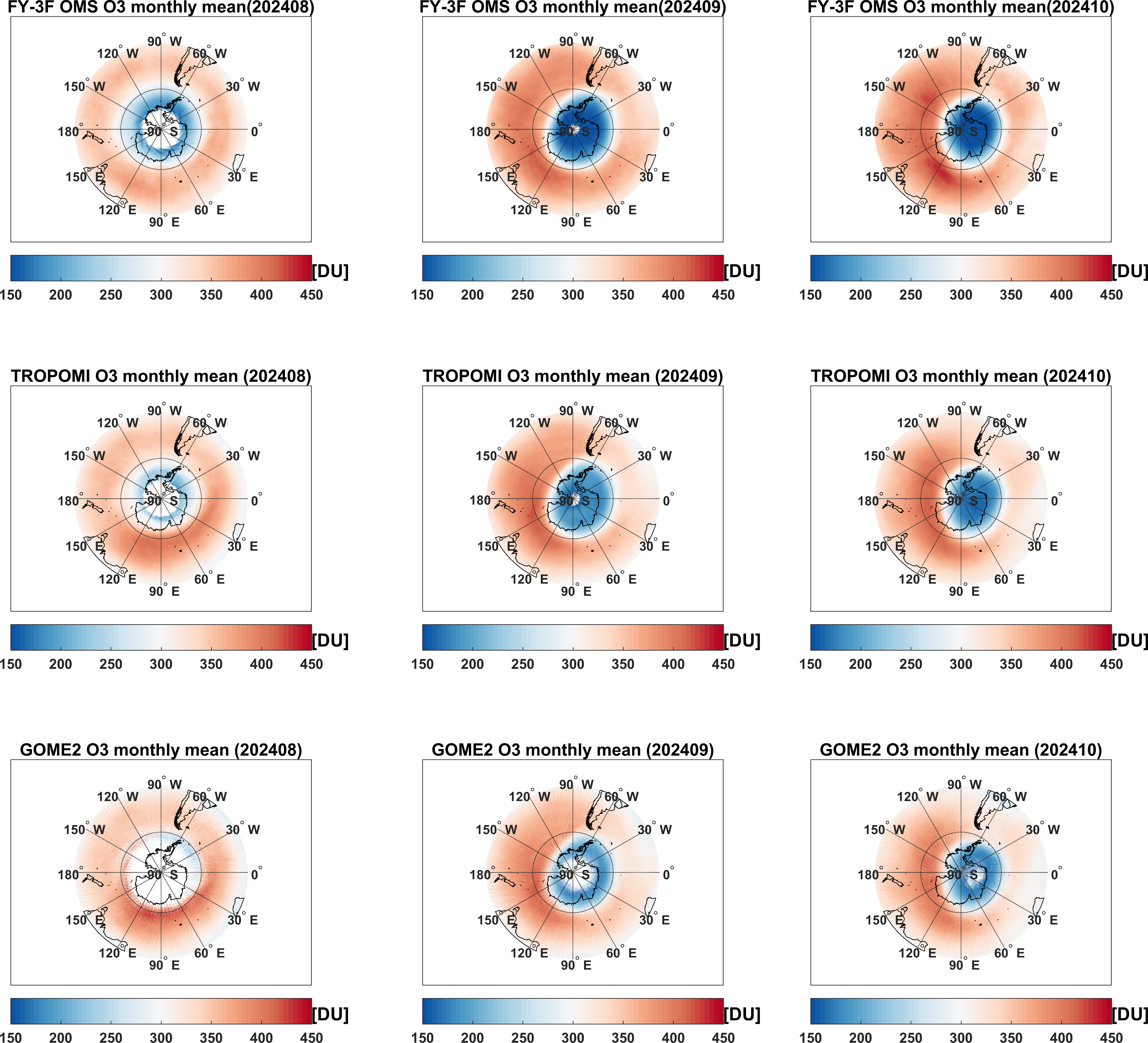
The OMS-N observations successfully capture large-scale seasonal ozone patterns as well as key features in high-latitude regions, including Antarctic ozone depletion events. These results demonstrate that OMS-N is ready for operational, high-resolution ozone monitoring and can provide valuable support for atmospheric composition studies, climate research, and long-term ozone assessments.
Please sign in or register for FREE

If you are a registered user on Research Communities by Springer Nature, please sign in

Follow the Topic

Atmospheric Science
Physical Sciences > Earth and Environmental Sciences > Earth Sciences > Atmospheric Science
Remote Sensing/Photogrammetry
Physical Sciences > Earth and Environmental Sciences > Geography > Geographical Information System > Remote Sensing/Photogrammetry