A Quantum Checkerboard

Introduction
In some low-dimensional quantum systems, charge transport can exhibit discrete, quantized characteristics set by fundamental physical constants, such as the conductance quantum e2/h or the magnetic flux quantum h/2e that emerges in superconducting systems [1-3]. These quantization phenomena form an essential foundation of modern quantum metrology and are also expected to provide material building blocks for fields such as quantum computing. However, to date, condensed-matter systems that display quantized physical quantities remain relatively rare, being largely limited to phenomena such as the quantum Hall effect and the ac Josephson effect. Exploring physical systems with novel forms of quantization is therefore not only of fundamental significance to physics, but also offers new avenues for applications such as quantum metrics.
Out collaborative team, Shanxi University, NIMS Japan, Liaoning Academy of Materials, Hefei High Magnetic Field Laboratory CAS, and Wuhan University, have recently discovered a new quantization mechanism of the ratio between electric displacement field and magnetic field (D/B) in large-angle twisted bilayer graphene (LA-TBLG). By exploiting this quantized ratio, we observed quantized checkerboard patterns at Landau-level crossing, and proposed a new principle for magnetic sensors operating in cryogenic and high-magnetic-field environments.
Experimental results
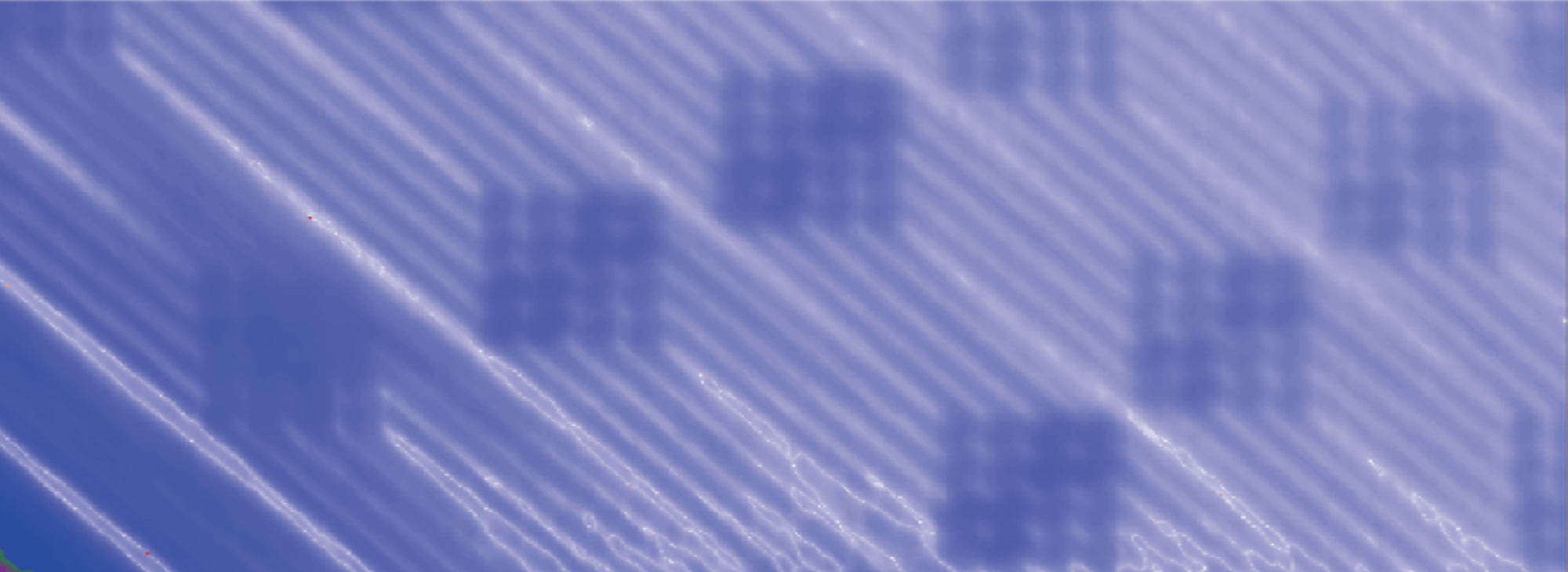
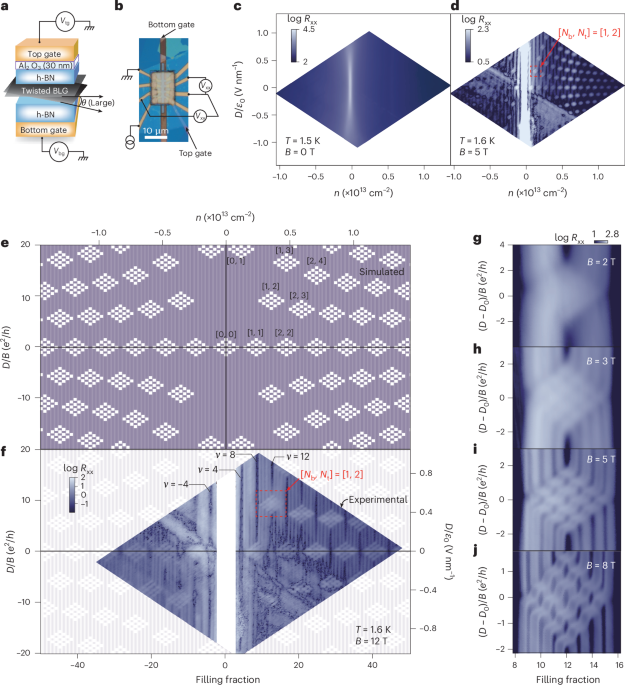
We fabricated high-quality large-angle (20°–30°) twisted bilayer graphene devices encapsulated by hexagonal boron nitride using mechanical exfoliation and dry-transfer techniques (Fig. 1a–b). Under strong magnetic fields, this system exhibits a distinctive weak interlayer coupling [4]. When tuning the vertical electric displacement field (D) and the carrier density (n), the Landau-level crossings form a uniform 4×4 “Checkerboard”–shaped patterns in longitudinal resistance in the D–n parameter space (Fig. 1c–d). These unique equal-sized checkerboard features originate from an electric-field-driven interlayer charge-transfer phase transition: at the Landau-level crossings, a vertical electric field drives charge transfer between Landau orbits in the upper and lower graphene layers. Such charge-transfer mechanism under Landau-level confinement thus leads to the quantization of the ratio between critical displacement-field spacing (δD), whose value equals e/2πlB2, where lB=sqrt(ℏ/eB) is the magnetic length.
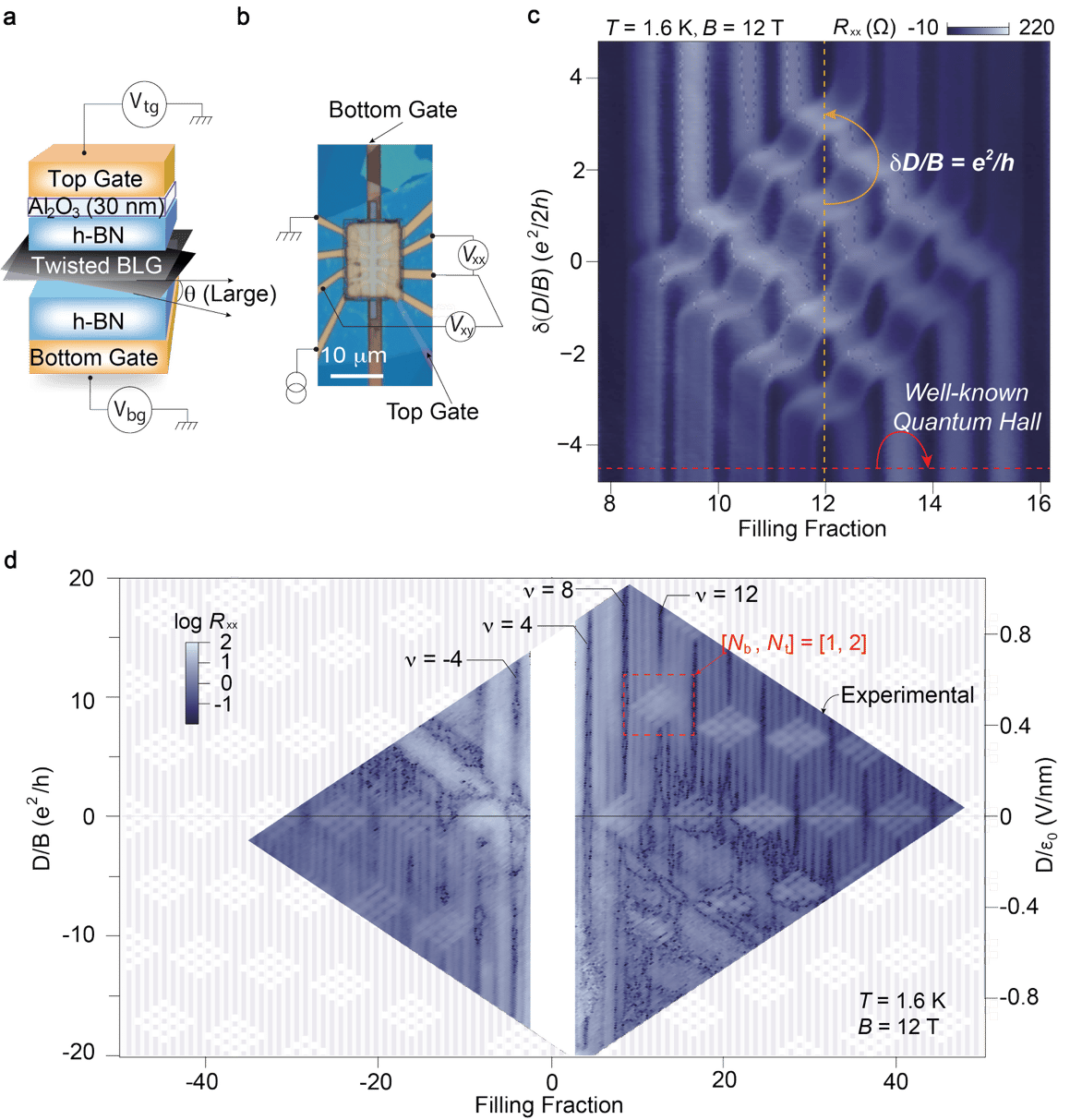
Experiments show that this quantized feature remains robust in magnetic fields as high as 30 T (can in principle be even higher). By fitting and analyzing the resistance peak positions at different magnetic fields, the team verified that the quantized value of δD/B remains close to e2/h over a wide magnetic-field range. On this basis, we further proposed a new cryogenic magnetic sensing scheme (Fig. 2), which exploits the linear relationship between the magnetic field B and the critical displacement-field spacing δD, whose slope is given by the von Klitzing constant RK=h/e2.
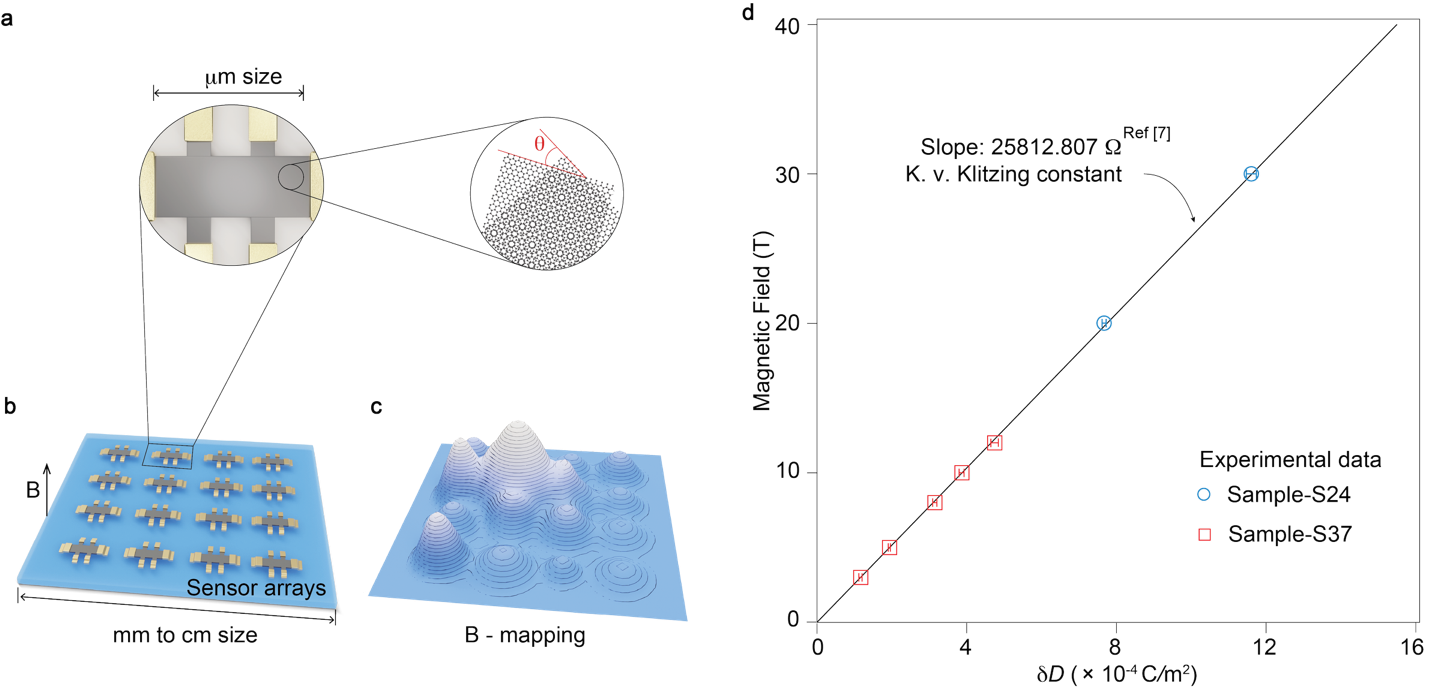
Figure 2. Schematics of an array of such devices for future spatial mapping of high magnetic fields.
By simply measuring the spacing of the quantized “Checkerboard” patterns (Fig. 2d), the magnetic field strength B can be directly inferred. In principle, this sensor offers high spatial resolution (Fig. 2a–c) and is expected to serve as a new-type of magneto-meter for cryogenic and high-magnetic-field environments, as shown in Fig. 3. Compared to nuclear magnetic resonance (NMR), another widely-used B-sensor at cryogenic temperatures (actually NMR can work at higher temperatures as well) [5-6], our method shows specific advantages for its wide range in a single device, as well as potentially high spatial resolutions.
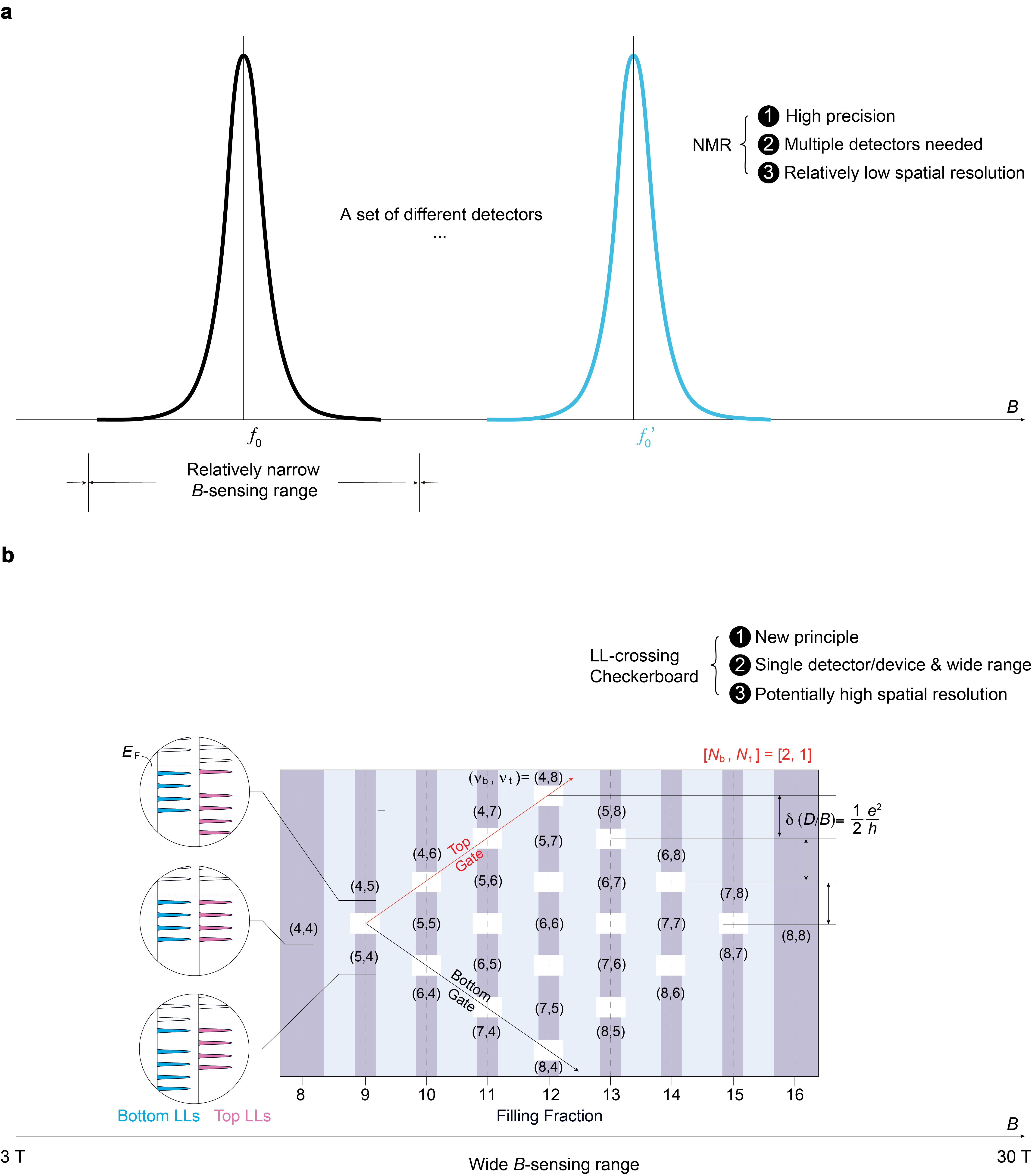
Figure 3. Comparison between conventional NMR method and our method, for B-sensing at low temperature and high magnetic fields.
For more details, please see the original version of the manuscript in Nature Sensors
https://www.nature.com/articles/s44460-025-00018-8
References:
[1] Shapiro, S. Phys. Rev. Lett. 11, 80–82 (1963).
[2] Klitzing, K. v. Phys. Rev. Lett. 45, 494–497 (1980).
[3] Haldane, F. D. M. Phys. Rev. Lett. 61, 2015–2018 (1988).
[4] Sanchez-Yamagishi, J. D. et al. Phys. Rev. Lett. 108, 076601 (2012).
[5] Guo, T., He, W., Wan, C., Zhang, Y., & Xu, Z. Sensors, 23(10), 4663. (2023).
[6] Jang, J. Y., et al. IEEE Transactions on Applied Superconductivity, 28(3), 1-5. (2018).

Follow the Topic
-
Nature Sensors
Publishing fundamental, applied, and engineering research across the full spectrum of sensing technologies, spanning biological, computational, engineering, and systems domains.