A Simple Rule for Surviving a High Daily Email Load
Published in Education
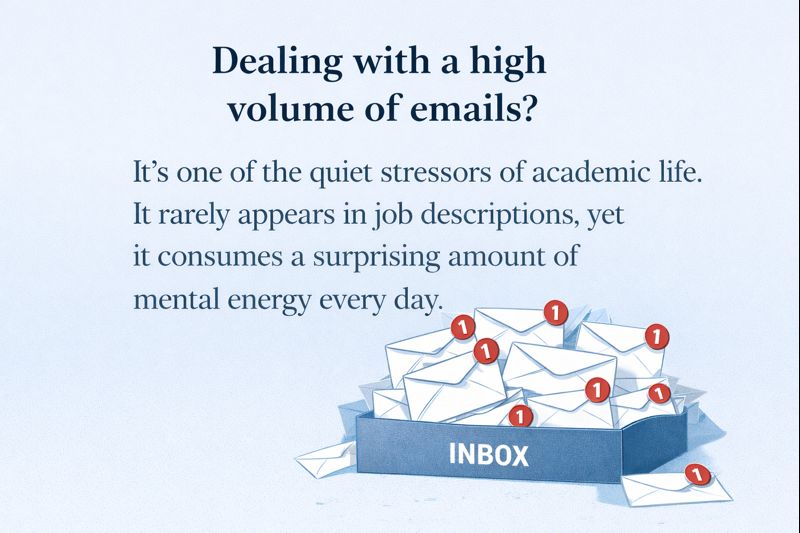
Over time, I realised that the problem was not only the number of emails, but how I related to them. Every message felt personal, urgent, and demanding, even when it wasn’t.
A simple rule helped me regain control.
Role or person?
When an email arrives, I now ask myself one question:
Is this email addressed to my role, or to me as a person?
-
If it is about my role (professor, editor, committee member, coordinator):
I reply in a standardised way, efficiently and without emotional involvement. -
If it is about me as a person (a genuine question, a request for advice, a thoughtful exchange): I consciously decide if and when to respond.
That’s it. No complex system. No productivity app.
Why this works
This small distinction creates distance where distance is needed, and intention where intention matters.
By separating role-based obligations from personal communication, the emotional and mental load drops significantly, in my experience, by 20–30%. Emails stop competing equally for attention, and decisions become clearer and calmer.
Not every message deserves the same cognitive space.
Sometimes, surviving academia is less about doing more, and more about deciding what deserves you.

I am a wood scientist and professor at the University of Torino (Italy). My research explores wood anatomy, ecology, and conservation, linking plant biology, dendrochronology, and cultural heritage studies. I’m interested in how wood structure reveals growth conditions, species identity, and material history, from living trees to ancient objects.


