A small ring with a big role: turning cyclopropanol into a controllable tool for bioconjugation
Published in Chemistry and Cell & Molecular Biology






When we started this project, we were driven by a deceptively simple question:
Can we control chemical modification of proteins with both spatial and temporal precision?
For decades, chemical biologists have developed increasingly selective methods to modify proteins in complex biological systems. Bioorthogonal chemistry has transformed the field by enabling reactions that proceed with remarkable chemoselectivity while minimally perturbing native biological functions. Yet selectivity is only part of the challenge. Ideally, we would like to control not only which protein is modified, but also when and where the modification occurs.
This is why electrochemistry caught our attention: electricity can be switched on and off at will.
Unlike conventional catalysts or oxidants, electrochemistry uses electrical potential as a clean and tunable reagent, generating reactive intermediates only when the appropriate voltage is applied. Inspired by the pioneering work of Gouin and co-workers(J. Am. Chem. Soc. 2018), who demonstrated electrochemical bioconjugation through selective tyrosine modification using urazole reagents, we wondered whether electrochemistry could be combined with an even smaller chemical handle for protein modification.
That question led us to cyclopropanol (CPol).
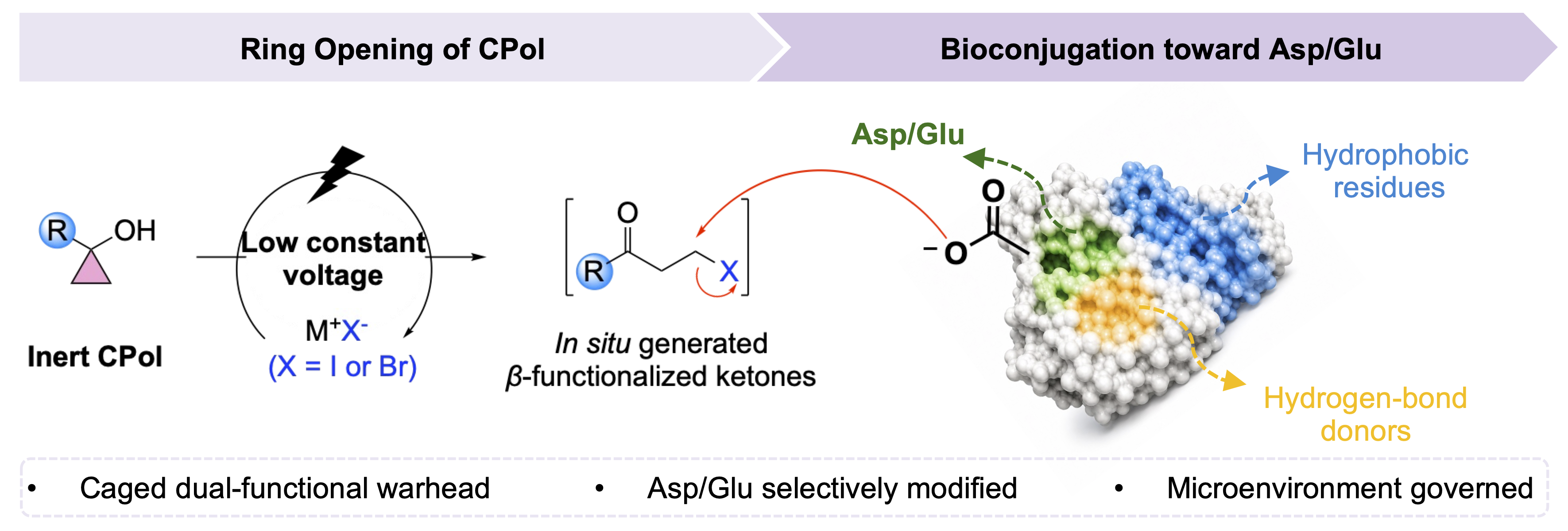
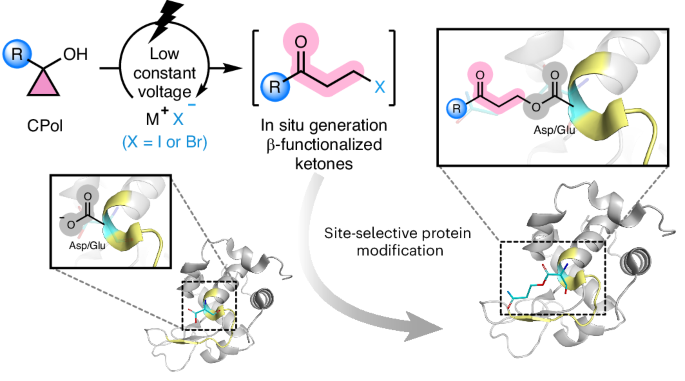
A simple molecule. CPol is deceptively simple. Its three-membered ring stores substantial strain energy, making it an attractive precursor to reactive intermediates. Earlier work by the Flowers group (Org. Lett. 2007) showed that strong oxidants, such as cerium ammonium nitrate, can trigger CPol ring opening through a single-electron-transfer process to generate electrophilic β-haloketones. These products are particularly attractive because they are dual-functional: they can react with biomolecules while retaining a ketone handle for subsequent labeling.
We wondered whether electrochemistry could achieve the same transformation under much milder conditions.
Our original hypothesis seemed straightforward. Because tyrosine has one of the lower oxidation potentials among the common amino acids, we anticipated that electrochemical oxidation would first generate a tyrosyl radical. This radical, we thought, would initiate CPol ring opening and ultimately lead to tyrosine modification.
The reaction had other ideas. Under mild electrochemical conditions in aqueous solution, CPol barely reacted with tyrosine derivatives. Ring opening occurred only after bromide or iodide salts were added. Then came the much bigger surprise: instead of tyrosine, mass spectrometry consistently revealed modification of aspartate (Asp) and glutamate (Glu) residues in peptides treated with CPol and bromide or iodide salts.
This was unexpected. Asp and Glu are generally regarded as weak nucleophiles and are rarely considered ideal targets for selective bioconjugation. Yet experiment after experiment gave the same answer. The chemistry was clearly going somewhere we had not planned.
Looking for an explanation. To understand what was happening, we simplified the system. If Asp and Glu were intrinsically reactive under our conditions, then their corresponding small-molecule analogues should also react. But they did not. Under identical electrochemical conditions, no conjugation occurred. Product formation required much harsher conditions and pre-activated electrophiles, suggesting that the intrinsic reactivity of isolated Asp or Glu could not explain what we observed in peptides.
We therefore looked back at the proteins.
As we expanded the study to larger biomolecules, the same selectivity appeared again. More intriguingly, the modified Asp/Glu residues were consistently located in local environments enriched in hydrogen-bond donors and hydrophobic amino acids. For us, this observation became the turning point of the project.
When proteins decide the chemistry. The most exciting outcome of this work was not simply the development of a new small electrochemical warhead. It was the realization that the protein microenvironment appears to govern the selectivity of CPol bioconjugation.
Many bioconjugation strategies begin with the question: Which amino acid is intrinsically reactive enough to be modified? Our findings suggest a different perspective: Which local protein environments can enable an otherwise weakly reactive residue to become chemically competent?
In other words, the protein is not merely the substrate. Its local structure, neighboring residues, and microenvironment can actively shape the chemistry.
When the hypothesis is wrong. Like many research projects, the published paper tells a much cleaner story than the experiments themselves. Our original mechanism did not survive the first few experiments. Each new result seemed to challenge what we expected, and more than once we wondered whether we had made a mistake.
Only after repeating the experiments—and obtaining the same unexpected outcome again and again—did we begin asking a different question. Sometimes the most interesting discovery is not the reaction you planned to find, but the one that forces you to reconsider the assumptions that guided the project.
Looking forward. Electrochemistry gave us a controllable, mild way to activate CPol, but it is only one possible trigger. We are now exploring photochemical approaches as a complementary strategy for opening the strained CPol ring under biologically compatible conditions.
Light offers a particularly exciting possibility: it could provide spatial control that is difficult to achieve with bulk electrochemical activation, allowing chemistry to be initiated only in selected regions or at selected times. Together, electrochemical and photochemical activation may help turn CPol into a broader platform for studying proteins and other biomolecules in their native environments.
Ultimately, our goal is to develop reagents that do not simply seek the most reactive amino acid, but instead respond to the distinctive chemical landscape created by a folded protein.
I am a postdoctoral researcher at Scripps Research working at the interface of glycan chemical biology, cancer immunology, and cancer therapeutics. My current research focuses on understanding and modulating antitumor immune responses using innovative chemical and biological tools.
I received my Ph.D. in Chemistry from the University of South Carolina, where my research focused on organic chemistry and chemical biology.
Follow the Topic
-
Nature Chemistry
A monthly journal dedicated to publishing high-quality papers that describe the most significant and cutting-edge research in all areas of chemistry, reflecting the traditional core subjects of analytical, inorganic, organic and physical chemistry.