A tailored plant diversity strategy benefits humanity
Published in Ecology & Evolution
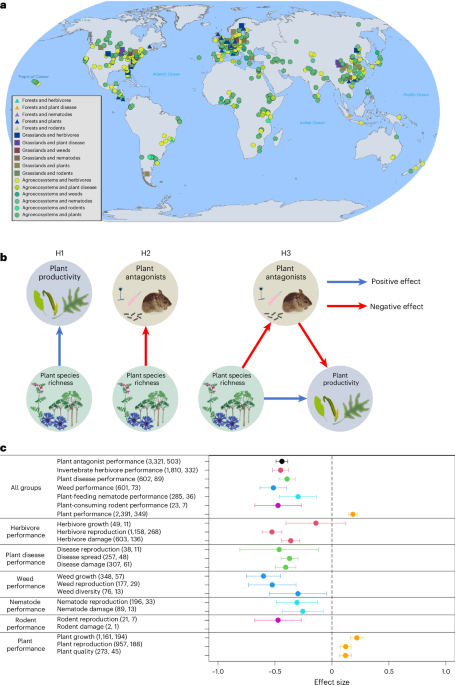

The classic "biodiversity–ecosystem functioning relationships" theory posits that enhanced plant diversity directly boosts plant productivity, as demonstrated by seminal studies in Nature and Science (e.g., Nature 379, 718–720; 431, 181–184; Science 354, aaf8957). However, whether plant diversity indirectly elevates productivity by suppressing plant antagonists—insect pests, pathogens, weeds, and rodents—remained unclear. To address this, we collaborated with researchers from 18 institutions across nine countries (China, UK, France, Germany, Finland, Netherlands, Sweden, Switzerland, Canada). By analyzing global data from 609 experiments, they not only validated the traditional theory but also revealed that plant diversity significantly enhances productivity through antagonist suppression. This led to the proposal of the "plant antagonist hypothesis", offering a novel perspective on biodiversity's regulatory role in ecosystems.
The study, which divided terrestrial ecosystems into agricultural, grassland, and forest systems, found that plant diversity directly enhanced plant productivity in all three ecosystems. However, the indirect effect of crop diversity in agricultural systems—where it suppressed crop pests and diseases to significantly increase yield—was particularly pronounced. In contrast, grasslands and forests did not exhibit significant pest-control-mediated yield benefits.
Building on the evidence that crop diversity in agricultural systems enhances productivity through both direct and indirect pathways by suppressing pests, we categorized crop diversity planting practices into three types: intercropping, cover cropping, and sown field margins. The study revealed that intercropping and cover cropping significantly increased the yield of main crops, whereas sown field margins showed no significant yield enhancement. Moreover, intercropping exhibited a particularly pronounced indirect yield-boosting effect through pest suppression, while the other two practices lacked significant indirect benefits from pest control. These findings suggest that intercropping represents the most ideal planting model for achieving pest-suppression-mediated yield gains through crop diversity.
The study further classified plants into herbaceous and woody species, finding that plant diversity significantly enhanced productivity directly in both. However, the indirect yield gain through pest suppression was significant only in herbaceous systems, with no clear effect observed in woody plants. This suggests that diversified planting is more likely to achieve pest control-driven yield increases in herbaceous systems than in woody ones.
When categorized by climatic zones, temperate and tropical regions exhibited distinct response patterns. Data show that plant diversity directly enhanced productivity in both zones, but its indirect yield-boosting effect through pest suppression was significant only in temperate regions, not in tropical ones. This suggests that diversified planting is more effective for pest control-driven yield increases in temperate zones, offering key insights for optimizing planting strategies across climates.
The study not only deepens the classic "biodiversity–ecosystem functioning relationships" theory by revealing the regulatory mechanism through which biodiversity indirectly enhances plant productivity by suppressing pests and diseases, but also validates, based on global experimental data, the synergistic advantages of diversified cropping (particularly intercropping) in achieving both ecological pest control and yield increases. This provides differentiated technical solutions for various climatic zones and crop types in China: 1) In temperate grain-producing regions (e.g., North China Plain, Northeast China Plain, Middle and Lower Yangtze Plain), intercropping should be prioritized, optimizing spatial crop configurations (e.g., maize-soybean strip intercropping) and incorporating companion plants with specific ecological functions (e.g., nitrogen-fixing legumes or insect-repellent herbs) to boost yields and resistance in staple crops like rice, wheat, and maize. 2) In tropical regions, more adaptable rotation (e.g., rice with green manure crops like Chinese milk vetch) or integrated farming systems (e.g., "rice-fish/duck" coculture systems) should be explored to balance ecological benefits and production stability. 3) For woody crops (e.g., fruit trees, economic forests), understory intercropping with shade-tolerant species (e.g., medicinal herbs like Panax notoginseng or edible mushrooms like shiitake) or interplanting with green manure (e.g., alfalfa) can be developed, leveraging the complex canopy structure to harness biodiversity's pest-suppression potential and improve soil microenvironments, achieving both ecological and economic benefits. The widespread adoption of these tailored practices can significantly reduce pesticide reliance, enhance land-use efficiency, and provide scientific support for building a high-yield, efficient, and ecologically sound modern agricultural system, contributing to China's food security and green agricultural transformation.
References
1. Wan NF, Wang YQ, Fu L, Liu J, Woodcock BA, Hu YQ, Eskelinen A, Hector A, Loreau M, Hautier Y, Bardgett RD, Kardol P, Zuppinger-Dingley D, Fraser LH, Bullock JM, Nakagawa S, Shen S, Xin F, Shi DP, Li Z, Zhou J, Scherber C, 2026. Global evidence that plant diversity suppresses pests and prom otes plant performance and crop production. Nature Ecology & Evolution, https://www.nature.com/articles/s41559-025-02964-5
2. Wan NF, Woodcock BA, Scherber C, Wyckhuys KAG, Li Z, Qian X, 2025. Leaving synthetic pesticides behind. Science, 388: 712-713.
3. Wang YQ, Shi DP,Scherber C, Woodcock BA, Hu YQ, Wan NF, 2025. Understanding biodiversity effects on trophic interactions with a robust approach to path analysis. Cell Reports Sustainability, 2: 100362.
4. Wan NF, Fu L, Dainese M, Kiær LP, Hu YQ, Xin FF, Goulson D, Woodcock BA, Vanbergen AJ, Spurgeon DJ, Shen S, Scherber C, 2025. Pesticides have negative effects on non-target organisms. Nature Communications, 16: 1360.
5. Wan NF, Dainese M, Wang YQ, Loreau M, 2024. Cascading social-ecological benefits of biodiversity for agriculture. Current Biology, 34: R587-R603.
6. Wan NF, Fu L, Dainese M, Hu YQ, Kiær LP, Isbell F, Scherber C, 2022. Plant genetic diversity affects multiple trophic levels and trophic interactions. Nature Communications, 13: 7312.
7. Wan NF, Zheng XR, Fu LW, Kiær LP, Zhang Z, Chaplin-Kramer R, Dainese M, Tan J, Qiu SY, Hu YQ, Tian WD, Nie M, Ju RT, Deng JY, Jiang JX, Cai YM, Li B, 2020. Global synthesis of effects of plant species diversity on trophic groups and interactions. Nature Plants, 6: 503-510.

My interest is in biodiversity and ecological entomology.
Follow the Topic
-
Nature Ecology & Evolution
This journal is interested in the full spectrum of ecological and evolutionary biology, encompassing approaches at the molecular, organismal, population, community and ecosystem levels, as well as relevant parts of the social sciences.

Related Collections
With Collections, you can get published faster and increase your visibility.
Biodiversity and ecosystem functioning of global peatlands
Publishing Model: Hybrid
Deadline: Jan 31, 2027
Understanding species redistributions under global climate change
Publishing Model: Hybrid
Deadline: Dec 31, 2026