A Year of Decay and Transition
Published in Astronomy, Earth & Environment, and Mathematics

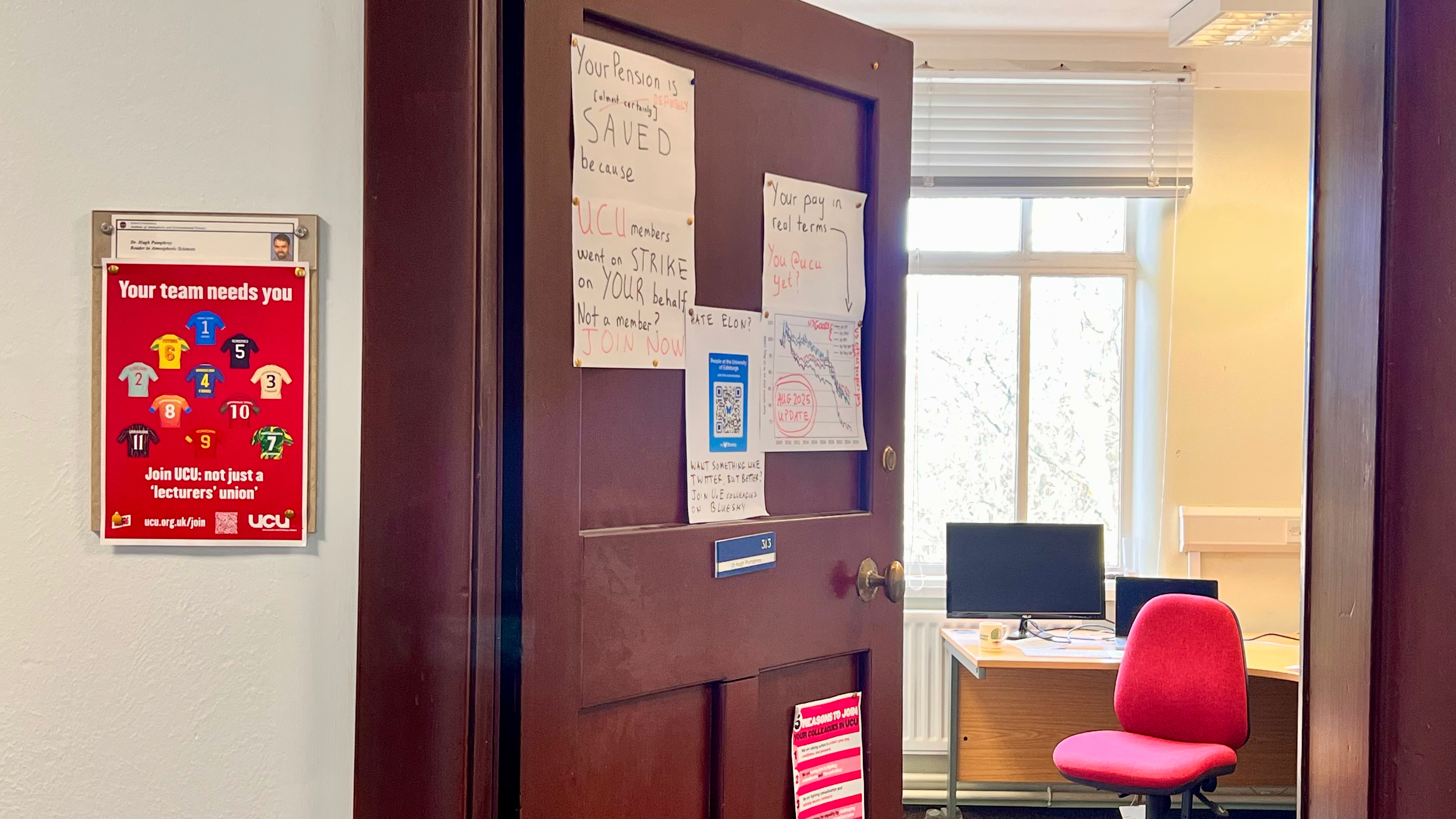

In Hugh's office
At the time of writing, I am sitting alone at a desk in the Crew Building, part of the School of GeoSciences at the University of Edinburgh. Spring is approaching, but today is another grey Scottish afternoon.
This was the office where the study was done last summer, when I was visiting Dr. Hugh Pumphrey—one of the world’s leading experts on the NASA Microwave Limb Sounder (MLS). It was only a few months ago, yet the summer of 2025 now feels distant, quietly absorbed into the shadow of Hugh’s sudden voluntary early retirement amid financial pressures at the university.
2025 Summer
Supported by a Royal Society international exchange grant, I spent three months in Edinburgh from June to August 2025. The evenings seemed endless. During the Edinburgh Festival, I cycled across the city almost every night to catch Fringe shows. It was a summer full of light.
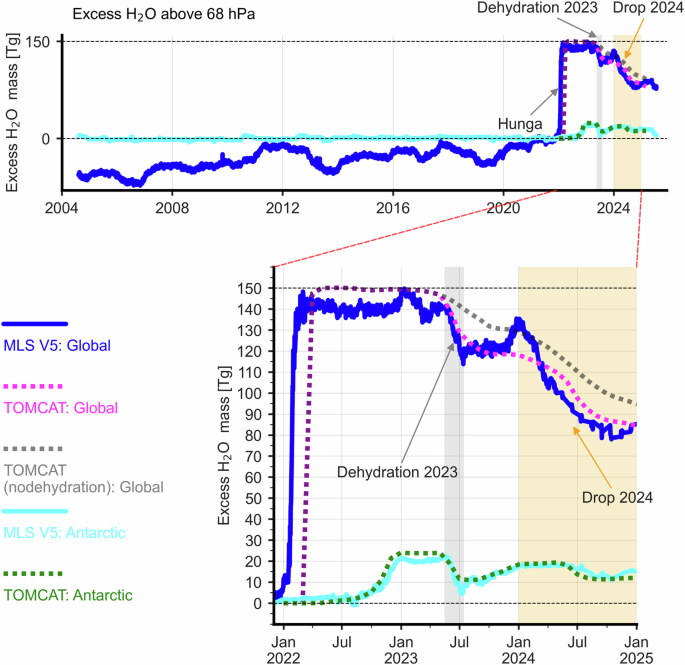
Meanwhile, MLS, which has been in orbit for over twenty years, continued delivering measurements of atmospheric trace gases, including stratospheric water vapour. As a powerful greenhouse gas, it traps outgoing longwave radiation and influences both chemistry and climate. In January 2022, the undersea volcano Hunga injected an unprecedented ~150 Tg of water vapour into the stratosphere. I first learned of the eruption while running TOMCAT simulations during a sabbatical visit to Prof. Martyn Chipperfield at the University of Leeds, where my work on Hunga water first began (Zhou et al., GRL, 2024).
Yet for two years after the eruption, the global stratospheric water burden remained essentially unchanged. That stability made it difficult to constrain the residence time of the perturbation — a key determinant of its climate impact.
Then we saw it: a sudden drop of ~55 Tg in total stratospheric water vapour mass within just one year. For the first time, the decay became clear in the satellite observations.
With that signal emerging, we were finally able to substantially reduce the uncertainty in previous estimates.
I spent the summer characterising the observed decline and interpreting it using the model TOMCAT. I shared Hugh’s office, relied on him for MLS preprocessing, and probably pestered him daily with random questions ranging from LaTeX citations to suspicious spikes in the data.
At one point in the manuscript, there was even a placeholder entry labelled “Hugh”, where he drafted the MLS data description and key references. We abbreviated “Hunga Excess Water” as HEW — a shorthand that, not entirely unintentionally, carried the sound of Hugh through the manuscript. The journey to publication felt remarkably smooth and joyful.
We quantified the residence time of the Hunga water perturbation to be around nine years, implying that its climate influence could persist through the end of this decade. The excess water is now descending into the lower stratosphere, where its removal is increasingly dominated by stratosphere–troposphere exchange, overtaking Antarctic dehydration as the primary long-term sink.
2025/2026 winter
After submission, I returned home, already discussing with Hugh plans for another visit in the winter of 2025/2026. The financial situation at the University of Edinburgh was uncertain, but Hugh’s early retirement was the last thing I expected.
Things changed quickly.
My current visit coincides with his retirement symposium. It was a warm and deeply moving event. Martyn, whom I had first visited in Leeds when the Hunga story began for me, recalled their days together at Jesus College, Cambridge, forty years ago. Prof. Ruth Doherty presented collaborative work led by their co-supervised PhD student, Emma Sands. Nathaniel Livesey, the principal investigator of MLS based at NASA JPL, reflected on Hugh's foundational contributions. Friends and collaborators joined from around the world. His commitment to science and education was evident in every talk.
Now, I am sitting again at the same desk, but alone.
MLS continues to make measurements. The Hunga water continues its slow decay. Science moves forward steadily and quietly. What remains with me from that summer is not only a tighter constraint on the residence time of Hunga water, but the example of intellectual generosity, patience, and quiet dedication. Some perturbations decay on timescales we can quantify. Others leave traces that last much longer. Whatever comes next, I will carry that with me.
Further information
To find out more about this work, have a look at our paper: DOI: 10.1038/s43247-026-03216-5
(available to read here: https://doi.org/10.1038/s43247-026-03216-5)
Follow the Topic
-
Communications Earth & Environment
An open access journal from Nature Portfolio that publishes high-quality research, reviews and commentary in the Earth, environmental and planetary sciences.

Related Collections
With Collections, you can get published faster and increase your visibility.
High-resolution modeling for Earth system
Publishing Model: Open Access
Deadline: Feb 07, 2027
Soil microbiomes and carbon sequestration under global change
Publishing Model: Hybrid
Deadline: Mar 18, 2027


