From Spins in Diamond to Spins in Proteins
Published in Physics and Protocols & Methods



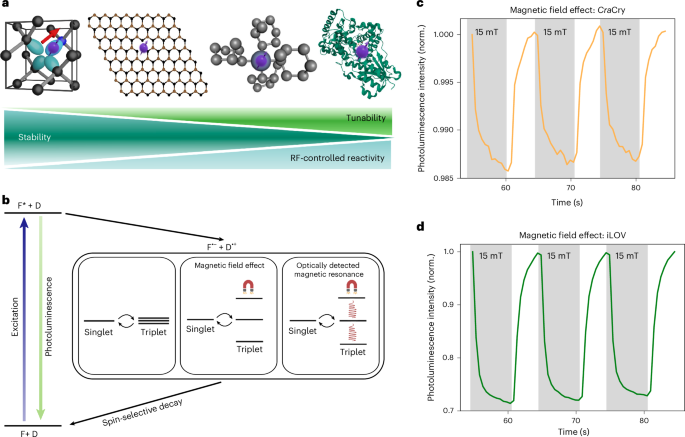

This story actually began long before the paper itself—during my PhD. Back then, I was working on a side project probing the structural dynamics of the protein cryptochrome using infrared spectroscopy. That was also when I first met Erik Schleicher. The project was interesting, but it did not make it to publication at that time. Eventually, I moved on, changed research fields, and built my own research group around optically addressable spin systems in diamond for quantum sensing applications. Somewhere along the way, that early work on cryptochrome simply faded into the background. I never fully realized that the system I had worked on back then was connected to what I was doing later.
Everything changed in 2023.
Our group had been working for years with nitrogen-vacancy (NV) centers in diamond -defects that host optically addressable spins and serve as powerful quantum sensors for magnetic fields at the nanoscale. The key concept behind this is ODMR, optically detected magnetic resonance, where spin transitions are read out via fluorescence. While exploring alternatives to the NV center, a fundamental question emerged: could similar physics exist outside of diamond? Could a biological system do something comparable?
The moment that question came up, the answer felt almost obvious—cryptochrome. This protein is well known for generating spin-correlated radical pairs, which are thought to play a role in sensing Earth’s magnetic field during bird navigation.
And I had worked on it before. All the pieces were there, but I had never connected them.
So I reached out to Erik. Within a short time, Erik’s PhD student Johannes Berger sent us a sample—along with a clear warning: “This is a protein. It is fragile.” For my research group, this was new territory. Coming from diamond-based systems—robust, stable, almost indestructible—we suddenly had to work with something delicate and highly sensitive.
My PhD student Kun Meng, who had been working extensively on NV centers, took on the challenge of testing whether cryptochrome could exhibit ODMR. The first hurdle was technical—we had to adapt our setup, originally designed for solid-state spin systems, to be compatible with a biological sample. The second hurdle was more fundamental: could this possibly work at all? Observing spin physics in a protein at room temperature felt, at the time, almost like science fiction.
So we tried.
And nothing happened.
We tried again. Still nothing. After a few attempts (and quite a few protein samples), skepticism set in. Most of us believed that ODMR in biological systems was simply too weak or just not possible in complex biochemical environments. The project gradually lost momentum and slipped into the background.
The turning point came from an entirely different direction.
In parallel, another project in my lab, led by Roberto Rizzato, was exploring boron nitride nanotubes, a new type of optically addressable spin system. These materials behaved in some ways similarly to NV centers, and importantly, they helped us improve and recalibrate our experimental setup for the cryptochrome. Once the setup was working reliably with these nanotubes, Kun decided to revisit the cryptochrome experiments.
With a better-calibrated system, improved sensitivity, and perhaps also a fresh perspective, we suddenly saw it—a clear but weak ODMR signal from cryptochrome.
That moment was both exciting and humbling. The physics had always been there. The chemistry had been known for years. The connection between ODMR in semiconductors and radical pairs in proteins remained hidden simply because I had not linked the two concepts for ten years, despite being aware of both.
The rest is described in the paper—the measurements, the implications. But for me, the real takeaway is different.
This project taught me how easy it is to become trapped in your own research trajectory, focusing on one field so intensely that you stop seeing connections to others—even ones you personally explored before. The key insight did not come from digging deeper, but from stepping back.
Sometimes, the most interesting discoveries are not entirely new ideas—they are old ideas, seen from a new perspective.
So if there is one lesson from this story, it is this: take a step back every once in a while. Look at your work from a different angle. Connect fields that seem unrelated. That is often where genuinely new ideas emerge.

Follow the Topic
-
Nature Biotechnology
A monthly journal covering the science and business of biotechnology, with new concepts in technology/methodology of relevance to the biological, biomedical, agricultural and environmental sciences.