Acidified Seas, Deeper Sinks? Future Carbon Burial in Mediterranean Seagrass Meadows
Published in Earth & Environment

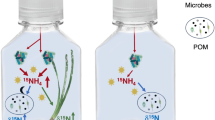

Seagrass meadows are often described as quiet climate allies. Beneath the waves, dense underwater savannas formed by the Mediterranean seagrass Posidonia oceanica slowly trap and bury carbon in the seabed, sometimes storing it for centuries or more. Because of this ability, they are considered one of the ocean’s most important natural carbon sinks.
But a key question remains unanswered: what happens to carbon burial as the ocean itself changes?
What happens when the ocean changes?
As atmospheric CO₂ rises, the ocean absorbs a large fraction of it, increasing the acidity of seawater – a process known as ocean acidification. While seagrasses are expected to experience these changes everywhere in the coming decades, predicting their response is difficult. Laboratory experiments can only go so far, and long-term future conditions are impossible to create perfectly.
So we looked for a place where the future is already happening.
A rare window into the future ocean
In the coastal areas surrounding the volcanic island of Ischia, Italy, CO₂ naturally seeps through the seafloor. These CO₂ vents lower seawater pH locally, creating gradients that closely resemble projected future ocean conditions. For us scientists, they offer a rare natural experiment: ecosystems living today under tomorrow’s chemistry.
Layers of carbon through time
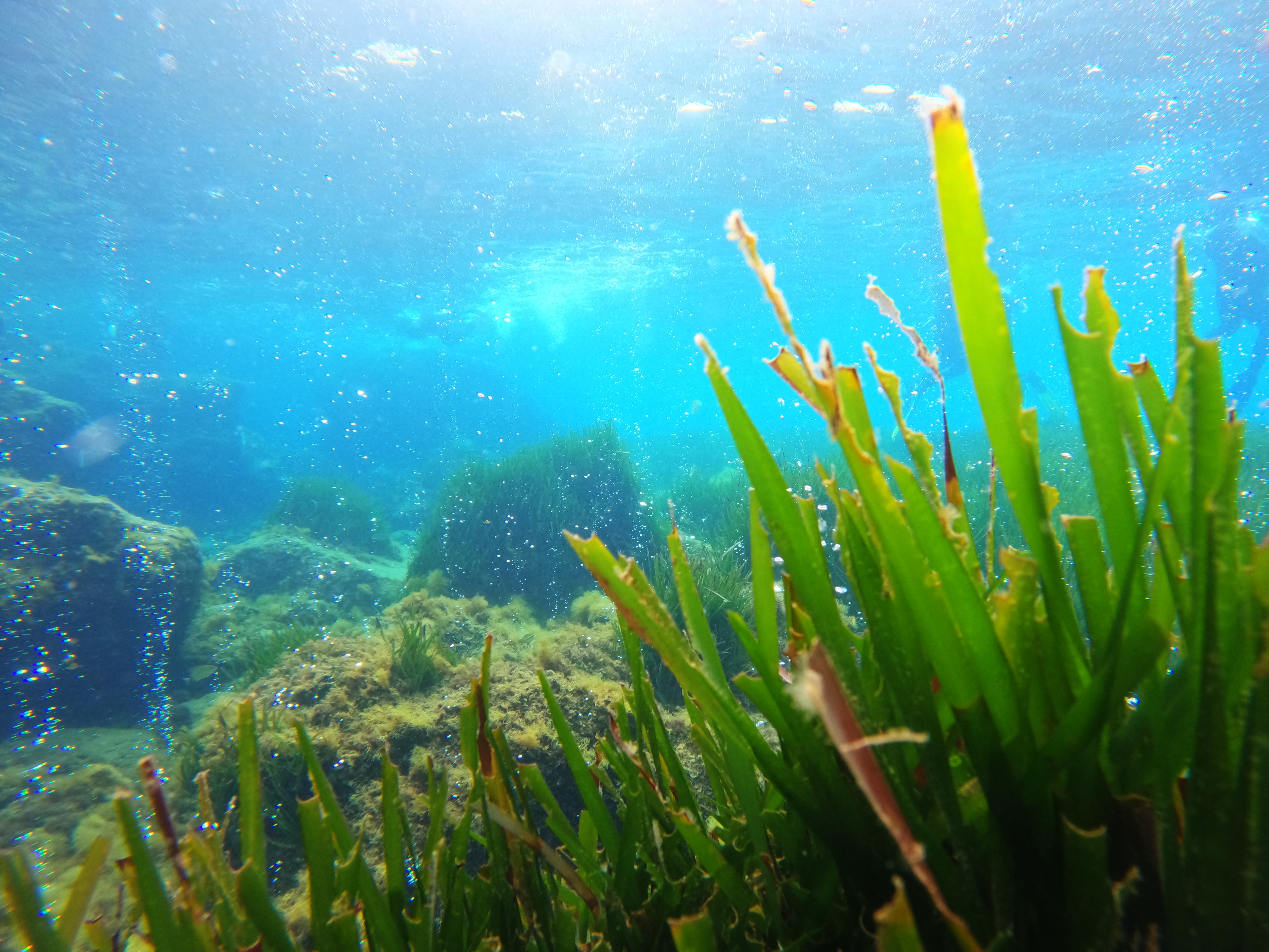
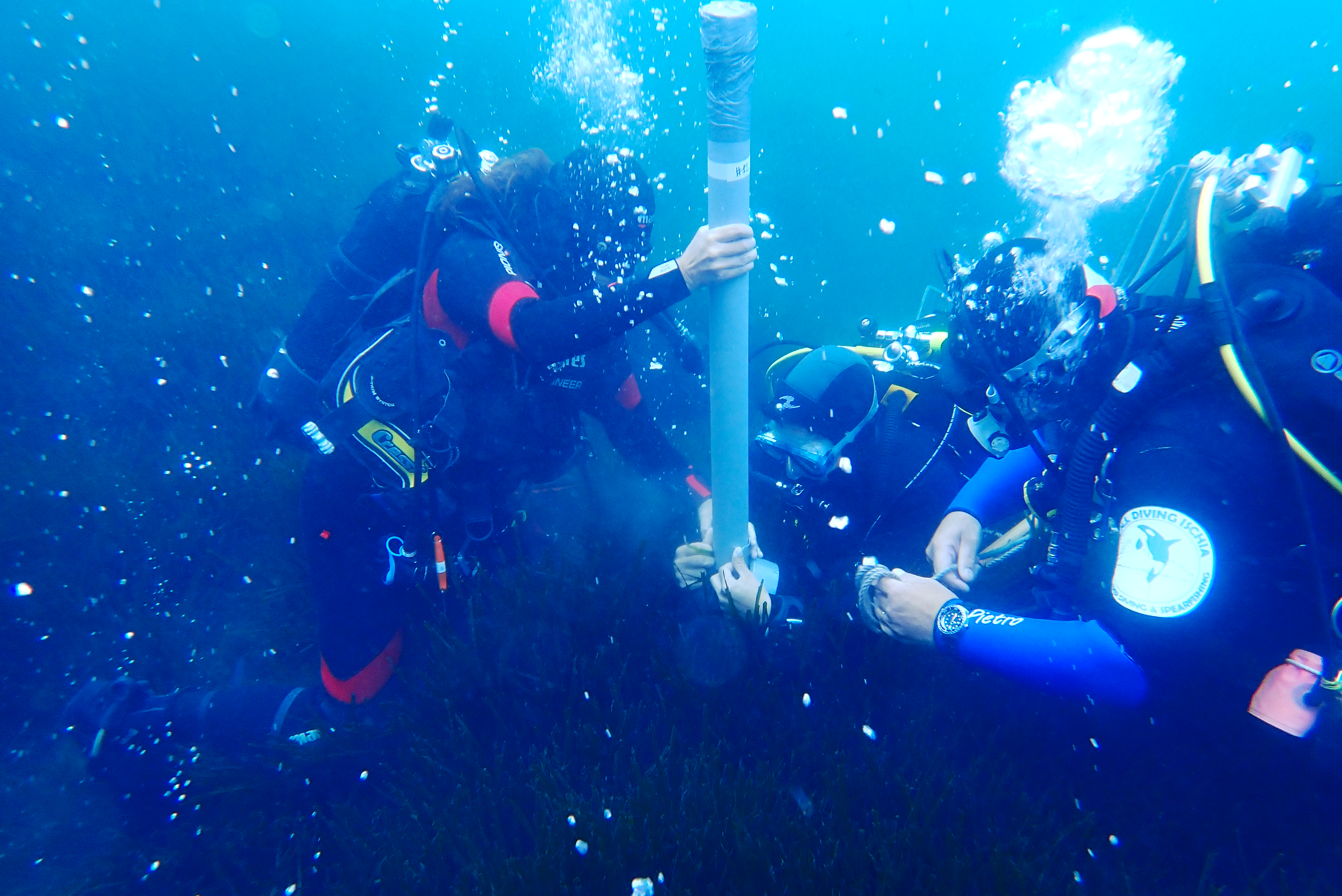
We started preparing field work after the COVID-19 pandemic, with several periods of lockdown over the previous two years. Travelling was challenging and there were many uncertainties for field work. With a team of three scientific divers and a local dive leader we set out to collect sediment cores from seagrass meadows growing under different pH conditions – from present-day seawater to higher CO2 environments representing conditions expected at the end of this century and beyond. Each sediment core acts like a time capsule, preserving layers of organic material accumulated over time. By analyzing these layers, we could reconstruct how much carbon had been buried and where it came from. Each core was like a treasure of potential information kept over time. Another part of the team simultaneously collected seagrass and algae in the same sites, making it possible to link what is growing above the sediment surface to what is found beneath.
What we expected was uncertainty. What we found was striking.
Boosted burial
Organic carbon burial – the process that makes seagrass meadows valuable for climate mitigation – increased dramatically as seawater increased in acidity. At the lowest pH sites where CO₂ venting is most intense, burial rates were seven times higher than under ambient pH conditions. Chemical signatures in the sediments suggested that shifts in the local community of primary producers – seagrass and algae – may have changed how carbon was processed and preserved in the seabed.
However, there was a catch. Sediments also accumulated inorganic carbon in the form of calcium carbonate, which can partially offset climate benefits depending on how it forms. Under present-day conditions, this inorganic carbon burial effectively cancelled out much of the CO₂ sequestration provided by organic carbon burial. Only in the lowest pH condition (pHT ≈ 6.6 – 7.2) did the seagrass meadows function as a clear net sink of CO₂.
Ocean acidification – not only a threat
These findings fundamentally alter projections of carbon burial under future climate scenarios. Ocean acidification – often perceived only as a threat – may actually boost the carbon sink capacity of some seagrass ecosystems, creating a natural negative feedback that partially counteracts climate change. At the same time, the results revealed that evaluating blue carbon ecosystems requires considering both organic and inorganic carbon processes together.
Ultimately, this study highlights how complex ecosystem responses to climate change can be. Even well-known carbon sinks such as seagrass meadows may behave differently in the future ocean than they do today – and understanding those changes is essential if we want to accurately predict their role in climate mitigation.

Follow the Topic
-
Communications Earth & Environment
An open access journal from Nature Portfolio that publishes high-quality research, reviews and commentary in the Earth, environmental and planetary sciences.

Related Collections
With Collections, you can get published faster and increase your visibility.
Climate extremes and water-food systems
Publishing Model: Open Access
Deadline: May 31, 2026
Drought
Publishing Model: Hybrid
Deadline: Jun 30, 2026


Please sign in or register for FREE
If you are a registered user on Research Communities by Springer Nature, please sign in