AD-RIDDLE: Transforming Alzheimer’s disease detection, prevention and care
Published in Neuroscience and Biomedical Research


Background
Alzheimer’s disease is one of the major health challenges facing ageing populations. Across the world, millions of people are living with Alzheimer’s disease or related dementias, and this number is expected to increase substantially in the coming decades. At the same time, research has shown that changes associated with Alzheimer’s disease can begin many years before noticeable symptoms develop.
This creates an important opportunity. If people at risk can be identified earlier, they may be able to access appropriate lifestyle interventions, monitoring, diagnosis and, where appropriate, treatments sooner.
Recent advances in digital cognitive assessments, blood-based biomarkers and personalised approaches to prevention are opening up new possibilities. The challenge now is to understand how these innovations can be used effectively, responsibly and equitably in everyday healthcare. This is where the AD-RIDDLE project comes in.
What is AD-RIDDLE?
AD-RIDDLE stands for Real-World Implementation, Deployment and Validation of Early Detection Tools and Lifestyle Enhancement.
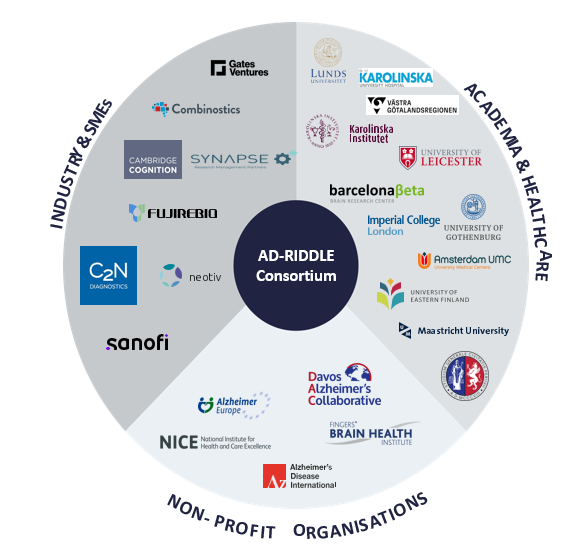
Started in 2024 with a 5-year duration, the public-private partnership brings together 27 organisations from research, healthcare, industry, patient and public involvement, regulation and policy. It is coordinated by Region Stockholm, with Miia Kivipelto as project co-lead alongside Niranjan Bose of Gates Ventures.
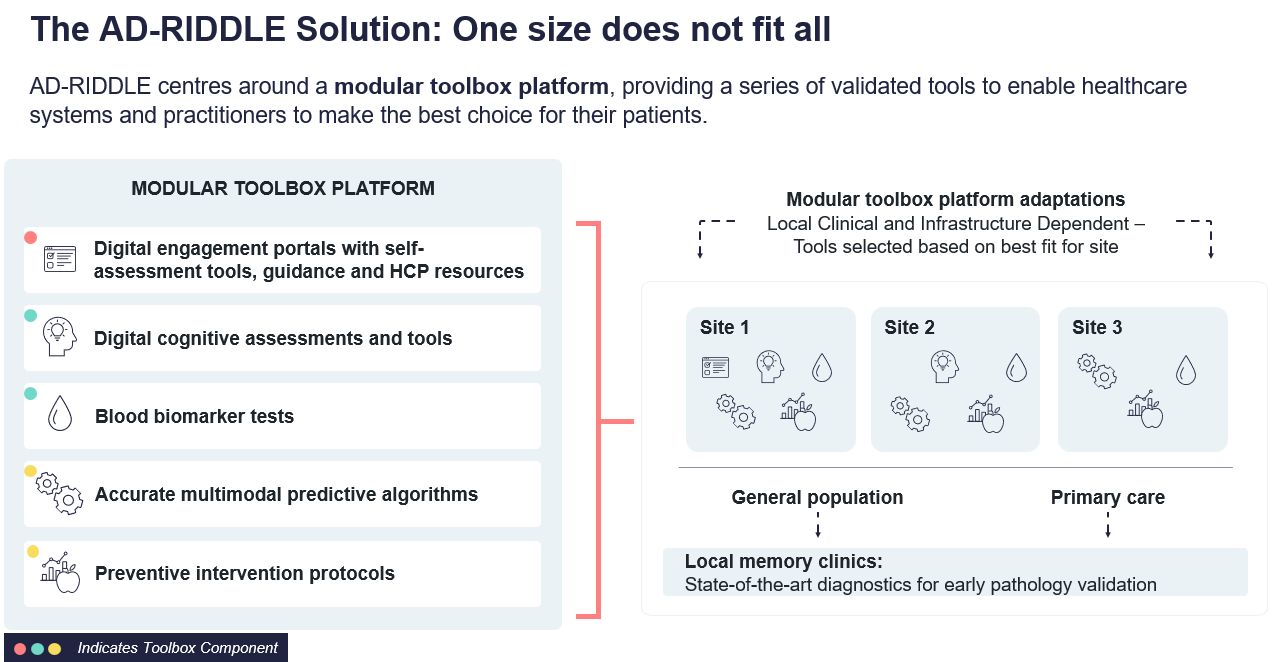
At the centre of AD-RIDDLE is the development of a modular toolbox platform designed to support different stages of the Alzheimer’s disease pathway, from raising awareness and reducing dementia risk through to early detection, diagnosis and personalised prevention and treatment.
The toolbox is expected to include:
- Educational and informational resources that can help people learn about brain health and assess their risk
- Digital cognitive assessments to support earlier detection of cognitive changes
- Blood-based biomarkers that may help identify people at risk of Alzheimer’s disease
- Clinical decision-support tools to help healthcare professionals interpret information and identify appropriate next steps
- Personalised lifestyle and treatment approaches.
The tools will be tested in real-world healthcare settings, including primary care and memory clinics, across six European countries: Finland, Italy, the Netherlands, Spain, Sweden and the United Kingdom.
What does the study aim to do?
AD-RIDDLE includes a series of harmonised real-world studies examining blood-based biomarkers and digital cognitive assessments in different populations and healthcare settings. These include people from the general population, primary care and specialist memory clinics.
An important objective is to evaluate these tools against established reference standards in memory clinic populations. Where clinically appropriate, participants may undergo established assessments such as cerebrospinal fluid analysis or positron emission tomography imaging to determine whether Alzheimer’s disease pathology is present. The project will investigate a broad range of blood-based biomarkers, with a particular focus on p-tau217-based assays, while also evaluating digital cognitive assessments.
Importantly, AD-RIDDLE does not take a one-size-fits-all approach to real-world testing. Healthcare systems and clinics have different needs, resources and preferences. Rather than requiring every site to use exactly the same combination of tools, the study allows sites to select digital cognitive assessments and blood-based biomarker options that are appropriate for their setting. At the same time, common data requirements will help ensure that findings can be compared and analysed across sites. This flexible approach will help researchers understand not only whether individual tools work, but also where, when and how they can best be integrated into different healthcare pathways. Furthermore, the project will explore new ways of combining these data through prediction modelling and exploratory biomarker research, with the aim of identifying approaches that could support more personalised early detection and improve our understanding of disease progression.
Who can participate in the study?
We are looking for volunteers aged 40 years and over. This includes both people from the general population with no known memory concerns, as well as patients attending memory clinics because of concerns about their memory or cognition. Participants should be comfortable using a smartphone, tablet or computer.
Depending on the study setting, participation may involve:
- Completing digital memory and thinking assessments on your own device or that provided to you in clinic
- Providing a blood sample to measure specific biomarkers related to brain health and Alzheimer’s disease
- Answering questions about general health, lifestyle and other factors relevant to cognitive health
- For people attending a memory clinic, undergoing routine clinical assessments such as brain imaging or lumbar puncture where these form part of their standard clinical care.
Who is funding the study?
AD-RIDDLE is supported by the Innovative Health Initiative Joint Undertaking (IHI JU) under grant agreement No. 101132933. The JU receives support from the European Union’s Horizon Europe research and innovation programme and COCIR, EFPIA, EuropaBio, MedTech Europe and Vaccines Europe, with Davos Alzheimer’s Collaborative, Combinostics OY., Cambridge Cognition Ltd., C2N Diagnostics LLC, and neotiv GmbH
“Funded by the European Union, the private members, UKRI, and the contributing partners of the IHI JU. Views and opinions expressed are however those of the author(s) only and do not necessarily reflect those of the aforementioned parties. None of the aforementioned parties can be held responsible for them.”
For further information, please visit our website: https://ad-riddle.org/
Article link: ISRCTN - ISRCTN10245911: Early detection tools for Alzheimer's disease: a multi-site observational study

Follow the Topic
-
ISRCTN: The UK’s Clinical Study Registry
A primary clinical trial registry recognised by WHO and ICMJE that accepts studies involving human subjects or populations with outcome measures assessing effects on human health and well-being, including studies in healthcare, social care, education, workplace safety and economic development.