Additive Manufacturing for Nanogenerators: Fundamental Mechanisms, Recent Advancements, and Future Prospects
Published in Bioengineering & Biotechnology and Materials
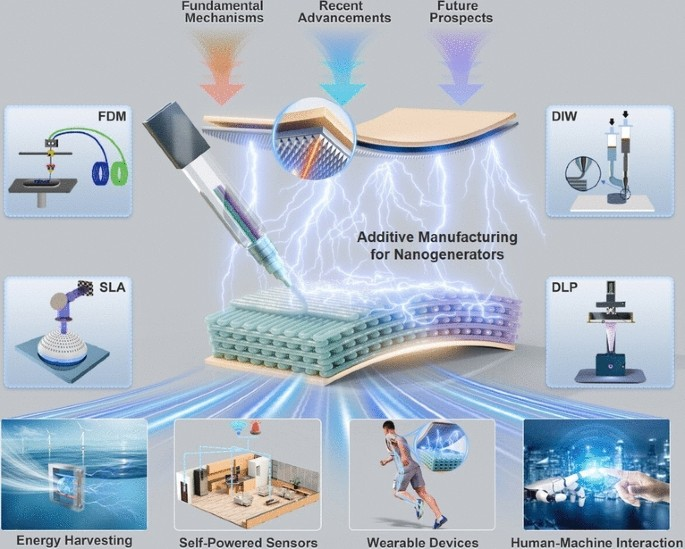
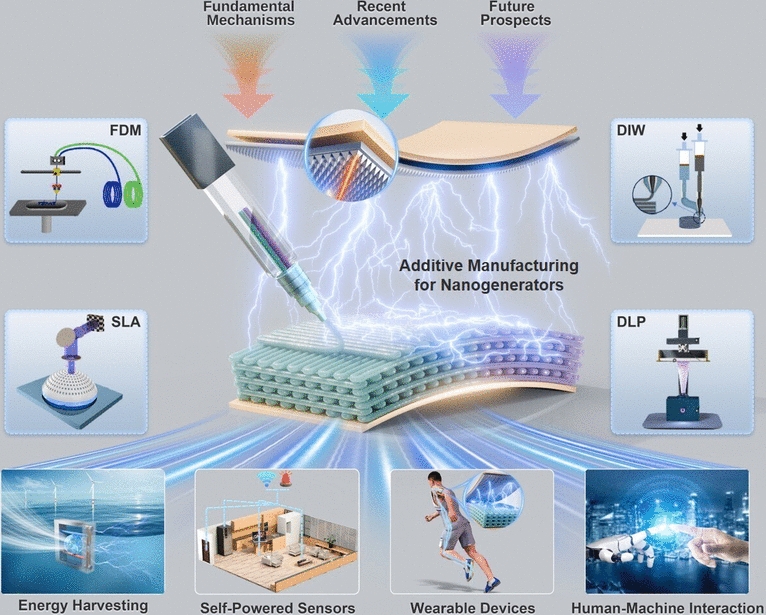

As the world shifts toward sustainable energy and intelligent infrastructure, the demand for self-powered, miniaturized, and customizable energy solutions is rapidly increasing. Now, researchers from The Hong Kong Polytechnic University, led by Prof. Gary Chi-Pong Tsui, have published a comprehensive review on additive manufacturing (AM) for nanogenerators, offering critical insights into how 3D printing is transforming the design, performance, and scalability of next-generation energy harvesters.
Why Additive Manufacturing Matters for Nanogenerators
- Customization & Flexibility: AM enables the fabrication of complex geometries and multi-material structures, allowing nanogenerators to be tailored for specific applications such as wearable electronics, smart sensors, and human–machine interfaces.
- Performance Enhancement: Through structural topology optimization, microstructure design, and material versatility, AM significantly improves key performance indicators like output voltage, current, and power density.
- Scalability & Sustainability: Compared to traditional manufacturing, AM reduces material waste, supports rapid prototyping, and offers a more sustainable path toward mass production of energy harvesting devices.
Innovative Design and Features
- AM Technologies: The review systematically examines four major AM techniques—FDM, DIW, SLA, and DLP—highlighting their working principles, material compatibility, and suitability for fabricating piezoelectric and triboelectric nanogenerators.
- Material Systems: AM supports a wide range of functional materials, including polymers, ceramics, composites, and conductive inks, enabling the integration of piezoelectric layers, electrodes, and packaging structures in a single print.
- Structural Innovation: AM allows for the creation of porous, kirigami-inspired, and bio-mimetic microstructures that enhance mechanical responsiveness, charge accumulation, and energy conversion efficiency.
Applications and Future Outlook
- Energy Harvesting: AM-enabled nanogenerators can harvest mechanical energy from sources like wind, waves, and human motion, powering LEDs, sensors, and small electronics without batteries.
- Self-Powered Sensors: These devices can autonomously monitor environmental parameters such as pressure, temperature, and vibration, making them ideal for smart infrastructure and IoT systems.
- Wearable & Implantable Devices: With biocompatible materials and flexible designs, AM-fabricated nanogenerators are paving the way for self-powered health monitors, electronic skin, and even implantable medical devices.
Challenges and Opportunities
The review also addresses current limitations, including fabrication quality, cross-scale manufacturing, processing efficiency, and industrial deployment. Future research is expected to focus on AI-driven AM, hybrid printing technologies, and sustainable materials to overcome these hurdles and accelerate the commercialization of AM-enabled nanogenerators.
This comprehensive review provides a roadmap for integrating additive manufacturing into the development of high-performance nanogenerators, emphasizing the convergence of materials science, mechanical engineering, and digital fabrication. Stay tuned for more groundbreaking work from Prof. Gary Chi-Pong Tsui and his team at The Hong Kong Polytechnic University!

Editor of Nano-Micro Letters, which is an Open-Access, peer-reviewed journal reported papers that have at least one dimension ranging from a few sub-nanometers to a few hundreds of micrometers. The journal is published by Springer Nature and indexed by SCI, EI, SCOPUS, Pubmed, etc. The 2025 JCR Impact Factor is 38.5. The 2025 CiteScore is 58.9.
Follow the Topic
-
Nano-Micro Letters
Nano-Micro Letters is a peer-reviewed, international, interdisciplinary and open-access journal that focus on science, experiments, engineering, technologies and applications of nano- or microscale structure and system in physics, chemistry, biology, material science, and pharmacy.