Advancing Energy Development with MBene: Chemical Mechanism, AI, and Applications in Energy Storage and Harvesting
Published in Chemistry, Materials, and Computational Sciences
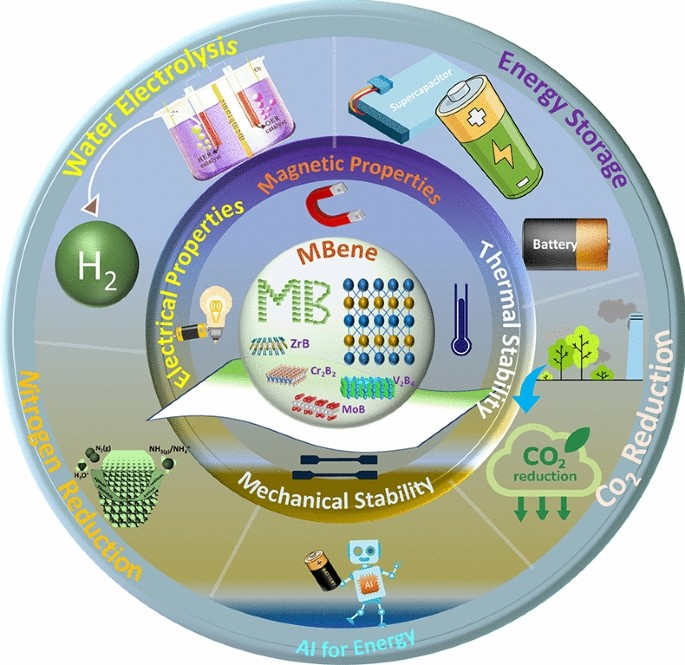
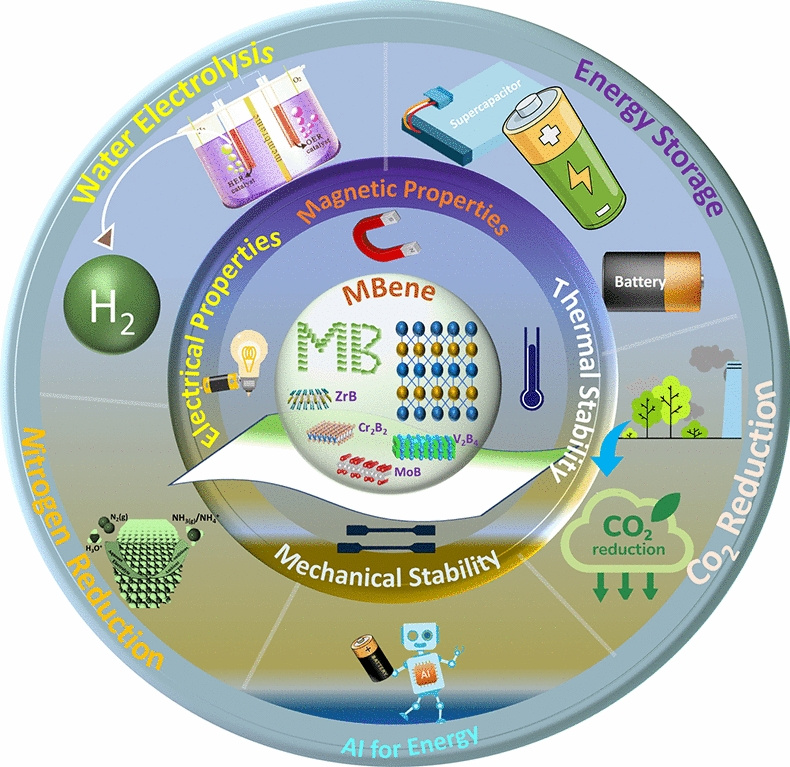

As global energy demands surge and fossil-fuel reserves shrink, next-generation 2D materials are racing to deliver ultrahigh capacity, ultrafast kinetics and rock-solid stability. Now, researchers from Henan University, Shanghai Jiao Tong University and the Chinese Academy of Sciences—led by Dr Jai Kumar, Dr Zhuanpei Wang and Prof Xiaowei Yang—have published a panoramic review on MBene, the boron-based sibling of MXene, that charts a direct route from wet-lab synthesis to AI-guided device deployment. The work offers a one-stop roadmap for harnessing MBene in batteries, supercapacitors, CO2 electro-reduction and ammonia electrosynthesis.
Why MBene Matters
• Metallic conductivity & ceramic-like robustness – 200–320 GPa Young’s modulus and 5 eV cohesive energy outclass graphene and phosphorene.
• Tunable 0–0.5 eV diffusion barriers for Li+, Na+, Mg2+, Ca2+ – enable 5 C charging without plating or dendrites.
• Boron-rich surface – delivers selective N2-to-NH3 and CO2-to-CH4 catalysis while suppressing H2 side-reactions.
• Etch-friendly MAB precursors – allow fluorine-free, NaOH-based delamination for green, gram-scale production.
Innovative Design & Features
• Structural palette: ortho-MBene, hex-MBene, tetr-Mo2B2, tri-Mo2B2 and vacancy-engineered Mo2B2-x.
• Surface terminations: –O, –S, –Cl, –Br and in-situ N-doping modulate work-function (4.2–5.1 eV) and ion affinity.
• Layer-number control: mono- to tri-layer flakes balance 450 m2 g-1 SSA vs long-cycle restacking resistance.
• Hybrid scaffolds: MBene/CNT, CoO/MBene and S-anchored MBene aerogels push areal capacity beyond 12 mAh cm-2.
Applications & Future Outlook
• Multi-metal-ion batteries: 3377 mAh g-1 (CrB4-Ca), 923 mAh g-1 (Mo2B-Mg), 797 mAh g-1 (Ti2BN-Na) and 144 mAh g-1 (MoB-Li) at ≥2 A g-1 for 1000 cycles.
• Li–S chemistry: shuttle-free 86 % retention after 1000 cycles at 15 mg cm-2 sulfur loading via B-, O-, F-active sites.
• Supercapacitors: 2006 mF cm-2 (1/24-MoAl1-xB) with 80 % retention after 5000 cycles in aqueous Na2SO4.
• CO2RR & NRR: overpotentials down to –0.13 V (CrB-NH3) and –0.45 V (MoB2-CH4) rival Cu and Ru benchmarks.
• AI acceleration: machine-learning models trained on 104 DFT data points now predict stable MAB phases and surface terminations within seconds, slashing trial-and-error by 90 %.
Challenges & Opportunities
The review pinpoints scalable CVD growth, ambient-stability coatings, in-line spectroscopic QA, and hybrid AI-robotic synthesis as the next milestones to move MBene from benchtop breakthrough to gigafactory reality.

Editor of Nano-Micro Letters, which is an Open-Access, peer-reviewed journal reported papers that have at least one dimension ranging from a few sub-nanometers to a few hundreds of micrometers. The journal is published by Springer Nature and indexed by SCI, EI, SCOPUS, Pubmed, etc. The 2025 JCR Impact Factor is 38.5. The 2025 CiteScore is 58.9.
Follow the Topic
-
Nano-Micro Letters
Nano-Micro Letters is a peer-reviewed, international, interdisciplinary and open-access journal that focus on science, experiments, engineering, technologies and applications of nano- or microscale structure and system in physics, chemistry, biology, material science, and pharmacy.