An ongoing marathon—tracing a continuing quest to understand the building blocks of musicality
Published in Behavioural Sciences & Psychology

What makes a sequence of sounds recognizable?
Think of a familiar melody played in a different key. The individual frequencies have changed, yet we can still recognize it. Something about the pattern remains. We often describe this as contour: the way a sound rises, falls, or changes across a sequence.
That simple observation led us to a larger question: is following a melodic pattern a general feature of auditory perception, or has it become especially important in humans?
Where two research paths converged
Our study grew out of a much longer conversation about musicality. Henkjan Honing and Carel ten Cate approached this question from different directions. Henkjan has a longstanding interest in the cognitive and biological foundations of musicality and what comparative research might reveal about its origins. Carel has spent years studying how birds learn and discriminate sounds, be it their own vocalizations or other sounds.
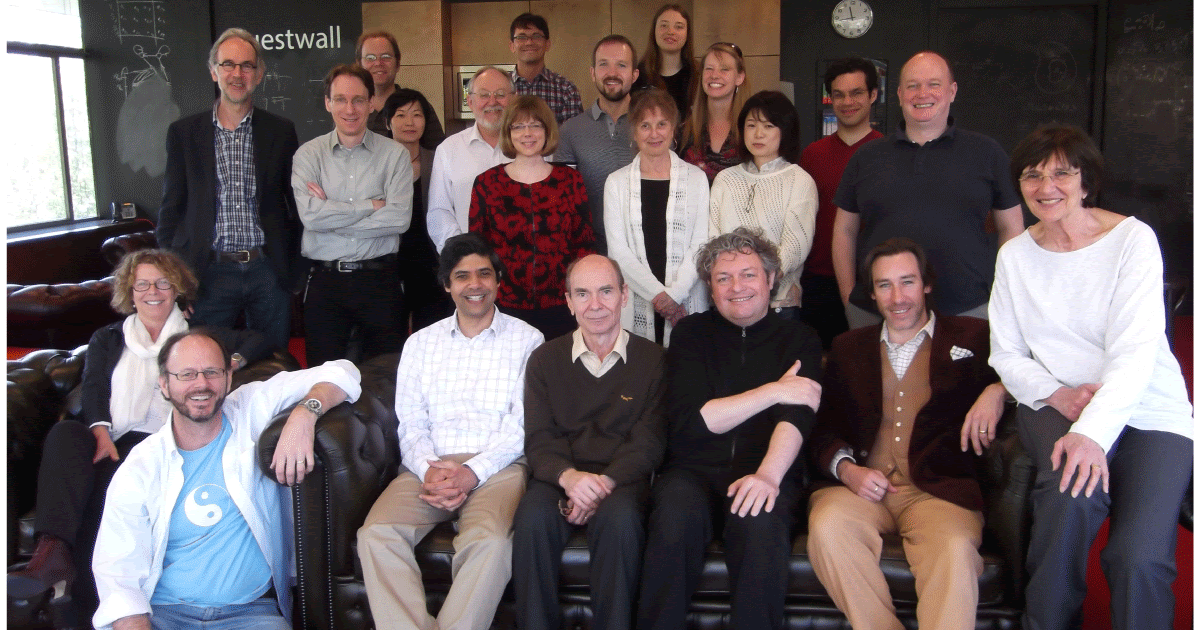
Their interests came together around a simple idea: rather than asking whether animals “have music”, we could break musicality into smaller capacities and ask which of them are shared across species. That perspective became a major theme of the 2014 Lorentz Center workshop in Leiden and the subsequent research programme on the cognitive, biological and evolutionary foundations of musicality. The programme emphasized studying constituent abilities in both humans and non-human animals.
From rhythm to spectral contour
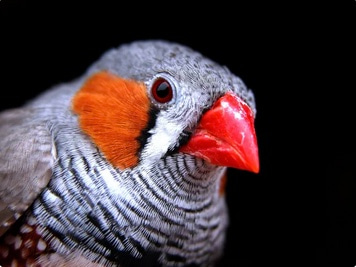
One of the first topics of this comparative approach was rhythm. In 2015, Henkjan and Carel compared zebra finches and humans using the same auditory sequences. The birds could distinguish regular from irregular patterns, but unlike humans, they did not readily generalize that regularity when the tempo changed. The result suggested that the two species could solve the same task while relying on different aspects of the sequence.
The question did not end there. Further work compared zebra finches with budgerigars and found a more nuanced picture: birds often relied on local temporal features, but some individuals also showed sensitivity to broader rhythmic structure. Rather than revealing a single “bird” strategy, the experiments pointed to variation both between and within species.
Henkjan later described this period in his book The Evolving Animal Orchestra, including his visits to Carel’s laboratory in Leiden and the discussions that eventually became their rhythm experiments. He recalls visiting the lab in October 2012, seeing the zebra finches and the experimental set-up, and discussing with Carel how to design the rhythm experiment. He also describes the later surprise when the zebra finches failed to generalize regularity across tempo changes. Reading his account, one gets a sense of how the research programme actually developed: through conversations, experiments, surprises and new questions, rather than from a fixed plan.
That way of thinking about comparative perception became important to my own work. During my PhD with Carel at Leiden, I became interested in what zebra finches actually use when they recognize an auditory sequence. My earlier experiments examined spectral and temporal features, and increasingly I wanted to know how individual features become part of a larger pattern.
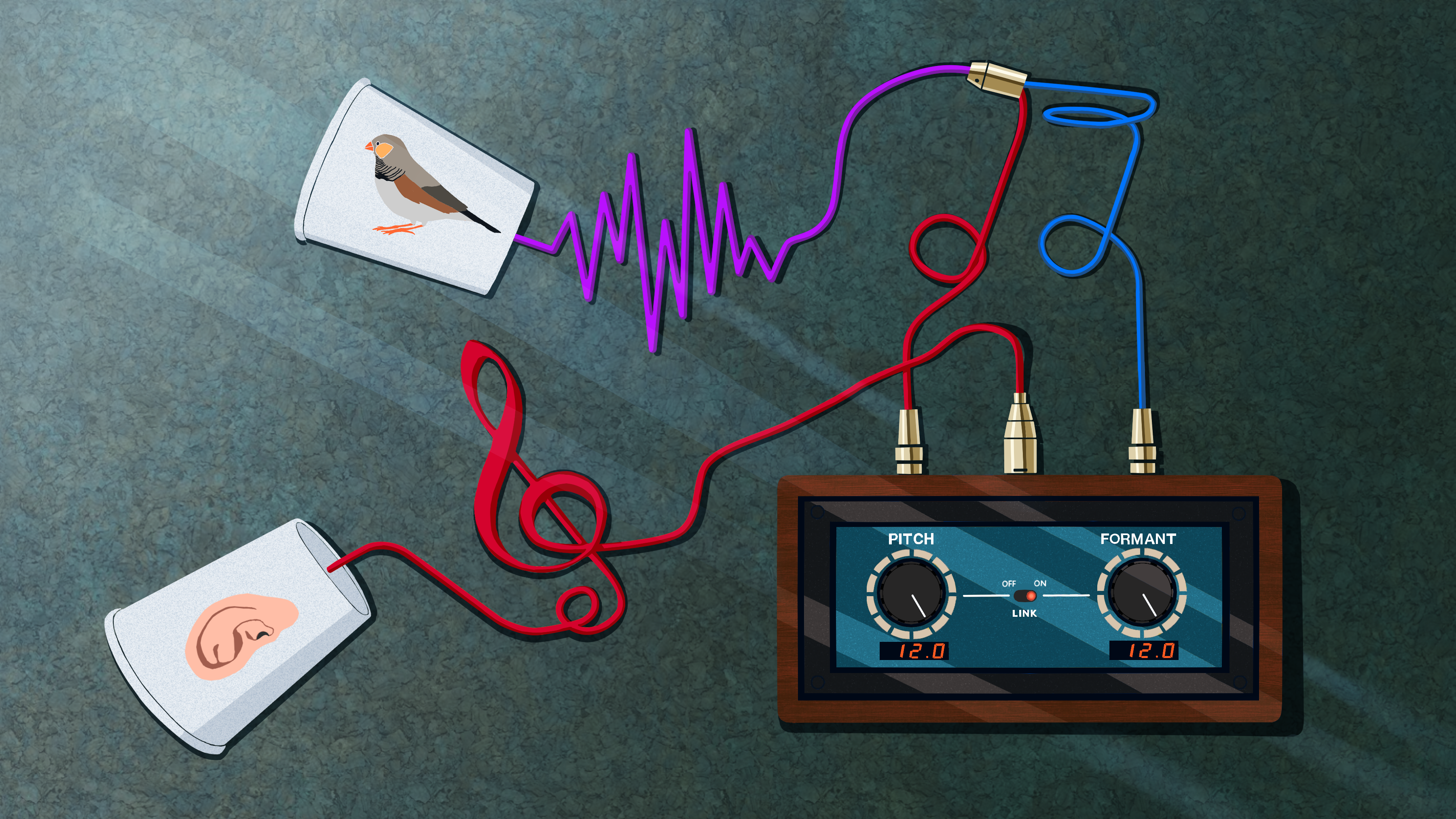
This brought us from temporal relationships to spectral contour. Pitch can change across a sequence, but so can spectral structure, including formant-related information. What happens when two dimensions both carry a pattern of change? Do listeners combine them, or does one become the dominant reference? And if different species weight them differently, can experience change that weighting?
Our initial plan was to ask these questions in zebra finches. As the songbird experiment was taking shape, however, we realized that we had not yet seen the same problem tested in humans. We could think of no better test than to mirror the design of the songbird study. And so we did.
So we built a digital Skinner box
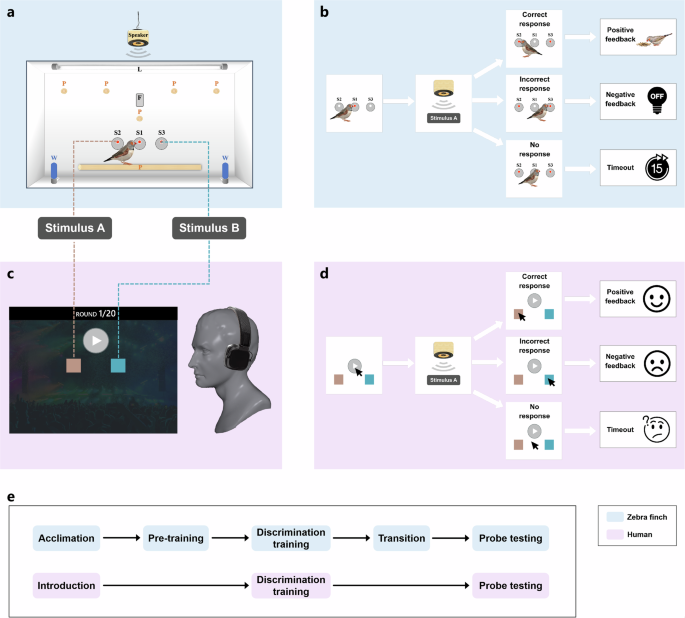
That decision shaped the cross-species experiment. We wanted humans and zebra finches to face essentially the same behavioural problem. At Leiden, we trained the birds to distinguish two sound sequences, differing in pitch as well as spectral change, and to associate them with different response locations using a food reward. For testing humans, we created a “digital Skinner box”. Instead of pecking sensors in a physical operant chamber, participants heard the sequences online and learned the stimulus-response associations through feedback, using smilies.
To test which stimulus dimension (pitch or formant trajectory) zebra finches and humans used to classify the sequences, we next changed the pitch or formant trajectory of the sequences, sometimes making the dimensions agree and sometimes making them conflict.
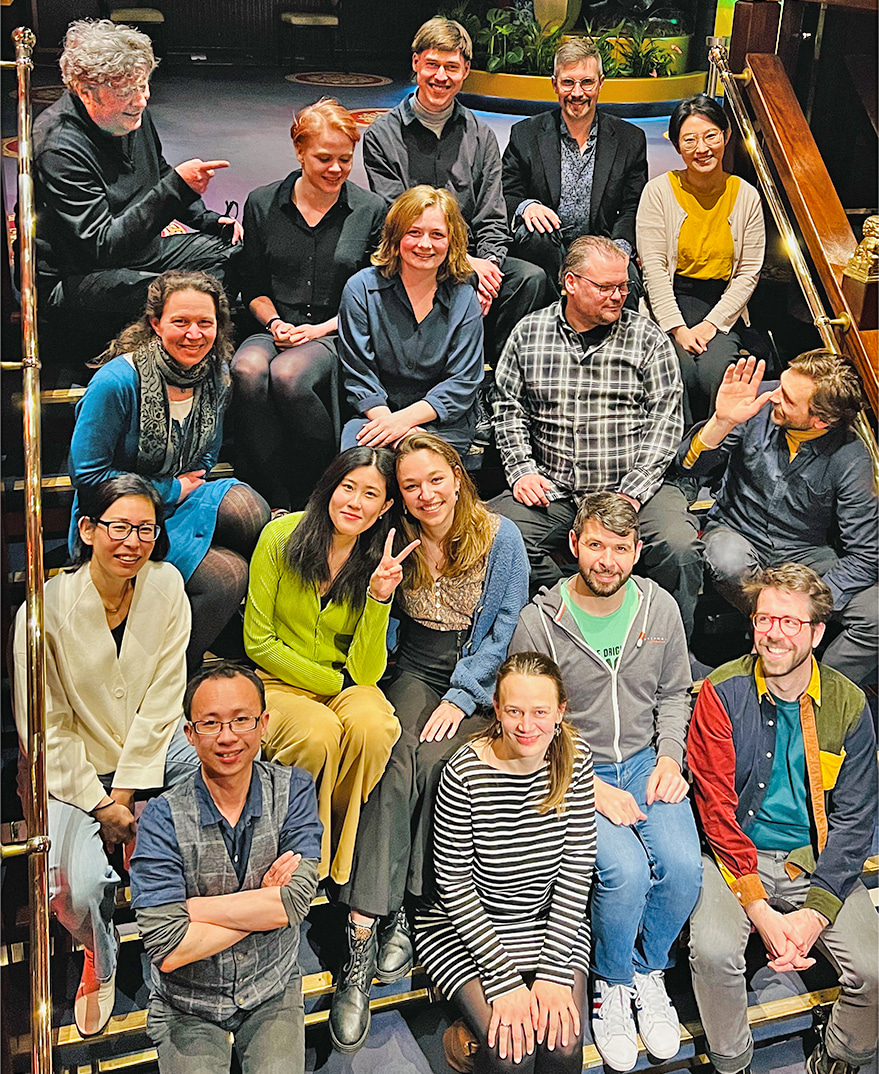
From left to right
Top row: Henkjan Honing, Mariëlle Baelemans, Atser Damsma, Ashley Burgoyne, Jiaxin Li.
Next row: Fleur L. Bouwer, Marianne de Heer Kloots, Evert Rot, Bas Cornelissen.
Next row: Makiko Sadakata, Xuan Huang, Zwanet Young, Fabian Moss, Dave J. Baker.
Front row: Zhi-Yuan Ning, Berit Janssen.
The UvA side of the project was important in making the human part of the comparison possible. By March 2022, Jiaxin Li was already working on a programme exploring the basic components of musicality through behavioural paradigms. She became closely involved in the human side of this study, translating the logic of the bird experiment into a form that could work with human participants online. Berit Janssen and Evert Rot developed the web application, while Jiaxin focused on implementing the human study.
A crucial goal was to avoid making the human task feel like an animal operant chamber. It was to preserve its logic. The zebra finches learned through repetition and feedback, without being told what to attend to. We wanted people to do something similar: hear a sequence, choose between two responses, receive feedback, and gradually work out the discrimination for themselves.
It took quite a bit of back-and-forth to get these details right, but the final solutions were surprisingly simple yet useful. A correct answer produced a smiley face and an incorrect one a sad face. The two response buttons had different colours, but which colour meant which answer was randomized across participants, so that colour itself could not become part of the solution. What emerged was our “digital Skinner box”: visually very different from the apparatus in the bird room, but built around the same basic behavioural logic.
In November 2022, the experiment was opened to the public through the Amsterdam Music Lab as “Can you do better than a songbird?”, allowing us to collect the human data in a format closely matched to the bird procedure. This study was one of the places where that approach met a very different kind of experiment: one that had begun with a songbird pecking at sensors in Leiden and now had to work on a person’s laptop/desktop at home.
Can you do better than a songbird?
The listening task used in the study is available online at
https://www.mcg.uva.nl/humansvszebrafinches/.
When humans and songbirds took different routes
At that point, we had a fairly simple prediction: both species would use the same information, but might weight the two dimensions differently. Then the results surprised us.
The zebra finches used pitch and formant structure together, suggesting that both dimensions contribute to recognizing the sequence. Humans were different: they relied much more strongly on pitch. But when pitch became unreliable, something unexpected appeared in the participants with richer musical experience. They could still recognize the sequence by mapping the familiar pitch contour onto the corresponding formant contour. In other words, the relational pattern seemed to survive a change in acoustic dimension.
We had expected musical experience to strengthen the use of pitch; we had not expected it to help listeners transfer a learned pitch-based pattern onto formant structure. We cannot directly observe the representation behind this behaviour, so the idea of cross-dimensional transfer is an interpretation of the response pattern rather than something we measured directly.
It would be easy to summarize the study as “birds use formants and humans use pitch”. That misses the more interesting point. Both species could use information from both dimensions. What differed was how those dimensions were weighted and combined. This is why the comparison matters beyond the particular stimuli we used. Species can hear the same acoustic stimuli, but perceive and process the auditory information differently.
The marathon continues
The story does not end with this paper. In April 2026, twelve years after the original Lorentz workshop on musicality in Leiden, researchers returned to the same place for a follow-up workshop, this time focused on spectral percepts such as pitch, timbre, and consonance. The topic had become more specific, but the broader comparative question remained.
We still do not know how much of the human preference for pitch reflects species-specific auditory predispositions, how much reflects a lifetime of exposure to pitch-rich sounds, or how other vocal-learning species would solve the same problem. Each of these questions points to another stretch of the road.
Perhaps that is the value of comparative research. Give different minds the same sounds and the same problem, and the comparison tells us what they share and where they diverge. The next question is where those different routes begin, and how far they can converge. For us, that is what makes the marathon worth continuing.

Follow the Topic
-
Communications Biology
An open access journal from Nature Portfolio publishing high-quality research, reviews and commentary in all areas of the biological sciences, representing significant advances and bringing new biological insight to a specialized area of research.

Related Collections
With Collections, you can get published faster and increase your visibility.
Healthy Aging
Publishing Model: Open Access
Deadline: Dec 31, 2026
DNA repair and human disease
Publishing Model: Hybrid
Deadline: Oct 31, 2026