Ultralow Noise Orthogonal Fluxgates Enabling Weak Magnetic Field and Biomolecular Detection
Published in Bioengineering & Biotechnology
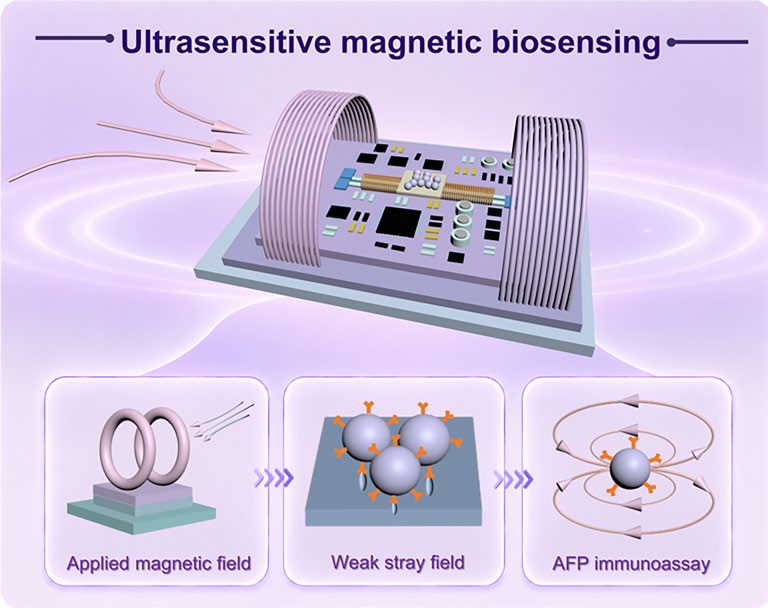
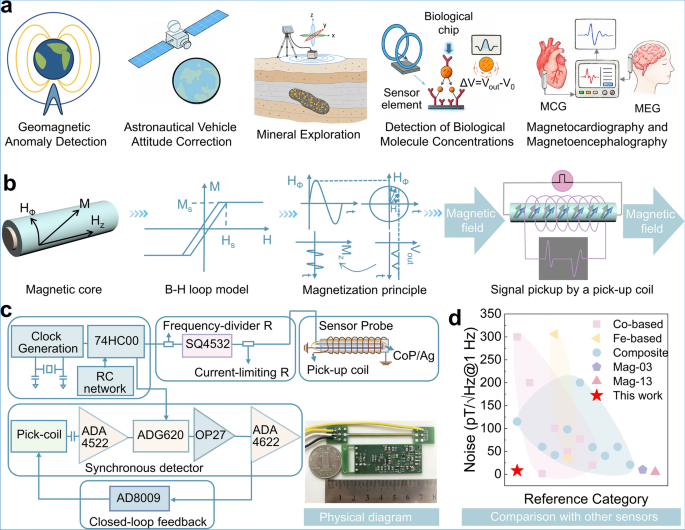

As biomagnetic sensing and molecular diagnostics increasingly demand the detection of extremely weak magnetic signals, conventional magnetic sensors remain constrained by intrinsic low-frequency noise, magnetic-domain fluctuations, and limited sensitivity. Researchers from Lanzhou University and the First Hospital of Lanzhou University have developed a low-noise orthogonal fluxgate (OFG) sensor that combines an amorphous–nanocrystalline CoP/Ag composite core with closed-loop signal conditioning. This integrated strategy substantially suppresses magnetic and electronic noise, enabling highly sensitive weak-field detection and biomolecular sensing.
Why This Magnetic Sensor Matters
Orthogonal fluxgates are attractive for weak magnetic-field measurements because of their high sensitivity and room-temperature operation, but intrinsic 1/f noise, magnetic hysteresis, and Barkhausen fluctuations can obscure extremely weak signals. These limitations become particularly important for biomagnetic and magnetic-bead detection, where the magnetic response from a small number of labeled biomolecules can be extremely weak. The new sensor addresses this challenge by coordinating magnetic-core microstructure with circuit-level noise suppression.
Innovative Design and Mechanism
The sensor employs a conductive Ag core coated with an amorphous CoP layer, followed by controlled DC annealing to introduce 10–20 nm nanocrystalline domains within the amorphous matrix. This dual-phase architecture combines the low magnetic-loss characteristics of an amorphous structure with improved magnetic ordering and permeability from nanocrystallization. Optimization of the electrodeposition current density and annealing conditions produces a uniform magnetic-domain structure and reduced dynamic hysteresis loss. Meanwhile, a closed-loop feedback circuit integrates phase-stable excitation, synchronous demodulation, and zero-drift compensation to further suppress electronic and low-frequency noise.
Outstanding Performance
The optimized CoP/Ag OFG achieves an exceptionally low system-level equivalent magnetic noise of only 8 pT/√Hz at 1 Hz, together with a sensitivity of 153.8 kV T-1 and a measured −3 dB bandwidth of 46 Hz. Compared with non-optimized cores, the optimized structure dramatically reduces low-frequency noise through improved permeability, more regular magnetic domains, and lower dynamic magnetic loss. The sensor can clearly resolve signals from superparamagnetic magnetic beads and provides a wide quantitative response for biomolecular detection.
Applications and Future Outlook
Using alpha-fetoprotein (AFP) as a model biomarker in an immunomagnetic bead assay, the sensor delivers a linear response over an exceptionally broad concentration range of 50 fg mL-1–100 ng mL-1, with a detection limit as low as 50 fg mL-1. The work establishes a clear structure–magnetism–noise relationship and demonstrates that low-noise OFGs can translate advanced magnetic-core engineering into practical biomolecular sensing. Beyond AFP detection, the platform shows promise for biomagnetic measurements, geomagnetic sensing, weak-field detection, and future clinical biosensing, with serum-based validation and anti-interference optimization identified as important next steps.

Editor of Nano-Micro Letters, which is an Open-Access, peer-reviewed journal reported papers that have at least one dimension ranging from a few sub-nanometers to a few hundreds of micrometers. The journal is published by Springer Nature and indexed by SCI, EI, SCOPUS, Pubmed, etc. The 2025 JCR Impact Factor is 38.5. The 2025 CiteScore is 58.9.
Follow the Topic
-
Nano-Micro Letters
Nano-Micro Letters is a peer-reviewed, international, interdisciplinary and open-access journal that focus on science, experiments, engineering, technologies and applications of nano- or microscale structure and system in physics, chemistry, biology, material science, and pharmacy.