The lymph node is not just a waystation for metastasis
Published in Biomedical Research

Melanoma, a skin cancer, can be particularly deadly because it is highly metastatic, growing aggressively from primary lesions of the skin to access the lymphatics or blood, from which it can travel to distant organs like the brain or bones and become even harder to treat. During this transition, melanoma cells will encounter lymph nodes, organized immune tissues that are distributed all throughout the body. As it is recognized in the clinical practice that spreading of the cancer to the nearby lymph nodes is a bad sign, it is considered a viable strategy to cut out the lymph nodes when surgically removing a tumor. However, the lymph nodes are sentinels that examine the lymph and making decisions as to whether to sound the alarm. Thus, it is important to consider the lymph nodes not just as a container for tumor cells, but key decision makers regarding how successful the immune system will be in combating the spreading tumor.
Our lab has been very interested in how structural changes with lymph node aging change its ability to activate the immune system. Along these lines, I wanted to know how initial encounters with pioneering tumor cells change the immune architecture of the sentinel lymph node. To study this, our group examined melanoma tumor cells implanted in the mouse footpad as they metastasized to the draining lymph nodes. In response to the tumor cells, the lymph nodes became activated and enlarged, whereas lymph nodes farther away remained small and silent. In the metastatic lymph node, the melanoma formed a dark, melanin-pigmented mass that was visible with the naked eye. When administering immunotherapy in the form of checkpoint antibodies to one group of mice, we could see the melanoma spot disappear. The lymph nodes, however, remained enlarged. How was the tumor cleared in these treated lymph nodes?
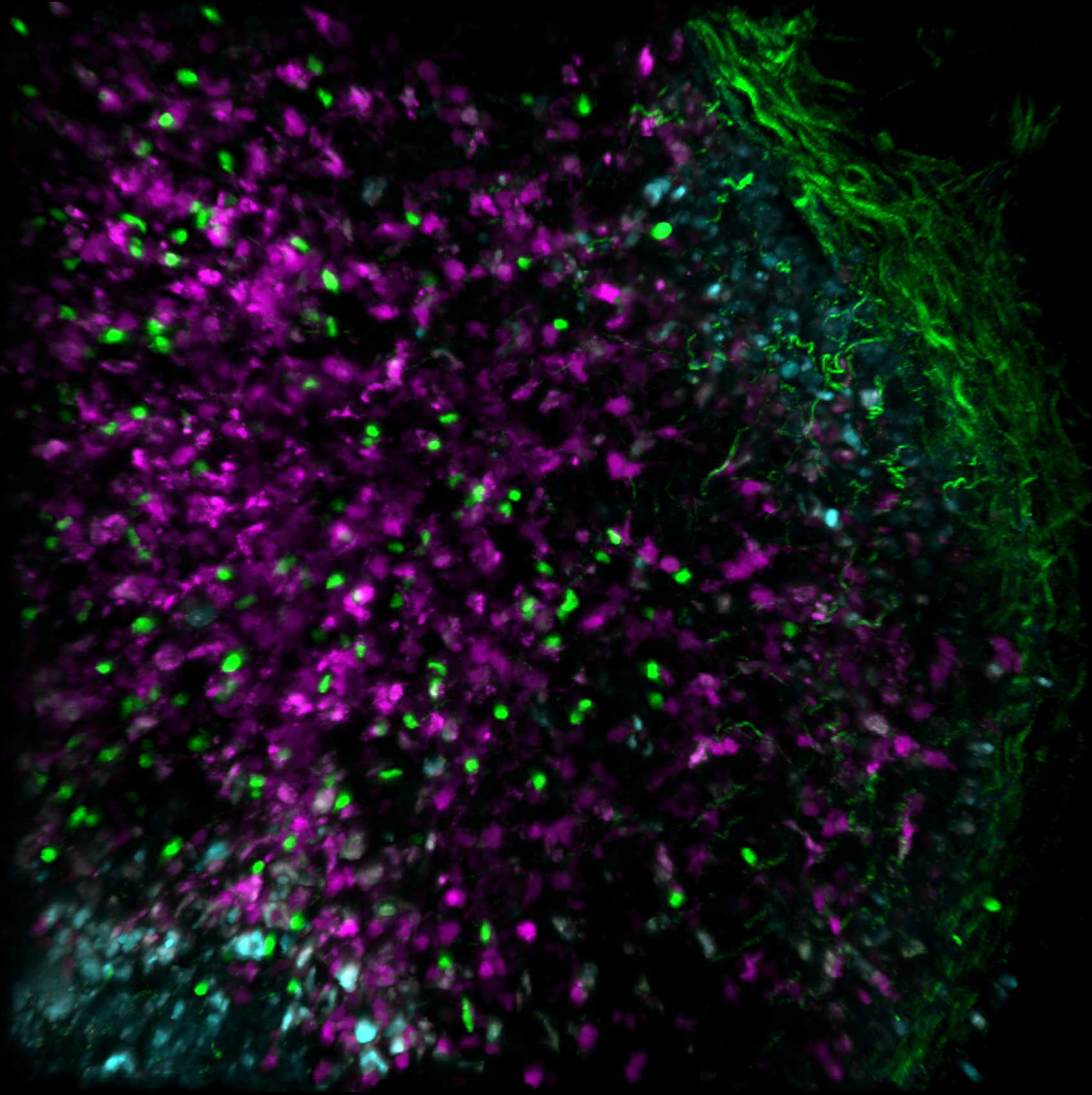
The lymph node is an ecosystem, not just a collection of immune cells. Cells and particles traveling in the lymph will encounter several layers of specialized immune cells, which communicate with each other to coordinate the correct response. Cells must often communicate through direct contact, or alternately by expression of secreted molecules that have limited range. To aid in cellular communication, the lymph node is organized into cell compartments. Our lab uses fluorescent tags and microscopy to directly visualize how the cells of the lymph nodes are positioned, as this can give us a clue as to how they communicate with each other. Thus, using advanced imaging approaches, we were able to take detailed images of the immune remodeling process as it occurs in the metastatic lymph nodes. Using these tools, we found that the checkpoint blockade didn't just remove the melanoma; treatment was associated with structural and biochemical remodeling of lymphoid, myeloid, and stromal cell organization.
The vanguard of the immune system are macrophages, which emerge as an important part of the story. They sit at the frontline of the lymph node barrier, directly probing the lymph, and also reside within the lymph node interior where they carry out various patrolling and housekeeping roles. In our study, we explored how macrophage positioning and signatures changed in the course of metastasis and therapeutic response. Macrophages have also been characterized as nuisances in cancer treatment, as they are coopted by the tumor to enforce the immune suppressive, pro-tumor environment. However, clinical trials where macrophages were cleared out have not yielded significant improvements to patient outcomes. There is a paradox that must be resolved in which both the presence and absence of macrophages impairs therapy. This suggests that what the macrophage is doing in the tumor is a key to fighting cancer.
In our study of successful tumor clearance in the metastatic lymph node, we saw that the macrophage profiles changed towards an inflammatory and immune activating program. Furthermore, the spatial relationship between macrophages and T cells changed. While for simplicity I call out the T cells and the macrophages in order to describe their changes in the lymph nodes, what we were attempting to capture in our study was that as an ecosystem, the lymph node was becoming reorganized, and that these may be the necessary conditions for immunotherapy to succeed. While the canonical checkpoint blockade narrative focuses on T cells, our work suggested that successful treatment was associated with something broader: remodeling of the lymph node tissues in which the T cells operate. Our work supports a prominent role for macrophages and other myeloid cells in this process. Therefore, rather than simply asking “How do we activate T cells?”, the next generation of immunotherapy might ask “How do we create an environment in which T cells can succeed?”
In promoting an updated edition of his book, The Emperor of All Maladies, the author Siddartha Mukherjee talked about how the discovery of immune checkpoint blockade was akin to an ice axe being able to make the initial purchase onto the face of the mountain that are incurable cancers. The past few decades has seen the development of cancer immunology and iterative innovation of immunotherapy. Now we have reached another steep section of the trail. Moving forward may require another paradigm shift, and I propose that this would include further consideration of the role of the lymph nodes. They are not just passive waystations for traveling tumor cells, but a dynamic site where the relationships between tumor and immune cells are being shaped. Moving forward, we continue to ask questions: What are macrophages and T cells actually doing when they interact? Which macrophage states help versus hinder immunity? Can those relationships be manipulated therapeutically? I am excited to see the story unfold.