Artificial Intelligence in Suicide Risk Assessment: A Systematic Literature Review
Published in Electrical & Electronic Engineering, Behavioural Sciences & Psychology, and Statistics





Suicide remains one of the most complex and pressing global public health challenges. It is a leading cause of preventable mortality, cutting across age groups, geographic regions, and socioeconomic contexts. Despite sustained prevention efforts, the accurate identification of individuals at risk of suicide continues to present significant clinical and systemic difficulties. Traditional risk assessment approaches, often reliant on self-reported psychometric instruments, clinician observation, and episodic evaluations, are constrained by subjectivity, recall bias, stigma, and limited temporal sensitivity. These limitations restrict the ability to detect dynamic changes in suicidal ideation and behaviour in real time.
Artificial Intelligence (AI) has emerged as a transformative force within mental health research. The capacity of AI systems to analyse large-scale, multimodal, and longitudinal data introduces new possibilities for early detection, personalised intervention, and scalable prevention. However, despite rapid growth in this domain, the evidence base has remained fragmented, with studies dispersed across technological silos, data contexts, and population groups.
This study aims to provide a comprehensive and structured synthesis of how AI technologies are being applied to suicide risk assessment. It seeks to consolidate current knowledge, evaluate methodological trends, identify performance patterns across AI subsets, and highlight critical gaps shaping future research and clinical translation.
Scope and Methodological Foundation
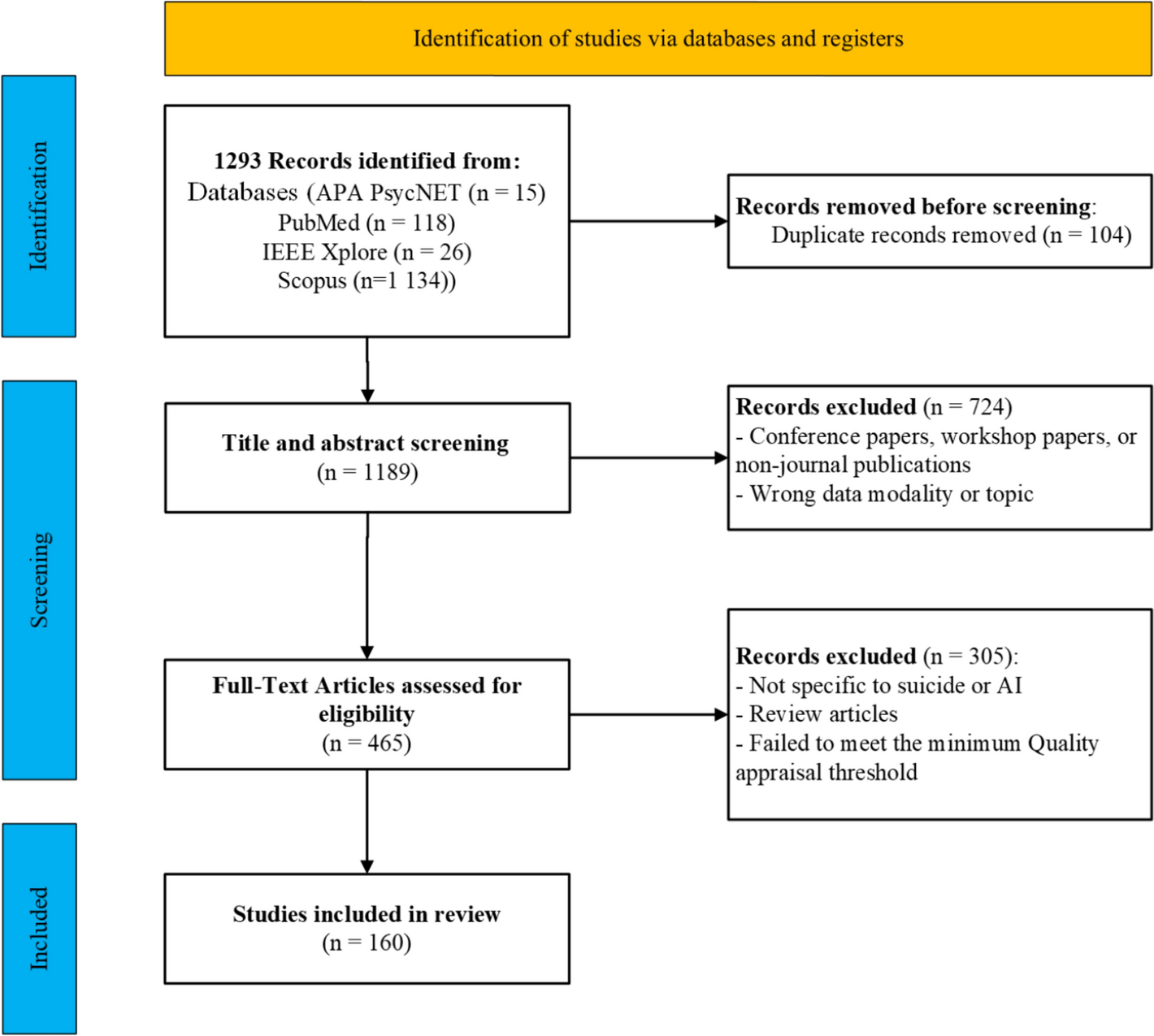
To achieve this objective, the study followed a rigorous systematic review methodology aligned with PRISMA reporting standards and a registered review protocol. A comprehensive search was conducted across four major interdisciplinary databases to ensure coverage of clinical, psychological, and computational research.
The search yielded 1,293 records, which were sequentially screened, assessed for eligibility, and appraised for methodological quality. Following duplicate removal and full-text evaluation, 160 peer-reviewed studies published in high-impact journals were included for in-depth synthesis. This extensive evidence base positions the review among the most comprehensive examinations of AI applications in suicide risk assessment.
Conceptualising the AI Landscape
A central contribution of the study lies in its integrative taxonomy of AI technologies. Rather than examining isolated techniques, the review situates suicide research within a hierarchical AI ecosystem encompassing:
- Machine Learning
- Deep Learning
- Natural Language Processing
- Explainable Artificial Intelligence
- Generative AI
- Large Language Models
This classification enables comparative analysis across modelling paradigms, data modalities, and clinical contexts, providing a systems-level understanding of technological evolution within suicide research.
Growth Trajectory of the Field
Descriptive analysis revealed a sharp escalation in publication output over the past decade. Early work in this domain was sparse, with minimal annual production before 2018. However, a marked increase in studies emerged from 2019 onward, coinciding with advances in computational capacity, expanded availability of digital data, and heightened global attention to mental health. This upward trajectory signals the consolidation of AI-driven suicide prevention as a mature and rapidly growing research frontier.
Data Modalities and Predictive Performance
The findings demonstrate that AI applications span diverse and increasingly sophisticated data environments. Three dominant modalities emerged:
1. Social Media and Digital Behavioural Data
Social media platforms constitute a significant data source due to their capacity to capture real-time emotional expression and behavioural signals. AI models analysing user-generated text have demonstrated strong performance in detecting suicidal ideation, linguistic distress markers, and behavioural escalation patterns. Deep learning architectures outperform traditional statistical models in extracting contextual and semantic meaning from unstructured text.
2. Clinical Notes and Electronic Health Records
Clinical documentation represents another critical domain. AI systems applied to unstructured medical records can identify suicide risk indicators that structured diagnostic codes frequently overlook. Transformer-based language models show strong sensitivity in detecting nuanced clinical signals, enabling enhanced surveillance within healthcare systems.
3. Multimodal and Passive Sensing Data
Emerging research explores audio, visual, and speech-based indicators of suicide risk. Vocal tone, facial expressivity, and linguistic cadence have demonstrated predictive utility, suggesting the feasibility of passive and non-invasive monitoring frameworks.
Population-Specific Risk Modelling
Demographic, cultural, and contextual determinants shape suicide risk. The review found that AI models tailored to specific populations consistently demonstrate improved predictive performance. Stratified modelling across age groups, gender populations, occupational cohorts, and geographic regions reveals distinct risk pathways and patterns of feature importance. These findings underscore the necessity of context-aware algorithm design to avoid generalisation bias and ensure equitable predictive validity.
Integration With Traditional Assessment Frameworks
A critical insight emerging from the synthesis is that AI does not function as a replacement for established suicide risk assessment tools. Instead, it operates as an augmentation layer. Psychometric instruments, diagnostic classifications, and clinical interviews remain foundational. AI enhances these frameworks by introducing continuous monitoring, pattern detection, and predictive analytics. This hybrid paradigm strengthens diagnostic precision while preserving clinical interpretability.
Explainability and Clinical Trust
The adoption of AI in sensitive domains such as suicide prevention depends not only on predictive accuracy but also on transparency. Explainable AI techniques, including feature attribution and post-hoc interpretability models, play a pivotal role in translating algorithmic outputs into clinically meaningful insights. These mechanisms enable practitioners to understand the drivers of risk classification, thereby fostering trust, accountability, and ethical deployment.
Emerging Technological Frontiers
Generative AI and Large Language Models represent an emerging but underexplored frontier. Early applications include synthetic data generation, conversational risk screening, and automated support systems. While promising, these technologies require robust validation, ethical governance, and clinical alignment before widespread implementation.
Structural Gaps and Future Directions
Despite significant advances, several systemic challenges persist:
- Limited cross-cultural validation
- Underrepresentation of low- and middle-income regions
- Scarcity of prospective and real-time trials
- Ethical risks relating to privacy, bias, and consent
Addressing these gaps will be essential for translating experimental models into scalable, real-world suicide prevention systems.
Concluding Reflection
This study aims to advance the discourse on AI-enabled suicide risk assessment by providing a unified, methodologically rigorous synthesis of the field. The evidence indicates that AI holds substantial potential to enhance early detection, personalise intervention strategies, and support clinical decision-making. However, its most significant value lies in complementing, not replacing, human expertise.
As the field progresses, the responsible integration of explainable, context-sensitive, and ethically grounded AI systems will be central to reshaping suicide prevention frameworks and ultimately reducing the global burden of suicide.

Follow the Topic
-
Discover Artificial Intelligence
This is a transdisciplinary, international journal that publishes papers on all aspects of the theory, the methodology and the applications of artificial intelligence (AI).

Related Collections
With Collections, you can get published faster and increase your visibility.
Transforming Education through Artificial Intelligence: Opportunities, Challenges, and Future Directions
Artificial Intelligence (AI) is rapidly changing the educational field by enabling personalized learning, intelligent tutoring systems, automated assessments, learning analytics, and administrative automation.
This collection invites original research, systematic reviews, and visionary perspectives on the transformative impact of AI in education. It aims to explore how AI technologies can enhance equity, inclusion, and efficiency in educational settings across different contexts, including higher education, K-12, vocational training, and lifelong learning. This collection will address technical, pedagogical, ethical, and policy aspects, fostering interdisciplinary perspectives and evidence-based insights.
This Collection supports and amplifies research related to SDG 4 and SDG 9.
Keywords: Artificial Intelligence, AI in Education, Educational Technology, Data Analytics, AI Ethics
Publishing Model: Open Access
Deadline: Nov 30, 2026
Advanced AI Methods for Personalized Healthcare
The advancement of Artificial Intelligence (AI) technologies, especially Reinforcement Learning (RL) and Deep Learning (DL), is transforming healthcare, enabling innovative solutions for patient monitoring, diagnostics, and personalized treatment. These technologies facilitate the effective use of healthcare data and intelligent analytics, enhancing clinical decision-making and improving patient outcomes. AI is revolutionizing how healthcare is delivered, making it more proactive, efficient, and accessible. This Collection explores new methods and applications of AI for healthcare such as personalized healthcare. Contributions in this Collection showcase novel frameworks, case studies, and interdisciplinary approaches that drive the future of personalized healthcare, fostering innovations that bridge technology and patient care.
In this context, we are inviting original research articles, reviews, and perspective papers addressing (but not limited to) the following themes:
- Personalized medicine
- IRL for dynamic treatment regimes
- Wireless sensor networks for patient monitoring
- Identification and prevention of critical condition
- Monitoring systems within the medical devices contest
- Methodologies and tools for the rapid integration of WSNs, IoT and AI in health monitoring
- Behavior analysis of patients
- Personalized health-promoting interventions
- Ambient assisted living and active assisted living
- AI security and privacy models for healthcare applications
- AI methods for rehabilitation
Publishing Model: Open Access
Deadline: Feb 27, 2027