Behind The Paper: Genetic algorithm-based assessment of kinetic façade prototypes for energy optimization and user comfort: a hotel case study in Iran
Published in Social Sciences, Earth & Environment, and Civil Engineering

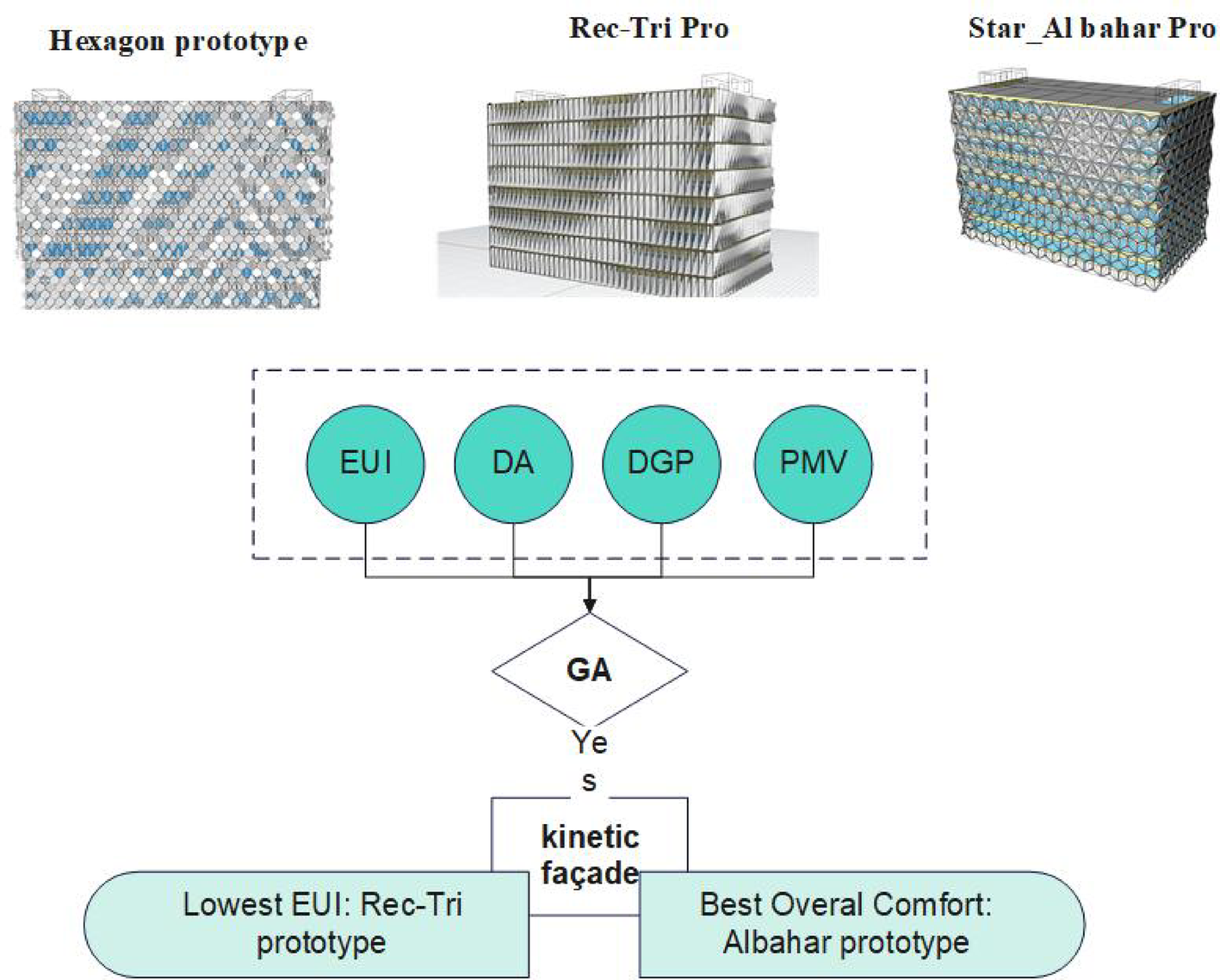

What followed was a long and often demanding journey. One of the most difficult parts was identifying the right kinetic façade prototypes and translating them into working parametric models. Each system whether rotating, sliding, or folding had its own logic, and implementing them accurately was far from straightforward. Many times, models did not behave as expected, simulations failed, or results contradicted assumptions. What appears as a clear comparison in the paper was, in reality, the result of repeated trial and error.
At the same time, conducting this research without access to advanced facilities particularly in Iran, added another layer of challenge. Limited resources meant that every step required more time, creativity, and persistence. Tasks that might be straightforward in well-equipped environments often became complex and time-consuming.Data collection and analysis were equally demanding. Running hundreds of simulations, checking outputs, and ensuring consistency across different performance metrics required continuous energy and focus. There were moments of exhaustion and doubt, especially when progress felt slow or uncertain. Staying motivated throughout this process was, in itself, a challenge.
Yet, over time, patterns began to emerge. Each façade system revealed its own strengths and trade-offs, and the complexity of the problem became clearer. This was perhaps the most rewarding moment when scattered results started to form a coherent narrative, and the research question began to find its answer. Looking back, this paper is not only about kinetic façades or optimization techniques. It is about persistence in the face of limitations, about learning through failure, and about continuing the process even when it becomes difficult. The challenges were not separate from the research—they were part of what shaped it.

I am Dr. Marjan Ilbeigi, an architectural engineer and researcher specializing in energy-efficient design, human-centered architecture, and AI-driven optimization in the built environment. My work focuses on integrating Post-Occupancy Evaluation (POE), building performance simulation, and advanced machine learning techniques particularly Generative Adversarial Networks (GANs) to develop intelligent and adaptive design solutions.
I have authored multiple peer-reviewed publications in high-impact journals and actively contribute as a reviewer for international publishers such as Elsevier and Springer. My research interests include sustainable school design, indoor environmental quality, thermal comfort, kinetic and adaptive façade systems, and circular economy strategies in architecture.
Alongside my research, I serve as an Assistant Professor in Interior Design, where I teach environmental design and supervise graduate projects. I am also the co-founder of a design and engineering firm, where I bridge academic research with real-world applications in architecture and building performance.
My goal is to advance data-driven, user-centered design approaches that enhance both environmental performance and human well-being in buildings.
Follow the Topic
-
Discover Sustainability
A multi-disciplinary, open access, community-focussed journal publishing results from across all fields relevant to sustainability research whilst supporting policy developments that address all 17 of the United Nations Sustainable Development Goals (SDGs).

Related Collections
With Collections, you can get published faster and increase your visibility.
Food, Societies and Sustainability: Contemporary Concerns around Local Food Production and Consumption
Food goes far beyond nutrition. It reflects sociocultural identities and territorial heritage, consumption dynamics, economic development, public policies, sustainability concerns, food production, distribution and consumption. Understanding food production and food products, practices and strategies offers key insights into both historical traditions and contemporary lifestyles. Around the world, food and drink serve as powerful symbols of identity and attract interest through diverse value chains, economic interests and cultural expressions. On the other hand, traditional and local food systems contribute to cultural heritage, biodiversity conservation and sustainability matters from environmental, sociocultural and economic concerns.
The Collection "Food, societies and sustainability: Contemporary concerns around local food production and consumption" explores how food is locally produced, promoted and protected through public and private initiatives, food-based experiences, media platforms, and sustainable dietary and productive practices. It encourages contributions that examine how food concerns are shaped in contemporary societies, how globalization is affecting local food cultures, emphasizing the role of food as both tangible and intangible cultural heritage. Food preferences, food stereotypes, and attitudes towards food sustainability, analysed through the lenses of generational gaps and gender differences are also welcomed. This Collection seeks original research and case studies using both qualitative and quantitative methods.
Keywords: Food Systems, Food culture, Food Production, Locality, Heritage, Tourism, Gastronomy, Agricultural Biodiversity, Livestock Biodiversity, Food Sustainability, Regenerative Tourism.
This Collection supports and amplifies research related to SDG 2, SDG 3, SDG 4, SDG 5, SDG 10, SDG 12, and SDG 17.
Publishing Model: Open Access
Deadline: Sep 30, 2026
Weather and Climate Extremes: A Special Reference to Multidisciplinary Research and Policy Developments
This Collection, titled "Weather and Climate Extremes: A Special Reference to Multidisciplinary Research and Policy Developments," focuses on the increasing global challenges posed by extreme weather events and climate phenomena. As these events intensify due to changing climate patterns, their impacts on ecosystems, infrastructure, human health, and socioeconomic systems become more pronounced, necessitating a multidisciplinary approach to understanding and addressing these complexities.
The Collection aims to bring together research from diverse fields, including atmospheric sciences, hydrology, ecology, engineering, public health, and social sciences. It encourages innovative contributions that explore cutting-edge solutions to predict, manage, and mitigate the effects of climate extremes. Topics may include advanced modelling techniques, nature-based solutions, climate-resilient infrastructure, risk assessment frameworks, and strategies for equitable policy development. The emphasis is placed on integrating scientific understanding with actionable solutions that address vulnerability, resilience, and adaptation.
Moreover, this Collection seeks to foster cross-disciplinary collaborations to bridge the gap between scientific research and policy implementation. By highlighting case studies, theoretical advancements, and practical approaches, it aims to advance the dialogue on climate resilience and inform decision-making processes globally. This platform aspires to serve as a critical resource for researchers, practitioners, and policymakers striving to navigate the escalating challenges of a changing climate.
Given the increasing frequency and intensity of climate extremes, this topic holds critical importance. Such extremes profoundly affect ecosystems, infrastructure, and human livelihoods, demanding coordinated efforts across disciplines to analyse risks, develop mitigation strategies, and inform policy. This Collection seeks to bring together cutting-edge research and innovative approaches from diverse fields, bridging scientific understanding and actionable policy frameworks. The proposed focus areas include, but are not limited to:
• Advances in modelling and forecasting weather and climate extremes
• Impacts on ecosystems, agriculture, water resources, and public health
• Nature-based solutions and climate-resilient infrastructure
• Interdisciplinary frameworks for risk management and adaptation planning
• Policy advancements addressing vulnerability, resilience, and equity
This call aims to engage a broad community of researchers, practitioners, and policymakers to enhance global discourse and support evidence-based decision-making by emphasising multidisciplinary contributions.
This Collection supports and amplifies research related to SDG
Keywords: Weather Extremes Modeling; Climate Change Impacts; Risk Assessment Frameworks; Nature-Based Solutions (NbS); Resilient Infrastructure Design; Equitable Policy Development; Interdisciplinary Climate Research; Adaptation and Mitigation Strategies; Socioeconomic Vulnerability Analysis; Extreme Event Forecasting
Publishing Model: Open Access
Deadline: Feb 28, 2027