Behind the paper_ipRGC properties prevent light from shifting the SCN clock during daytime
Published in Neuroscience




Breaking the Retinal Gate: The Story Behind Our Discovery
When this project began, I had long discussions with almost every member of the lab. Everyone agreed on one thing; the retina probably was not involved in gating light input to the SCN during the daytime. And honestly, after all those conversations, I started to believe that too.
Still, deep down, I could not quite let go of an idea I had explored earlier in my JBR paper, where I proposed that either the retina, the SCN, or both could act as a gate for light input. I felt an obligation almost a scientific responsibility to test that model properly. It wasn’t about proving myself right; it was about finding the truth, even if it meant showing my own hypothesis was wrong.
So, I began cautiously. My first experiments focused on checking molecular markers, fully expecting to see nothing. I remember that day vividly I ran the staining, came back to the microscope, and froze. There was a strong cFos signal in the SCN during the daytime. My heart sank, not from excitement, but confusion. That could not be right. It went against everything we knew. I was convinced I had made a mistake.
In disbelief, I actually threw my samples in the trash and started all over again.
When I repeated the experiment more carefully, methodically, and skeptically the same result appeared. The signal was real. That was the moment I realized something much deeper might be happening, something that challenged the field’s central assumption.
Finding Belief Amid Doubt
Not everyone believed in the idea that the retina could play a role in daytime light gating except one person: Corinne Beier. But Corinne didn’t just believe in the idea, she stood by me and worked with me through every step. Before and after every lab meeting, we would sit together, preparing how to present our data so that others might finally see what we saw. Her support was not just emotional; it was scientific, strategic, and deeply collaborative. She helped me find the words, the evidence, and the confidence to keep pushing when it would have been easier to give up.
At that time, the long-standing belief, the “central dogma” of our field was that the SCN alone was sufficient for controlling light input. To even suggest otherwise felt almost heretical. But science advances precisely when someone dares to test what everyone else takes for granted.
The Turning Point
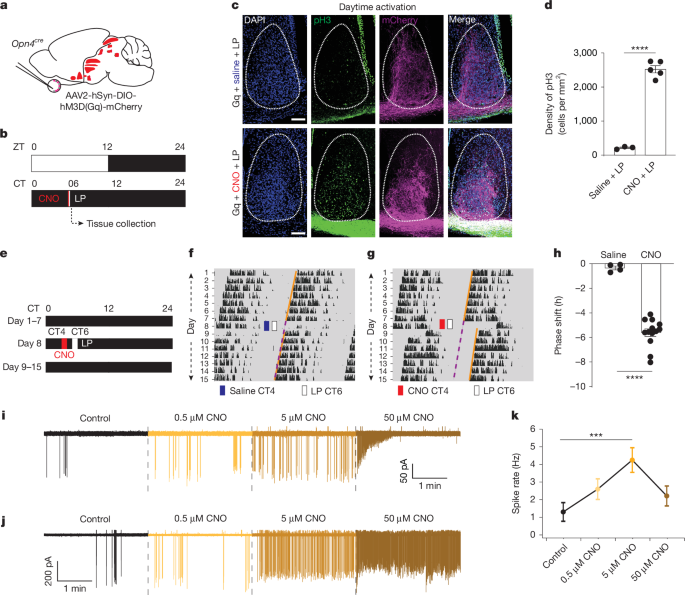
My first real approach was chemogenetic. I designed experiments to test whether activating ipRGCs could alter circadian responses during the “behavioral dead zone” a period when the system is thought to be unresponsive to light.
When I injected CNO, the result stunned me: a six-hour phase shift during the day. I still remember sitting in disbelief, thinking, “This should not be happening.”
The next logical step was to look at molecular changes. Within just 30 minutes of CNO injection, we observed clear shifts in gene expression within the SCN.
And that’s when everything finally made sense. I remembered those early samples I had thrown away, convinced that the strong cFos signal during the day was a mistake. Now, seeing these molecular changes after the behavioral phase shift, it all came together, the retina was indeed influencing the SCN during the daytime.
That was the true turning point. I began to believe that by activating ipRGCs during the day, we had somehow “broken the gate.”
This was a huge realization. Later, we discovered that the circuits controlling daytime versus nighttime phase shifts were distinct a finding that made the story even richer and more complex.
At that stage, we felt confident that we had something important. We sent our manuscript to Science, Nature, and Cell. Each time, it was rejected at the editorial stage. The feedback was consistent: the data are interesting, but the physiological relevance is unclear.
It was discouraging, but rejection has a way of refining both your science and your resolve.
A Brilliant Spark
Then came a game-changing idea from Dr. Samer Hattar. I still remember that moment vividly. Samer initially was not entirely convinced by our data and honestly, who could blame him? The idea that the retina could influence daytime gating went against everything the field believed. But what I truly appreciated about him was that he never stopped me from pursuing the experiments. He gave me space to explore, to make mistakes, and to gather proof.
Once we had enough evidence, he stood firmly by our side. His creativity and intuition shaped the direction of this project in profound ways. It was Samer who suggested, “If melanopsin is involved, why not use violet light to selectively activate it? Maybe that will produce a phase shift even during the daytime.”
It was a brilliant idea, and it worked. Using violet light, we induced a clear and reproducible phase shift, providing the physiological evidence we desperately needed.
We resubmitted our manuscript to Nature, and this time, it was sent out for review. We are deeply grateful to the reviewers their thoughtful and challenging questions pushed the work to the next level. One of the toughest requests was to show electrophysiological evidence of ipRGC responses under different wavelengths of light, something we had not initially planned for.
We owe a lot to our reviewers. Their questions were insightful and challenging, pushing us to strengthen the work. One major request was to demonstrate electrophysiological evidence showing how ipRGCs respond under different wavelengths of light.
Collaboration and Conviction
Coming from a non-electrophysiology lab, that request felt overwhelming. But one of the great advantages of being at the NIH is the incredible network of expertise all around you. And I have to give full credit to Dr. Samer Hattar for this, he truly loves collaboration and has an amazing way of connecting people and ideas. It was his vision and encouragement that made these collaborations possible.
We teamed up with Jeff Diamond’s lab for single-cell electrophysiology and Ben Sivyer’s lab for MEA recordings. When we first presented our idea, I am not sure they believed us either and I can laugh about it now. There were plenty of lively discussions (and a few friendly “fights”), but once the data started coming in, it beautifully aligned with our behavioral and molecular results.
Those collaborations became some of the most rewarding experiences of my career. They reminded me that science thrives not only on ideas but also on trust, teamwork, and leadership that welcomes open collaboration.
Beyond the Data
This project was much more than an experiment it was a journey of conviction, collaboration, and rediscovery. It taught me that belief in your work doesn’t always start within the community; sometimes it begins quietly, with one or two people who refuse to give up.
For me, that belief came from Corinne, who stood beside me through every step, and from Dr. Samer Hattar, who even when he thought my idea was crazy never stopped me from pursuing it. His openness and trust gave me the freedom to explore what many considered an impossible question. And in the end, that freedom made all the difference.
Beyond the lab bench, this research holds meaningful potential for society. By using violet light to minimize the retinal gate and shift control to the SCN, we may open new therapeutic avenues for correcting circadian misalignment a condition that affects shift workers, frequent travelers, and many others whose biological clocks are out of sync with the world around them.
In the end, what started as a controversial idea became a story of faith, collaboration, and discovery. And perhaps the greatest lesson I learned is this:
Sometimes in science, you don’t just break gates, you break belief

Follow the Topic
-
Nature
A weekly international journal publishing the finest peer-reviewed research in all fields of science and technology on the basis of its originality, importance, interdisciplinary interest, timeliness, accessibility, elegance and surprising conclusions.

Related Collections
With Collections, you can get published faster and increase your visibility.
Carbon Dioxide Removal
Publishing Model: Hybrid
Deadline: Jan 16, 2027
Cancer Neuroscience: from mechanisms to therapy
Publishing Model: Hybrid
Deadline: Jan 30, 2027