Beneath the ice of West Antarctica: Geophysical insights into the bed that determines future sea-level rise
Published in Earth & Environment


Prologue
The stability of the West Antarctic Ice Sheet is one of the largest uncertainties in projections of future sea-level rise. The Thwaites Glacier is one of the largest glaciers in Antarctica, comparable in size to the US state of Florida, and it is already undergoing rapid mass loss. Thwaites rests on a bed far below sea level, making it vulnerable to warm ocean water. Despite extensive modelling efforts, key observations are still missing for more accurate projections of future sea-level rise—especially the basal conditions of the more than two kilometre thick ice of Thwaites. The properties of the bed beneath Thwaites affect the ice dynamics: hard beds restrict ice flow, while soft beds produce enhance basal sliding and glacier acceleration.
The International Thwaites Glacier Collaboration (ITGC) was established to address these knowledge gaps. Within the GHOST project (Geophysical Habitat of Subglacial Thwaites), we use seismic and radar methods to investigate the physical properties at the glacier bed.
In late 2022, a small team from the Alfred Wegener Institute consisting of two glaciologists and one engineer set out for the first GHOST field campaign in the Antarctic summer. It was an expedition carried out under extreme conditions, and one that unfolded very differently from what we had planned.
Journey to Antarctica
On 1 November, we left Bremerhaven, Germany, carrying cold-weather gear, laptops, satellite phones, and camera equipment, and travelled to Christchurch, New Zealand. After a 36 hours journey, we met the rest of our international GHOST team. Following final preparations, we boarded a U.S. Air Force Boeing C-17 for the flight to Antarctica.
The experience was unlike any commercial flight: we sat on fold-down seats along the walls, surrounded by cargo and equipment. Five hours later, we landed on the ice shelf near Ross Island in temperatures of –26 °C and a biting wind. From there, the “Ivan the Terra Bus” took us to our first stop on the continent: McMurdo Station.

Map of Antarctica with McMurdo Station, WAIS-Divide and Thwaites Glacier. Source: Quantarctica (Matsuoka et al., 2021)
McMurdo Station
The first days were filled with safety briefings and field training. We learned how to set up Scott pyramid tents, operate stoves and prepared for working in the “deep field”, including a crevasse rescue course and a shakedown camp with an overnight stay on the ice. However, it quickly became clear that patience would be one of the most important skills on this expedition. Due to weather conditions and a COVID outbreak, our onward journey to WAIS-Divide Camp was repeatedly delayed. Days turned into weeks. We spent the time preparing equipment, supporting other teams, and waiting without knowing when we would be able to continue.
Only in early December did the first team reach WAIS-Divide to prepare the camp. For us, this brought both hope and increasing time pressure. The original plan was no longer feasible, and many projects had to be scaled back or cancelled. Our vibroseismic survey at Thwaites Glacier was among the few that remained a priority. After multiple cancelled flights and repeated packing and unpacking, we finally departed on 22 December. Five weeks behind schedule, we left McMurdo and arrived at WAIS-Divide just after midnight, under bright sunlight, on ice nearly 3,500 metres thick.

WAIS-Divide and Traverse to Thwaites Glacier
After our first night in tents at –20 °C, we inspected our equipment, which had been stored on site for two years. Following minor repairs, we successfully carried out a first test measurement with our survey vehicle on 24 December.
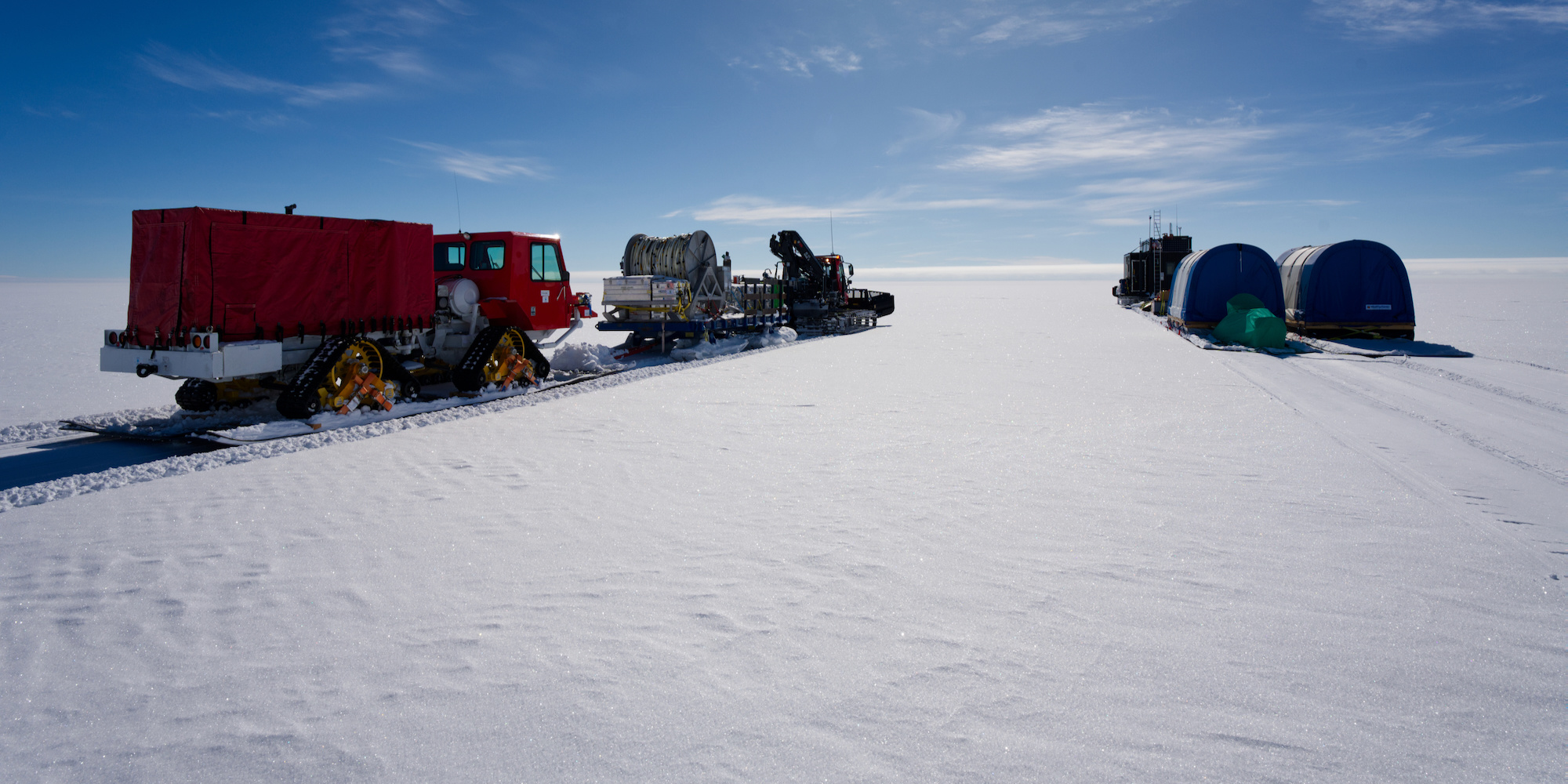
In the following days, we prepared for the traverse: a journey of more than 400 kilometres across Thwaites Glacier. Two PistenBully vehicles hauled our setup: a science train with seismic equipment and our survey truck, and a logistics train carrying sleeping tents, fuel, and supplies.
We set off on 27 December. For four days, we travelled north across an apparently endless white landscape. Bad weather with poor visibility was approaching, but we were able to stay on course. On 30 December, we reached a large crevasse field that prevented further progress. At this point, we turned around and began the actual data acquisition on our return route.

PistenBully driving in poor visibility. ©Alfred-Wegener-Institut/Ole Zeising
Data acquisition on Thwaites Glacier
Our objective was to image the structure beneath the ice using vibroseismic methods. To do this, we deployed a 1.5-kilometre-long streamer equipped with 480 geophones, which we towed behind the survey truck. Every 75 metres, we stopped for a measurement. A vibrating plate mounted on the vehicle generated seismic waves that propagated through the ice. The waves reflected at the ice base and within the underlying sediments, and were recorded by the geophones. We were able to assess data quality in real time inside the vehicle. Each measurement took less than two minutes, allowing us to acquire up to 300 data points per day. Evenings were spent with the logistics team: backing up data, reviewing initial results, and planning the next day’s work.
Early January brought slightly warmer temperatures, but on 8 January a low-pressure system moved in, bringing strong winds and drifting snow that forced us to remain in the vehicle for an entire day. Afterwards, we had to dig out parts of our equipment before continuing. Despite these interruptions, we were able to complete 2,770 measurements by 13 January, covering a total distance of 210 kilometres. That same night, we began dismantling our equipment in freezing winds to ensure we could start the return journey on time.

Science train with the survey truck on Thwaites Glacier. ©Alfred-Wegener-Institut/Ole Zeising
Return journey
The return traverse to WAIS Divide took two days. Temperatures had dropped further, and we secured our equipment for the Antarctic winter. The journey back to McMurdo started late at night when the LC-130 aircraft arrived at WAIS-Divide. As on the inbound journey, we sat along the walls of the cargo hold as the aircraft lifted off from the ice. A few days later, we left Antarctica, planning to return the following summer for further measurements. As the plane banked sharply over the ice shelf, we caught one last glimpse of the vast landscape where we had collected data under challenging conditions. Data that now form the basis of our scientific work.

Arrival at McMurdo with LC-130. ©Alfred-Wegener-Institut/Ole Zeising
I'm a geophysicist working in glaciology. I use radar and seismic to study the ice dynamics of ice streams and melting of ice shelves in Greenland and Antarctica.
Follow the Topic
-
Communications Earth & Environment
An open access journal from Nature Portfolio that publishes high-quality research, reviews and commentary in the Earth, environmental and planetary sciences.

Related Collections
With Collections, you can get published faster and increase your visibility.
Ecological resistance and resilience under global change
Publishing Model: Open Access
Deadline: Apr 07, 2027
Hazards in Mountain Regions
Publishing Model: Open Access
Deadline: Nov 02, 2026