Beyond 3D: How 4D Food Printing Could Transform Personalized Nutrition
Published in Bioengineering & Biotechnology and Agricultural & Food Science
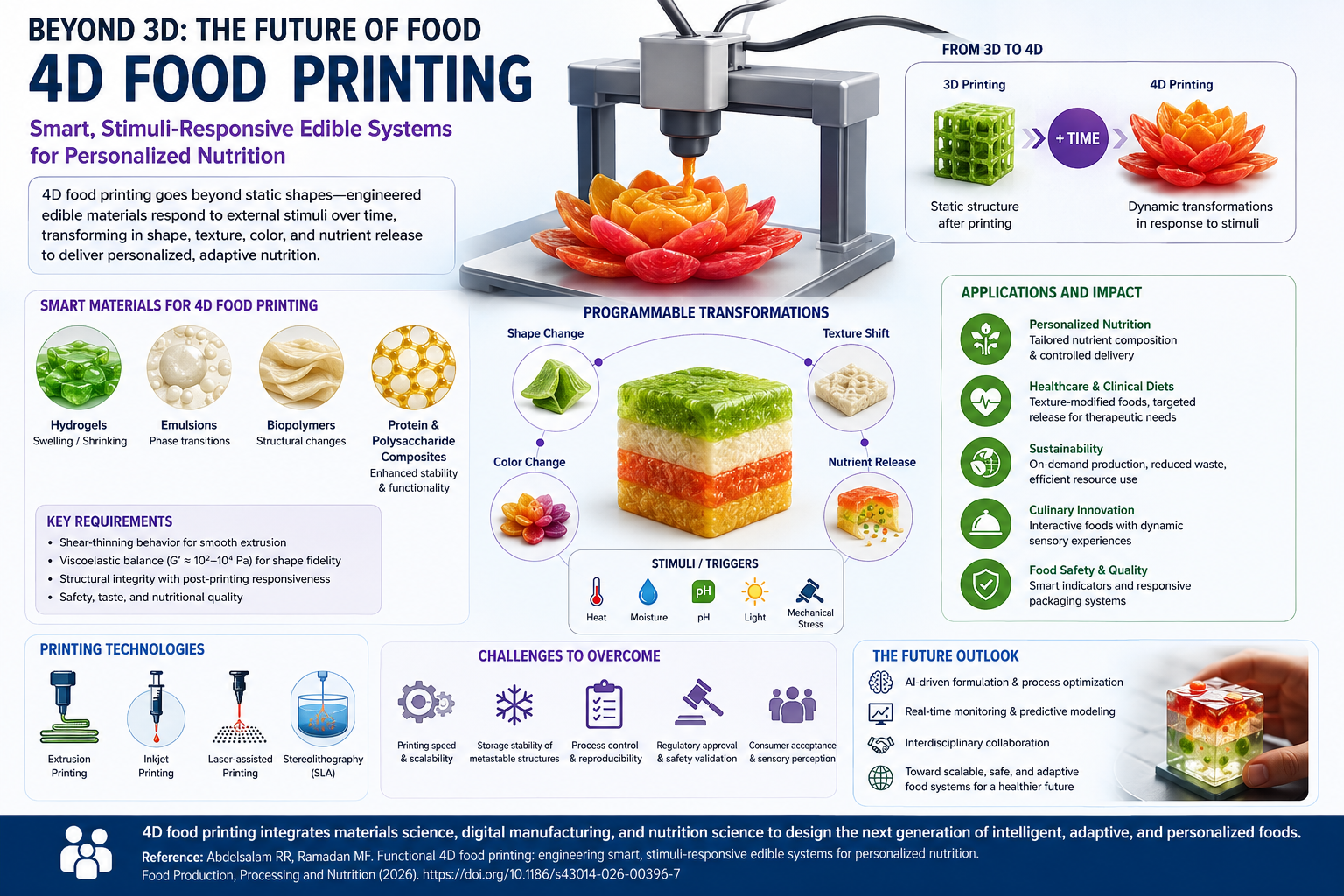
Three-dimensional (3D) food printing has already demonstrated that digital manufacturing can produce customized foods with precise shapes and compositions. However, the next generation of this technology is no longer focused solely on creating complex structures. Instead, it aims to develop foods that can actively respond to their environment. This vision lies at the heart of our review on 4D food printing, where time becomes an additional design dimension, allowing printed foods to transform after fabrication.
Our motivation for writing this review stemmed from a simple observation. Although research on 4D food printing has expanded rapidly in recent years, the literature remains highly fragmented. Some studies emphasize printable formulations, others investigate smart biomaterials, while others focus on printing hardware or consumer applications. Few attempts have integrated these perspectives into a coherent framework that connects material properties, printing processes, transformation mechanisms, and practical food applications. We wanted to bridge these areas and provide a roadmap for researchers entering this emerging field.
Unlike conventional 3D printing, 4D food printing relies on stimuli-responsive edible materials that undergo programmed changes when exposed to external triggers such as heat, moisture, pH, light, or mechanical forces. These transformations may include changes in shape, texture, color, aroma, or nutrient release. Rather than producing static foods, the technology enables the design of dynamic food systems capable of adapting during cooking, storage, or even digestion.
A central theme of our review is the importance of material engineering. Successful 4D printing begins with carefully designed printable inks that exhibit the right balance between flowability during extrusion and structural stability after deposition. We discuss how polysaccharide hydrogels, protein-based systems, starch matrices, lipid emulsions, and hybrid composites each contribute unique functional properties. Their rheological behavior determines not only printability but also the ability to generate predictable transformations after printing.
The review also examines the mechanisms responsible for these transformations. Hydration-induced swelling, thermal expansion, pH-responsive structural changes, reversible gelation, and phase transitions provide different pathways for creating programmable food behaviors. Recent studies demonstrate impressive examples, including self-folding pasta, microwave-responsive vegetable structures, color-changing edible systems, and controlled release of bioactive compounds. These examples illustrate how material composition and structural design work together to create intelligent food architectures.
An exciting aspect of 4D food printing is its potential contribution to personalized nutrition. Digital manufacturing already enables individualized nutrient composition, but smart materials add another level of functionality. Foods may eventually be designed to release nutrients at specific stages of digestion, modify texture for people with swallowing difficulties, or respond to physiological conditions within the gastrointestinal tract. Such adaptive foods could benefit elderly populations, patients requiring therapeutic diets, athletes with specialized nutritional needs, and consumers seeking highly customized eating experiences.
Beyond healthcare, we also discuss broader opportunities for the food industry. Smart food structures could improve sustainability by reducing waste, enabling on-demand manufacturing, and optimizing ingredient utilization. Interactive foods that change appearance during cooking or consumption may create entirely new culinary experiences, while intelligent packaging and freshness indicators may enhance food safety and quality monitoring.
However, our review also highlights significant challenges that must be addressed before widespread commercialization becomes possible. Many current demonstrations remain laboratory-scale proof-of-concept studies. Printing speed, reproducibility, storage stability, and scalability continue to limit industrial implementation. Stimuli-responsive structures must maintain their programmed behavior throughout processing, packaging, transportation, and shelf life while meeting rigorous food safety standards.
Another important consideration is regulation. Since many 4D food systems incorporate functional biomaterials, encapsulation technologies, or nano-enabled delivery systems, regulatory agencies will require comprehensive evidence regarding safety, stability, and consumer acceptance. Equally important is the development of standardized testing protocols that allow meaningful comparison between different formulations and printing approaches.
Looking ahead, we believe the future of 4D food printing will depend on stronger collaboration across disciplines. Advances in food chemistry, rheology, additive manufacturing, computational modeling, artificial intelligence, and sensory science must converge to accelerate innovation. AI-assisted formulation optimization, real-time monitoring during printing, and predictive simulation of structural transformations may significantly improve both efficiency and reproducibility.
Ultimately, 4D food printing represents more than an extension of additive manufacturing. It introduces a new way of thinking about food—as a programmable, functional system capable of responding intelligently to its environment. While many scientific and technological challenges remain, the rapid progress achieved over the past few years suggests that adaptive food systems may become an important component of future personalized nutrition and sustainable food production.
We hope this review provides researchers, engineers, and food scientists with a comprehensive framework for understanding the current state of the field, identifying existing knowledge gaps, and inspiring future innovations. As smart edible materials continue to evolve alongside digital manufacturing technologies, the concept of foods that transform over time may soon move from the laboratory to practical applications that improve nutrition, health, and consumer experiences.

Mohamed Fawzy Ramadan is a Professor of Biochemistry at the Department of Clinical Nutrition, Faculty of Applied Medical Science, Umm Al-Qura University, Makkah, Saudi Arabia.
Prof. Ramadan obtained his Ph.D. (Dr. rer. nat.) in Food Chemistry from the Berlin University of Technology (Germany, 2004). Prof. Ramadan continued his postdoctoral research at ranked universities, including the University of Helsinki (Finland), the Max Rubner Institute (Germany), the Berlin University of Technology (Germany), and the University of Maryland (USA). In 2012, he was appointed as a Visiting Professor (100% teaching) in the School of Biomedicine, Far Eastern Federal University in Vladivostok, Russian Federation.
Prof. Ramadan has published more than 450 research papers and reviews in international peer-reviewed journals. He also edited and published several books and book chapters (Scopus h-index is 55 and more than 11000 citations). He was an invited speaker at several international conferences. Since 2003, Prof. Ramadan has been a reviewer and editor for several highly cited international journals, including the Journal of Medicinal Food, eFood, the Journal of Umm Al-Qura University for Applied Sciences, and the Journal of Advanced Research. He is the editor-in-chief of Journal of Umm Al-Qura University for Medical Science.
Prof. Ramadan received several prizes, including Abdul Hamid Shoman Prize for Arab Researcher in Agricultural Sciences (2006), the Egyptian State Prize for Encouragement in Agricultural Sciences (2009), European Young Lipid Scientist Award (2009), AU-TWAS Young Scientist National Awards (Egypt) in Basic Sciences, Technology and Innovation (2012), TWAS-ARO Young Arab Scientist (YAS) Prize in Scientific and Technological Achievement (2013), and Atta-ur-Rahman Prize in Chemistry (2014).