Germination or Fermentation? Unlocking the Full Nutritional Potential of Legumes for Sustainable Food Systems
Published in Bioengineering & Biotechnology, Chemistry, and Sustainability
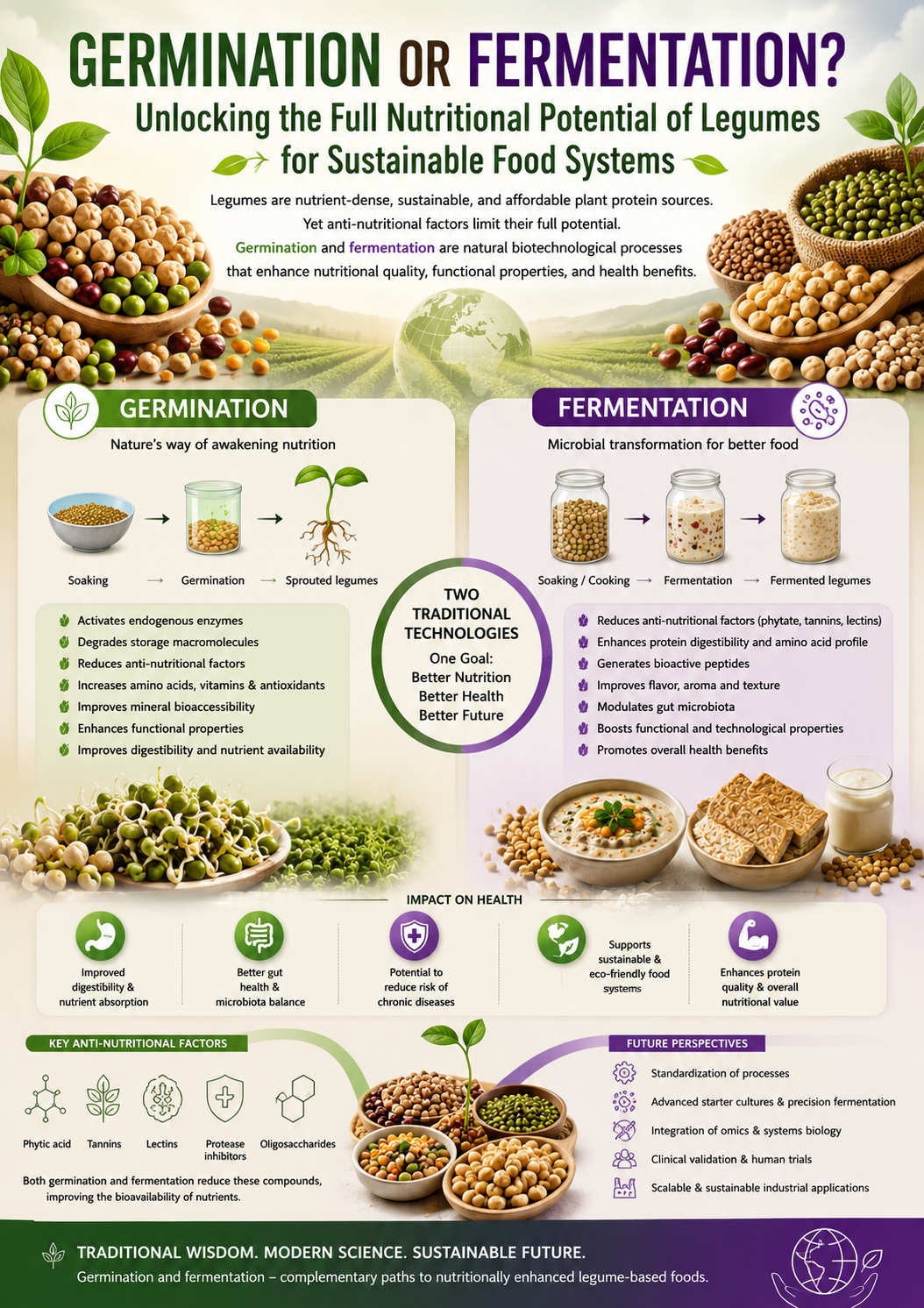
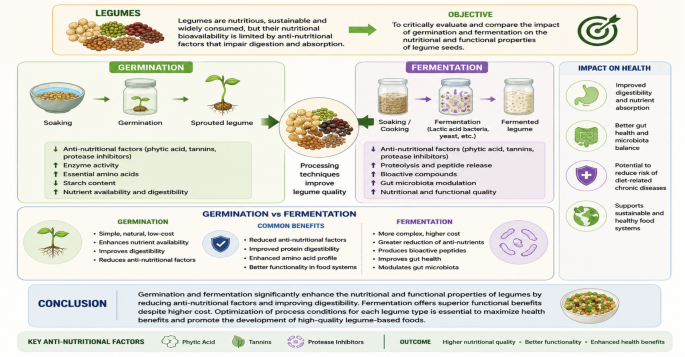

The global transition toward healthier and more sustainable diets has renewed interest in legumes as one of the most promising plant-based protein sources. Rich in proteins, dietary fiber, vitamins, minerals, and diverse phytochemicals, legumes are uniquely positioned to contribute to food security while reducing the environmental footprint of food production. However, their nutritional value is often compromised by anti-nutritional compounds such as phytic acid, tannins, lectins, protease inhibitors, and indigestible oligosaccharides, which reduce nutrient bioavailability and digestibility. These challenges inspired us to critically examine two of the oldest yet most effective processing technologies—germination and fermentation—and evaluate how they can transform legumes into nutritionally superior functional foods.
Although both techniques have been practiced for centuries, they are frequently studied independently. Our goal was to provide a comprehensive comparison of their mechanisms, nutritional impacts, functional improvements, and future opportunities. Rather than asking which technology is "better," we sought to understand where each process excels and how they might complement one another.
Germination initiates a remarkable biological transformation. Once seeds absorb water, endogenous enzymes become activated, mobilizing stored nutrients to support seedling development. This natural process breaks down starches into simpler sugars, hydrolyzes storage proteins into more digestible peptides and amino acids, and enhances the synthesis of bioactive compounds with antioxidant activity. At the same time, germination substantially reduces anti-nutritional factors, improving mineral bioaccessibility and overall nutritional quality. The review also highlights improvements in functional properties such as water-holding capacity, emulsification, and foaming characteristics, making germinated legume flours attractive ingredients for innovative food formulations.
Fermentation, in contrast, relies on the metabolic activities of beneficial microorganisms including lactic acid bacteria, yeasts, and filamentous fungi. These microorganisms further modify the legume matrix by producing enzymes that degrade phytates, tannins, and complex carbohydrates while generating bioactive peptides and flavor compounds. Fermentation not only enhances protein digestibility but also improves sensory characteristics that often limit consumer acceptance of legumes. Additionally, growing evidence suggests that fermented legumes may contribute to gut health through interactions with beneficial microbiota and the production of health-promoting metabolites.
One of the most exciting aspects of preparing this review was seeing how advances in analytical technologies have deepened our understanding of these traditional processes. Modern proteomic and metabolomic studies now reveal the formation of bioactive peptides during fermentation, while recent investigations demonstrate significant increases in antioxidant compounds, phenolics, flavonoids, and γ-aminobutyric acid (GABA) following optimized germination protocols. These molecular insights strengthen the scientific foundation behind processing methods that have been used for generations.
Another important message emerging from our analysis is that there is no universal processing strategy suitable for every legume. The magnitude of nutritional improvement depends on several interacting factors, including species and genotype, soaking conditions, germination duration, fermentation microorganisms, environmental conditions, and processing parameters. Even closely related legumes may respond differently to identical treatments. Therefore, optimization should be tailored to individual raw materials rather than applying generalized processing conditions.
Our comparison also highlighted practical differences between the two approaches. Germination offers an inexpensive, environmentally friendly, and relatively simple technology requiring minimal equipment, making it particularly attractive for household applications and small-scale food processors. Fermentation, while often requiring greater process control and microbial management, generally provides broader improvements in sensory quality, functional characteristics, bioactive peptide production, and potential health benefits. Instead of viewing these technologies as competitors, we believe they should be considered complementary tools within sustainable food processing systems.
From an industrial perspective, several challenges remain. Standardization of processing conditions across different legume varieties is still limited, making reproducibility difficult. Scaling laboratory protocols to commercial production requires careful consideration of product consistency, microbial safety, shelf stability, and economic feasibility. Furthermore, while numerous in vitro and animal studies demonstrate substantial nutritional improvements, well-designed human clinical trials remain relatively scarce. Bridging this gap will be essential for translating laboratory findings into evidence-based dietary recommendations and commercial functional food products.
Beyond nutrition, legumes also represent an opportunity to support more sustainable agriculture. As nitrogen-fixing crops, they contribute to improved soil fertility while requiring fewer synthetic fertilizers than many other crops. Enhancing their nutritional quality through germination and fermentation therefore aligns with broader goals of sustainable food systems, reduced environmental impact, and increased reliance on plant-derived proteins.
Looking ahead, we envision future research combining germination and fermentation sequentially, integrating precision fermentation technologies, advanced starter cultures, and systems biology approaches to maximize nutritional outcomes. Artificial intelligence and predictive modeling may further help optimize processing conditions for specific legume varieties, accelerating the development of next-generation functional foods.
Ultimately, our review reinforces a simple but important conclusion: both germination and fermentation significantly enhance the nutritional and functional value of legumes, each through distinct yet complementary biological mechanisms. As demand for sustainable plant-based foods continues to grow, these traditional bioprocesses—supported by modern scientific understanding—offer practical pathways for producing healthier, more nutritious, and consumer-friendly legume products. We hope this work encourages researchers, food technologists, and industry partners to continue exploring these remarkable natural technologies and their role in building resilient global food systems.

Mohamed Fawzy Ramadan is a Professor of Biochemistry at the Department of Clinical Nutrition, Faculty of Applied Medical Science, Umm Al-Qura University, Makkah, Saudi Arabia.
Prof. Ramadan obtained his Ph.D. (Dr. rer. nat.) in Food Chemistry from the Berlin University of Technology (Germany, 2004). Prof. Ramadan continued his postdoctoral research at ranked universities, including the University of Helsinki (Finland), the Max Rubner Institute (Germany), the Berlin University of Technology (Germany), and the University of Maryland (USA). In 2012, he was appointed as a Visiting Professor (100% teaching) in the School of Biomedicine, Far Eastern Federal University in Vladivostok, Russian Federation.
Prof. Ramadan has published more than 450 research papers and reviews in international peer-reviewed journals. He also edited and published several books and book chapters (Scopus h-index is 55 and more than 11000 citations). He was an invited speaker at several international conferences. Since 2003, Prof. Ramadan has been a reviewer and editor for several highly cited international journals, including the Journal of Medicinal Food, eFood, the Journal of Umm Al-Qura University for Applied Sciences, and the Journal of Advanced Research. He is the editor-in-chief of Journal of Umm Al-Qura University for Medical Science.
Prof. Ramadan received several prizes, including Abdul Hamid Shoman Prize for Arab Researcher in Agricultural Sciences (2006), the Egyptian State Prize for Encouragement in Agricultural Sciences (2009), European Young Lipid Scientist Award (2009), AU-TWAS Young Scientist National Awards (Egypt) in Basic Sciences, Technology and Innovation (2012), TWAS-ARO Young Arab Scientist (YAS) Prize in Scientific and Technological Achievement (2013), and Atta-ur-Rahman Prize in Chemistry (2014).
Follow the Topic
-
Journal of Food Measurement and Characterization
Journal of Food Measurement and Characterization is an interdisciplinary journal publishing new measurement results, novel methods, and procedures in food property measurement and characterization.

What are SDG Topics?
An introduction to Sustainable Development Goals (SDGs) Topics and their role in highlighting sustainable development research.
Continue reading announcement