Beyond the Battlefield: Simulating the Adaptive Dance of Modern War
Published in Mathematical & Computational Engineering Applications and Mathematics



The Russia-Ukraine conflict, now in its third year, has become a stark blueprint for 21st-century warfare. It’s not just a war of tanks and troops; it’s a complex, multi-dimensional struggle playing out in cyberspace, on energy grids, and across information networks. As an observer, you might wonder: how do you even begin to understand, let alone predict, the trajectory of such a fluid conflict where both sides are constantly learning and adapting?
In our recent study, published in Evolving Systems, we attempted to do just that. We didn't use a crystal ball, but something arguably more powerful: an agent-based model (ABM) . Think of it as a high-tech sandbox where we can simulate the war's key dynamics, not to predict the future, but to uncover the hidden rules that might determine who gains a strategic edge.
The Problem with Static Thinking
Traditional military models often treat war like a chess game with fixed rules and predictable moves. But the reality, especially in a hybrid conflict like the one in Ukraine, is far messier. Attackers and defenders are in a constant dance. One side develops a new drone tactic; the other quickly finds a way to jam it. Cyberattacks on the power grid are met with rapidly deployed, offline backup systems.
This is the core challenge our research tackles: how does the speed of adaptation itself become a deciding factor in a long, drawn-out conflict? We were particularly interested in a critical battleground that doesn't always make the front-page news: a nation's critical infrastructure. The power plants, communication networks, and railway systems that keep a country running and its military supplied.
Building a Digital War Lab
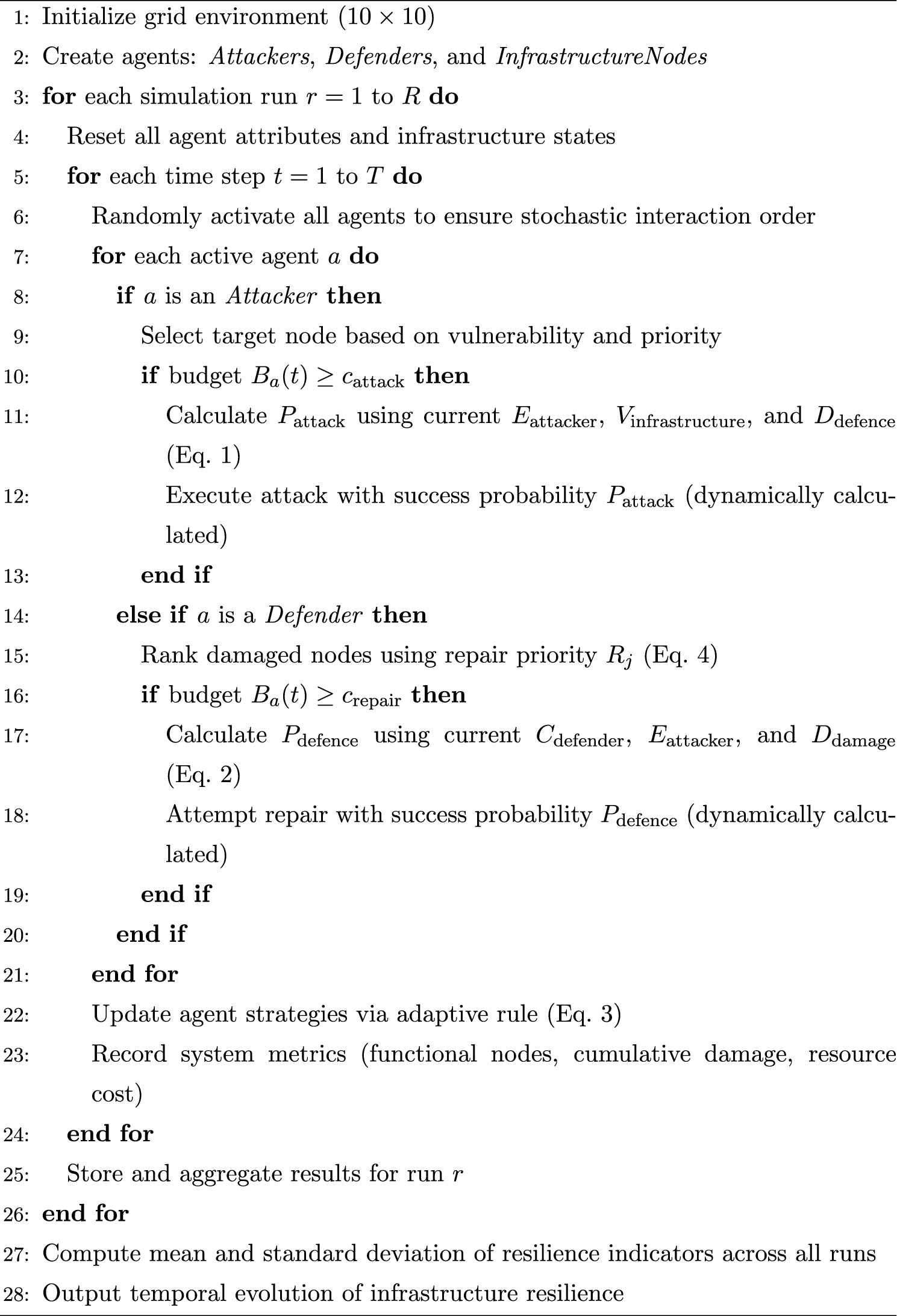
To explore this, we built a simulated world inside a computer, using an open-source Python library called Mesa. This world is populated by three types of agents:
-
Attackers: Modeled on the strategies of Russian cyber and military units, they try to damage infrastructure components.
-
Defenders: Representing Ukrainian repair crews and cyber defence teams, they work to protect and restore damaged systems.
-
Infrastructure Nodes: These are the targets—power stations, data centres, etc.—each with its own level of importance and vulnerability.
The magic of the model isn't just in these agents, but in how they behave. They aren't following a simple, pre-programmed script. Instead, they are adaptive. They learn from what happened in the previous round. If attacking a certain type of target proved successful, attackers might focus more effort there. If defenders successfully protected a critical energy hub, they learn to prioritize similar nodes in the future.
This mirrors the real-world "replicator dynamics" found in evolutionary biology and game theory—successful strategies spread, while unsuccessful ones die out. We also built in real-world complexities like redundancy (a system's ability to withstand an initial hit) and escalation thresholds (where a massive wave of attacks triggers a surge in defensive resources).
What the Simulation Taught Us
After running thousands of these simulated conflicts, three key insights emerged that resonate powerfully with what we're seeing in Ukraine.
1. Coordination is a Superpower.
Our model showed that uncoordinated attacks, while annoying, rarely cause lasting damage. But when attackers coordinated their strikes—for example, jamming communications just before a missile strike on a power plant—the damage was swift and severe. This reflects Russia's real-world tactics of synchronizing cyberattacks with kinetic strikes to maximize disruption.
Conversely, the power of coordinated defence was even more striking. When defenders prioritized repairs based on a node's criticality (e.g., fixing a main power distribution hub before a local substation), they could prevent a cascade of failures and keep the overall system running much longer. This perfectly mirrors Ukraine's "Power Banking Initiative" and its rapid, decentralized approach to repair, which has been vital to its resilience.
2. Redundancy Buys You Time, and Time is Everything.
In early, simpler versions of our model, infrastructure failed the moment it was hit. But by adding redundancy—the digital equivalent of backup generators and spare parts—the dynamic completely changed. Infrastructure could absorb the first few hits. This "delay" in total failure is crucial. It gives defenders the precious time they need to mobilize repairs and adapt their strategies, preventing a sudden, catastrophic collapse. This explains how Ukraine has kept parts of its energy grid running despite relentless targeting.
3. The Side That Learns Faster, Wins (in the long run).
This was our most important finding. Over an extended simulation, the single biggest factor determining long-term infrastructure health was not starting strength, but adaptive speed. The side that could more quickly adjust its tactics based on what just happened—attackers finding new weak points, defenders re-prioritizing their repairs—consistently ended up with a strategic advantage. In the real world, this is playing out in the drone war, the electronic warfare battle, and the constant struggle for control of the information space. Agility trumps brute force.
From Simulation to Strategy
Our model is, of course, an abstraction. It doesn't include the impact of international sanctions, foreign aid, or the morale of soldiers and civilians—factors that are incredibly difficult to quantify but undeniably important (Dalsjö et al. 2023; Hosoe 2023).
However, by focusing on the core feedback loop of attack, defence, and adaptation, we’ve built a powerful tool for thinking about the future. For military planners and policymakers, the implications are clear:
-
Invest in redundancy: A resilient system isn't one that never gets hit, but one that can keep functioning while under repair.
-
Prioritise coordination: Breaking down silos between different defence agencies (cyber, military, civil engineering) is not a bureaucratic nicety; it's a strategic imperative.
-
Value adaptability over raw power: The goal should be to build systems and train forces that can learn and evolve faster than the adversary.
The Russia-Ukraine war is a tragic reminder that conflict is a fundamental part of the human experience. By using tools like agent-based modeling, we can move beyond simple narratives of victory and defeat. We can begin to understand the deep, underlying dynamics of these conflicts, and perhaps, find smarter ways to build resilience and protect the critical systems our societies depend on.
References
-
Dalsjö, R., Jonsson, M., & Norberg, J. (2023). A Brutal Examination: Russian Military Capability in Light of the Ukraine War. Survival.
-
Dutta, K. (2026). Simulating adaptive warfare: insights from the Russia-Ukraine conflict. Evolving Systems. https://doi.org/10.1007/s12530-026-09796-z
-
Hosoe, N. (2023). The cost of war: Impact of sanctions on Russia following the invasion of Ukraine. Journal of Policy Modeling.

Follow the Topic
-
Evolving Systems
This is a scientific journal focusing on continuous, adaptive machine learning and dynamically evolving AI systems.