Boron nitride cages do not swallow metals
Published in Chemistry



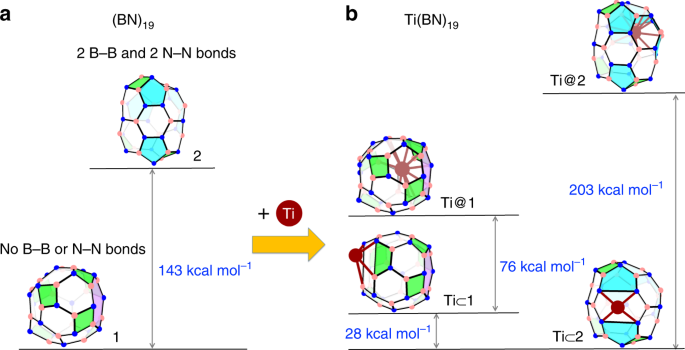

Boron nitride (BN) nanomaterials have been developed along with their isoelectronic carbon counterparts since the advent of nanoscience. They have received special attention owing to their unique properties and applications that carbon materials cannot offer. Metal-doped BN fullerenes, in particular, have been synthesized and identified experimentally and also intensively studied computationally. It has long been taken for granted that metal atoms are encapsulated inside BN nanocages, just as their carbon analogs do. The structures of the latter, known as endohedral metallofullerenes, have been well identified both experimentally and theoretically: even carbon cages as small as C28 have the ability to “swallow” a metal atom like Ti, Zr or U. However, to date the unambiguous, atomically resolved structures of metal-doped BN fullerenes still remain mysterious, due to lack of crystallographic evidence.
In our recently published paper in Nature Communications, we challenge the commonly held view that BN metallofullerenes are in general endohedral complexes. By systematically and carefully investigating a series of Ti(BN)n complexes (2n = 24—48) based on high-level DFT computations, we found, astonishingly, that the Ti atom strongly prefers to bind externally to the cage rather than to be “swallowed whole”. Thermodynamics calculations suggest that the former process is highly exergonic under typical conditions for producing BN clusters, while the formation of endohedral species is strongly hindered. This is strikingly contrasted with the known chemistry of carbonaceous fullerenes.
To understand these unexpected results, we scrutinized a large number of low energy isomers of Ti(BN)n and unveiled some common bonding features accounting for their high stability. Most notably, the tetravalent titanium atom is coordinated to four nitrogen atoms located at two parallel sides of a hexagonal face of the cage, which favors the metal-ligand orbital interactions while maintaining minimum strain of the cage framework. This means that by metal doping the BN nanocage must undergo a significant change in both cage topology and arrangement of B, N atoms. The doped cage contains a few pentagons or even heptagons, the unpopular rings that are always absent in pristine BN fullerenes. On the other hand, the redistribution of B, N atoms leads to the emergence of two B—B bonds. These “antisites” may have potential for CO2 capture and nitrogen fixation.
The exohedral nature of Ti(BN)n clusters could be verified by collision-induced dissociation experiments. With an excitation energy of the order of 10 eV, one should detect only Ti+ ions in mass spectra. If the metal was internally bound, much higher excitation energy would be required and the fragmented smithereens of parent cage might be observed as well.
Our findings may expand or alter the understanding of BN nanostructures functionalized with other transition metals, which we hope will stimulate further experimental and theoretical studies on this topic.
Follow the Topic
-
Nature Communications
An open access, multidisciplinary journal dedicated to publishing high-quality research in all areas of the biological, health, physical, chemical and Earth sciences.

Related Collections
With Collections, you can get published faster and increase your visibility.
Women's Health
Publishing Model: Hybrid
Deadline: Ongoing
Tumor Microenvironment Crosstalk and Therapeutic Implications
Publishing Model: Hybrid
Deadline: Nov 02, 2026