Bringing Single-Molecule Sensitivity to the Bedside: An Automated Digital Immunoassay for Pediatric Critical Care
Published in Bioengineering & Biotechnology, Chemistry, and Electrical & Electronic Engineering





The Clinical Reality of Pediatric Critical Care
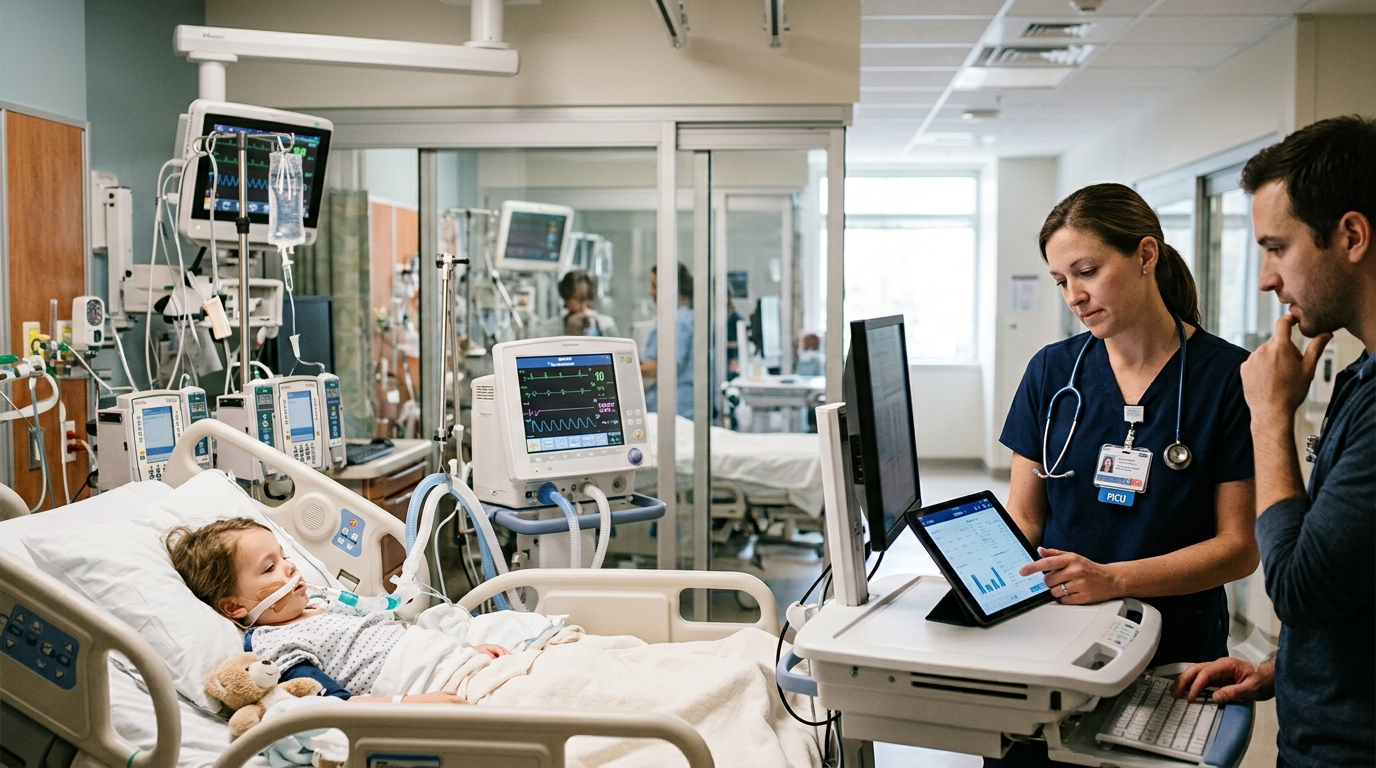
In a pediatric intensive care unit (ICU), clinicians routinely confront the frustrating limitations of broad, syndrome-based disease classifications. Critical illnesses such as acute respiratory failure (ARF) and acute respiratory distress syndrome (ARDS) are notorious for their profound biological heterogeneity. Two children presenting with the same clinical phenotype can often be grouped into distinct subphenotypes that exhibit unique underlying inflammatory profiles and divergent responses to therapy.
Our clinical collaborators at the University of Michigan established a vital framework to address this complexity, proving that pediatric patients can be stratified into distinct hyper- and hypo-inflammatory subphenotypes with different mortality rates and therapeutic needs. Crucially, this biological distinction is cleanly mapped by a small panel of three circulating biomarkers: soluble tumor necrosis factor receptor 1 (sTNFr1), interleukin-8 (IL-8), and interleukin-6 (IL-6).
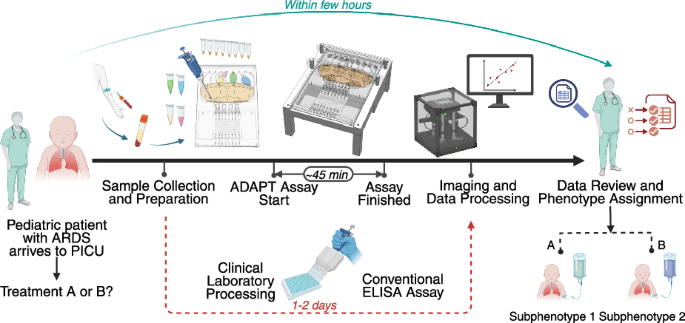
For an ICU physician, this discovery is exceptionally promising, but the therapeutic window for acute critical illness is measured in minutes to hours. However, conventional high-sensitivity digital protein detection is centralized and batch-based, often pooling samples over 12 to 24 hours and decoupling insights from the acute clinical timeline. Conversely, current point-of-care alternatives are rapid but lack the sub-picogram sensitivity required to resolve wide concentration fluctuations in severe immune dysregulation. Our goal was to build a system delivering central-lab sensitivity directly to the bedside on demand.
Automating Uniform Fluid Transport for a Digital Immunoassay Protocol
Executing a multi-step digital immunoassay on a microfluidic device requires consolidating bead handling, multi-stage washing, automated mixing, oil partitioning, and signal amplification into a seamless sequence.
Our primary engineering challenges centered on structural integrity and uniform fluid transport. Moving milliliters of fluid through an eight-channel parallel microscale network demands substantial positive pressure. Early prototype cartridges frequently suffered from fluid leakage, structural delamination, and flow non-uniformity; a localized resistance imbalance in a single channel would compromise the entire assay sequence.
Rather than relying solely on trial-and-error, we modeled the cartridge's architecture as an electrical equivalent circuit, treating channels as resistors and pneumatic pressures as voltages to analyze pressure build-up at critical junctions. This model guided the design of a precise dual-planar inlet geometry that stabilized flow distribution across all eight parallel channels and prevented sample cross-contamination. A major turning point came during a fluidic dye test: watching the high-contrast dyes stream uniformly through all channels without leaking confirmed our model worked, speeding up experimental progress.
Balancing Single-Molecule Sensitivity with Scalability
In the field of microfluidics, many exceptional innovations struggle to transition from academic proof-of-concept into large-scale manufacturing and user-friendly operation. To ensure our platform, called ADAPT (Automated Digital Assay for Precision Treatment), could scale realistically into clinical infrastructure, we pursued a hybrid manufacturing strategy that decouples the high-precision components from the bulk consumable volume. The high-density femtoliter-volume microwell arrays required for single-molecule counting are confined entirely to a small sensor substrate. While our analytical validation was performed using soft-lithography PDMS chips, we demonstrated the feasibility of migrating this fabrication to an injection-molded Cyclic Olefin Copolymer (COC) format suitable for industrial production. Conversely, the surrounding cartridge body is built via discrete 2D layers of laser-cut PMMA and pressure-sensitive adhesives (PSA). This lamination process avoided expensive injection-molding tooling during prototyping while remaining fully compatible with eventual scale-up manufacturing.
From Lab Bench to Clinical Relevance
Automating the fluidic sequence on-cartridge reduces human error, transitioning a complex, multi-step manual protocol into a single preloading step and run. This automation and the pre-equilibrium digital immunoassay method allows ADAPT to compress the fluidic assay time to approximately 35 minutes, achieving a total sample-to-answer turnaround of just 45 minutes.
To determine the platform's analytical performance, we generated standard titration curves across our multi-biomarker panel. The system achieves sub-picogram limits of detection (LOD) and three orders of magnitude dynamic ranges for our targets. While these metrics meet or exceed the capabilities of existing immunoassay platforms, their true significance lies in the clinical context. The resulting operational ranges match the pathophysiological concentrations found in critically ill patient groups. Because the system captures the full spectrum of high and low inflammatory signals, it meets the strict, rapid requirements for real-time stratification in the PICU.
To confirm this clinical utility, we profiled these three biomarkers using previously collected plasma samples from pediatric patients diagnosed with acute respiratory failure. When compared to gold-standard commercial multiplex assays, ADAPT demonstrated strong linear correlations, with R2 values ranging from 0.925 to 0.979. For our team, reviewing that final correlation data was an incredibly rewarding milestone. Seeing an automated system built from low-cost laminates generate data that matched the fidelity of a centralized laboratory instrument was a powerful moment. It made us realize that this technology could move beyond our lab and actively influence a child's clinical outcome in the future.
Towards the Ultimate Vision of Bedside Precision Medicine
While ADAPT successfully integrates single-molecule counting within a scalable, on-demand fluidic system, our current validation relies on plasma requiring off-cartridge centrifugation of whole blood. To achieve bedside operation, our next milestone involves integrating an on-cartridge blood separation module. This will allow the cartridge to accept fresh whole blood from a line draw or finger prick, bypassing off-cartridge processing.
Our ultimate vision is to see this system at the bedside in ICUs nationwide. Empowering clinicians to monitor fluctuating immune dynamics on demand will allow therapies to adapt dynamically to a patient's real-time biology, transforming critical care into data-driven, personalized precision medicine.
For more details, please refer to our full paper published in Microsystems & Nanoengineering: "An Automated, Digital Immunoassay on a Microfluidic Cartridge for On-Demand Cytokine Profiling" https://doi.org/10.1038/s41378-026-01374-2

Follow the Topic
-
Microsystems & Nanoengineering
This journal, with a target for a high-end journal for years to come, seeks to promote research on all aspects of microsystems and nanoengineering from fundamental to applied research.