Building a quantum probe of the unseen Universe






Behind the Paper: A Prototype Differential Atom Interferometer for Fundamental Physics
We still do not know what most of the Universe is made of. Roughly 95 percent of its content sits in dark matter and dark energy, and after decades of work the question of what they actually are remains wide open. One of the more interesting developments in recent years is that quantum sensing is now reaching the level where it can probe tiny effects that ultralight dark matter, or other exotic fields, would produce on individual atoms. Long baseline atom interferometers are built around this idea. They are sensitive to small changes in fundamental constants or fields across two widely separated locations, and they are also sensitive to gravitational waves in a frequency band that no existing detector can reach.
The principle is simple. A single laser interrogates two widely separated clouds of ultracold atoms, and a phase difference between the two could be induced by interesting new fundamental physics. This could be a dark matter field shifting atomic energy levels, or a gravitational wave passing through the detector. The problem is that the laser itself produces phase noise that is much larger than anything we want to measure. To overcome this, we compare two interferometers, between which the laser noise cancels almost perfectly. This common mode cancellation is the central assumption underlying the entire programme. However, until our experiment, nobody had shown that it could work in the regime that future detectors will operate in, specifically with strontium 87, which is the atom we want for long terrestrial baselines and eventually for an experiment in space.
That is what we set out to test in our paper [1], now published in Nature. In the Imperial Ultracold Strontium Laboratory we built a tabletop prototype with two macroscopically separated clouds of ultracold strontium 87 interrogated by a single ultrastable clock laser. We then deliberately added several radians of random phase noise to the laser. This is much more than the best clock lasers naturally produce, but it represents the kind of accumulated laser phase noise a kilometre scale detector would have to reject.
Each individual interferometer was, by any conventional measure, no longer usable. The fringes were scrambled and there was no signal one could interpret directly. But the differential measurement, comparing the two clouds, was made at the fundamental quantum limit set by the number of atoms we were counting. The moment it became real for me was watching the correlation plot of the two interferometers build up shot by shot. Each individual measurement looked random. The ellipse forming in the correlation was clean. The two unusable signals, taken together, were able to tell us about their difference.
We then went a step further and showed that an oscillating signal injected into one of the interferometers, the kind of signal a real detector could see from a dark matter field or a passing gravitational wave, was still cleanly recoverable under the same scrambled conditions. No individual interferometer carried usable phase information. The comparison between them did.
This work is the result of years of effort by the Atom Interferometer Observatory and Network (AION) consortium [2], involving eight UK institutions. Their combined work on ultrastable lasers, ultra high vacuum systems and ultracold strontium physics made the experiment possible. We dedicate the paper to the memory of Ian Shipsey of Oxford, whose vision and leadership were instrumental in establishing the AION programme, and who is sorely missed.
The natural next step is to take this from the laboratory to a real detector. AION members are now contributing to the Atom Interferometry CERN Experiment (AICE) [3], which is preparing a Technical Proposal for a long baseline atom interferometer at CERN. A facility on this scale would already enable sensitive searches for ultralight dark matter and other dark sector signatures, while building the infrastructure and techniques needed for the longer baselines that come after.
AICE sits within a broader international landscape that includes MAGIS-100 at Fermilab in the United States [4], MIGA in the deep underground laboratory at Rustrel in France [5], and ZAIGA under construction in China [6]. These efforts are now coordinated through the Terrestrial Very Long Baseline Atom Interferometry collaboration [7], with a long term horizon that reaches to space missions such as AEDGE [8].
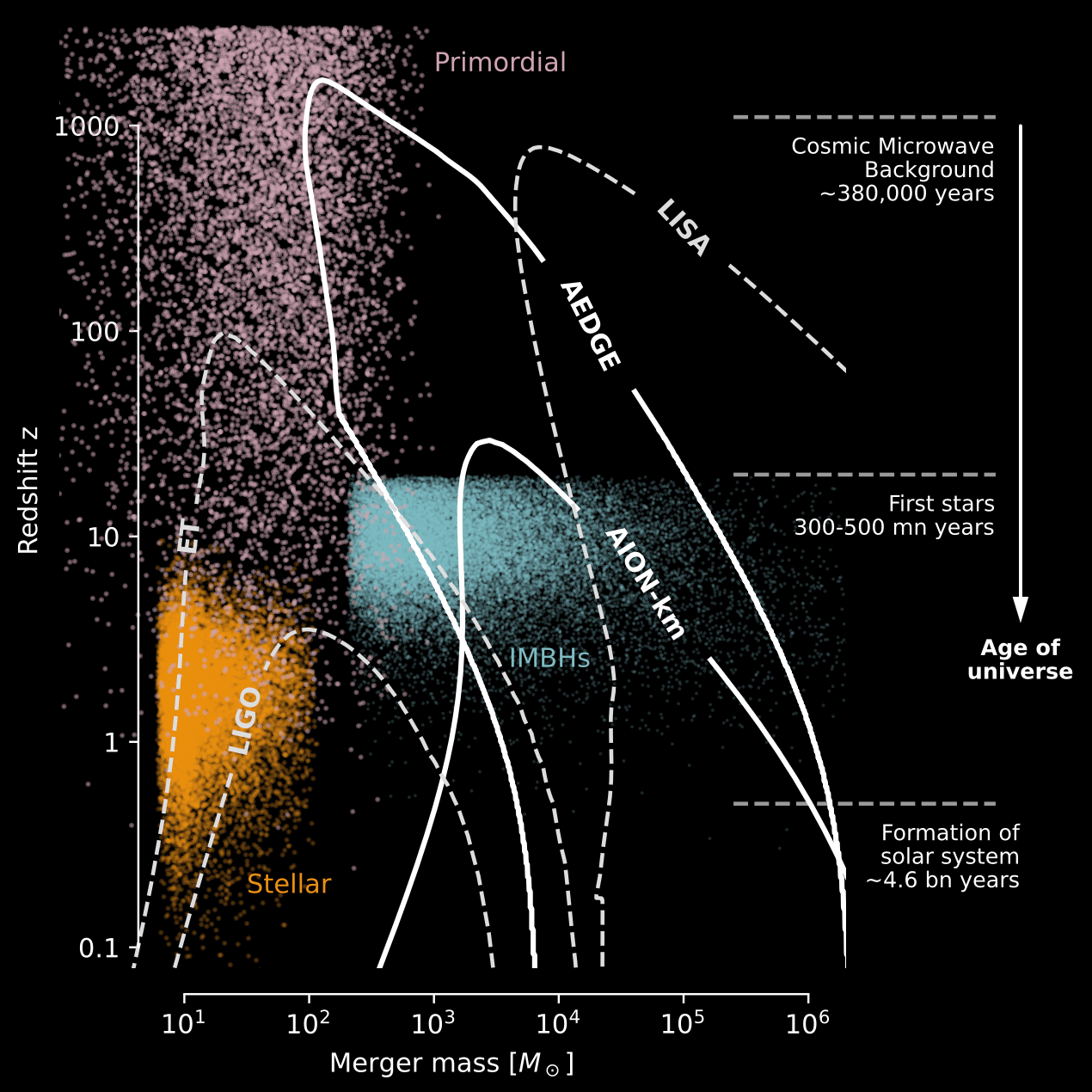
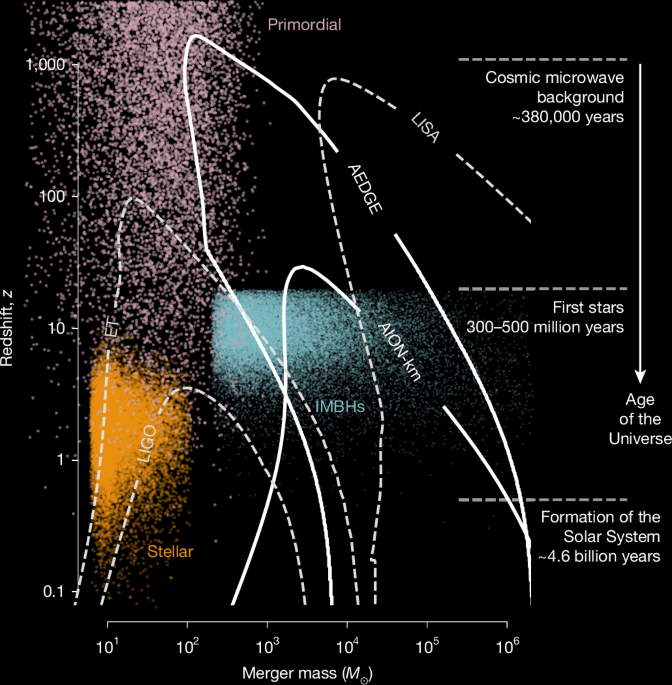
Atom interferometers of this kind are direct probes of the dark sector. They can search for ultralight dark matter, possible variations of fundamental constants, and other physics beyond the Standard Model. They will also open an unexplored part of the gravitational wave spectrum, the frequency band between LIGO and LISA where mergers of intermediate mass black holes would show up and where solar mass binary inspirals could be tracked for weeks before they enter the LIGO band, giving telescopes when and where to look.
The technology developed for these experiments reaches well beyond fundamental physics. Ultracold atom sources, ultrastable lasers and precision interferometry are also central to optical atomic clocks, quantum sensors for navigation and geodesy, and neutral atom approaches to quantum computing. Strontium is especially attractive because the same narrow optical clock transition that makes it useful for precision measurement also opens routes to coherent quantum control. The advances we need for long baseline atom interferometry, in atom number, coherence time and laser control, also strengthen this wider quantum technology platform.
We have not built a long baseline detector with this paper. What we have done is demonstrate that the central experimental principle, the cancellation of laser noise between two widely separated atom interferometers, works in the regime that future detectors will need. The remaining challenges are real. We need more atoms, longer baselines, large momentum transfer and squeezed quantum states. But people are working on all of these in laboratories around the world. The route to using quantum sensors as direct probes of the dark Universe is open.
References
[1] C. F. A. Baynham, R. Hobson, O. Buchmüller et al., "A Prototype Differential Atom Interferometer for Fundamental Physics", Nature (2026). DOI: [10.1038/s41586-026-10617-1], https://www.nature.com/articles/s41586-026-10617-1
[2] AION (Atom Interferometer Observatory and Network): hep.ph.ic.ac.uk/AION-Project. See also L. Badurina et al., JCAP 2020, 011 (2020).
[3] C. Baynham et al., "Letter of Intent: AICE, Atom Interferometry CERN Experiment", arXiv:2509.11867 (2025).
[4] MAGIS-100 at Fermilab: magis.fnal.gov. See also M. Abe et al., Quantum Sci. Technol. 6, 044003 (2021).
[5] MIGA project: miga-project.org. See also B. Canuel et al., Sci. Rep. 8, 14064 (2018).
[6] M.-S. Zhan et al., "ZAIGA: Zhaoshan Long-baseline Atom Interferometer Gravitation Antenna", Int. J. Mod. Phys. D 29, 1940005 (2020).
[7] S. Abend et al., "Terrestrial Very-Long-Baseline Atom Interferometry: Workshop Summary", AVS Quantum Sci. 6, 024701 (2024). See also A. Abdalla et al., EPJ Quantum Technology 12, 42 (2025).
[8] Y. A. El-Neaj et al., "AEDGE: Atomic Experiment for Dark Matter and Gravity Exploration in Space", EPJ Quantum Technology 7, 6 (2020).

Follow the Topic
-
Nature
A weekly international journal publishing the finest peer-reviewed research in all fields of science and technology on the basis of its originality, importance, interdisciplinary interest, timeliness, accessibility, elegance and surprising conclusions.

Related Collections
With Collections, you can get published faster and increase your visibility.
Carbon Dioxide Removal
Publishing Model: Hybrid
Deadline: Jan 16, 2027
Cancer Neuroscience: from mechanisms to therapy
Publishing Model: Hybrid
Deadline: Jan 30, 2027