Calling for nominations for JEET Emerging Scientist Award in Ethnobiology
Published in Social Sciences, Ecology & Evolution, and Microbiology


In 2025, the Editor-in-Chief, BMC, and the Board Members of Journal of Ethnobiology and Ethnomedicine (JEET) launched the JEET Emerging Scientist Award in Ethnobiology. This annual award is given to three colleagues – one winner and two runners-up – who made outstanding contributions to the field of Ethnobiology and Ethnosciences and are in the early stages of their career.
Ethnobiological sciences explore the inextricable links between human societies and nature, food, and health. The relationship between humans and nature is a topic that is as ancient as human civilization itself, and it has come back to the attention of the global scientific community over the past decades. Ethnobiology brings together many crucial topics of the present, including sustainability, the ecological transition, biodiversity and conservation, Indigenous knowledge, public health, and environmental protection. Advances have been made in all the relevant fields in this subject, such as ethnobotany, ethnomycology, ethnozoology, ethnoecology (including ethnopedology), ethnogastronomy, ethnomedicine, and ethnoveterinary, as well as all related areas in environmental, nutritional, and medical anthropology.
The JEET Emerging Scientist Award in Ethnobiology is a unique prize, aiming to reward and celebrate scholars who worked together with local communities and Indigenous Peoples to foster their wellbeing, create inclusion, and mitigate marginalization and stigmatization.
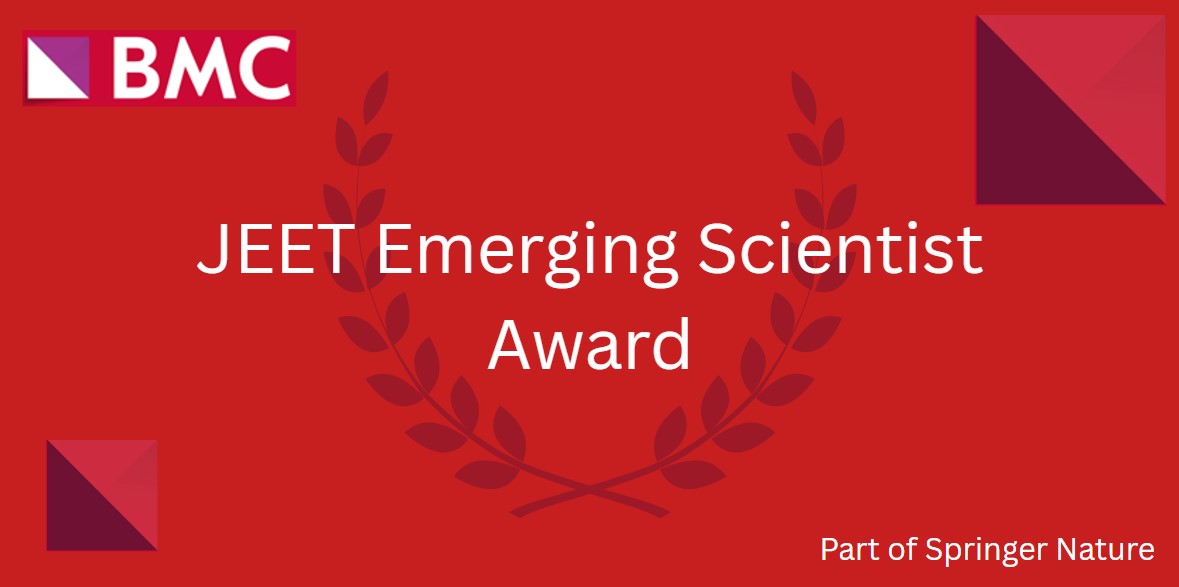
Nominations are open from 1 April to 31 April 2026. Prize criteria, including the process for nomination, eligibility and selection, and the Prize Committee, can be found on the prize page.
The criteria and rules of this award have been updated and improved for the 2026 selection. “Documented research work” has been redefined to ensure alignment and transparency, now referring to verifiable scholarly or research outputs that demonstrate active engagement in Ethnobiology and/or Ethnomedicine and that are publicly accessible or independently confirmable. To make the prize more inclusive, the early-career researcher window is defined as those who have begun publishing and/or conducting documented research in the fields of Ethnobiology and/or Ethnomedicine on or after 1 January 2016. A new assessment criterion designed to recognize and reward exceptional research achievements accomplished in contexts with particularly limited resources or funding. This should give more opportunities to disadvantaged researchers to display their work. Research work published in languages other than English will be allowed for the 2026 selection.
The winners will receive:
- A cash prize of 1,000 EUR for the most outstanding
- 2 cash prizes of 500 EUR for two runners-up
The cash prize is provided by Springer Nature.
This award recognizes exceptional scientific efforts in documenting, culturally analyzing, and interpreting local communities’ nature knowledge and folk medical practices heritage, especially those of neglected groups. By awarding and encouraging high quality research in this field, the Prize Committee, JEET, and BMC hope that more can be done to revitalize local ecological and medical knowledge systems and turn it into concrete future projects.
In recognition that some scholars —especially women, Indigenous and non‑binary researchers, and LGBTQIA+ individuals — face more structural obstacles to conducting research (including unequal domestic and care responsibilities, discrimination or exclusion within academic and fieldwork contexts, limited access to education or research opportunities, and other systemic barriers), the committee will give positive consideration to nominations that demonstrate exceptional achievement in the face of such challenges.
2025 JEET Emerging Scientist Award in Ethnobiology Winners
Winner: Naji Sulaiman, University of Gastronomic Sciences, Italy
Runner-up: Cheng Zhuo, Minzu University of China
Runner-up: Emiel De Meyer, Ghent University, Belgium
Read about the awardees here.

Follow the Topic
-
Journal of Ethnobiology and Ethnomedicine

This journal publishes original research focusing on cultural perceptions of nature and of human and animal health. It invites research articles, reviews and commentaries concerning the investigations of the inextricable links between human societies and nature, food, and health.
What are SDG Topics?
An introduction to Sustainable Development Goals (SDGs) Topics and their role in highlighting sustainable development research.
Continue reading announcementRelated Collections
With Collections, you can get published faster and increase your visibility.
Small-scale farming and ethnobiology – Bridging local knowledge, biodiversity, and cultural landscapes
The importance of deepening our understanding of small-scale farming and its intersections with ethnobiology and ethnoecology cannot be overstated. These fields illuminate not only traditional agricultural practices that have sustained communities for generations, but also contemporary locally adapted sustainable practices. Together, they underscore the vital role of local knowledge in preserving biodiversity and shaping cultural landscapes.
Recent research has highlighted the intricate relationships between local communities and their territories and ecosystems, showing how both traditional and locally adapted innovative farming methods can enhance biodiversity and promote ecological balance. These insights are essential for informing sustainable land management and ecosystem resilience.
Looking ahead, continued exploration in this area holds the potential to yield transformative insights. Integrating traditional knowledge with organic and agroecological practices—which may be ancient, innovative, or retro-innovative—can lead to more sustainable and resilient food and agriculture systems. This research is not only key to preserving cultural heritage but also to addressing urgent global challenges related to food security and environmental sustainability.
Topics of interest include, but are not limited to:
Local Knowledge & Sustainability
• Local Knowledge Systems in Agriculture
• Traditional Agricultural Practices and Sustainability
• Indigenous Knowledge and Climate Resilience
Biodiversity & Conservation
• Biodiversity Conservation in Small-Scale Farming
• Ethnobiological Approaches to Conservation
• Ethnoecological Perspectives on Land Use
Agroecology, Organic Farming & Cultural Landscapes
• Agroecological & Organic Practices and Transitions
• Innovation and Local Knowledge in Agroecological and Organic Systems
• Cultural Landscapes and Food Sovereignty.
This Collection supports and amplifies research related to SDG 2, Zero hunger, SDG 12, Responsible consumption and production, and SDG 15, Life on land.
All submissions in this collection undergo the journal’s standard peer review process. Similarly, all manuscripts authored by a Guest Editor(s) will be handled by the Editor-in-Chief. As an open access publication, this journal levies an article processing fee (details here). We recognize that many key stakeholders may not have access to such resources and are committed to supporting participation in this issue wherever resources are a barrier. For more information about what support may be available, please visit OA funding and support, or email OAfundingpolicy@springernature.com or the Editor-in-Chief.
Publishing Model: Open Access
Deadline: Jun 22, 2026
Ethnobiological Research in South and South East Asia
This collection seeks to advance ethnobiological research across South Asia and South East Asia—two regions rich in cultural and biological diversity yet underrepresented in global scholarship. By bringing together scientists from countries such as India, Pakistan, Nepal, Bangladesh, Sri Lanka, Bhutan, and the Maldives (South Asia), as well as Myanmar, Thailand, Laos, Cambodia, Vietnam, Malaysia, Singapore, Indonesia, Brunei, the Philippines, and Timor‑Leste (South East Asia), the collection aims to fill a critical gap in the literature while fostering collaborative networks that transcend political and social boundaries.
We invite contributions that explore:
- Traditional ecological knowledge
- Human–nature interactions
- The role of ethnobiology in addressing contemporary challenges, such as biodiversity conservation
- Ethnobiological perspectives on sustainable livelihoods
- Cultural heritage preservation in diverse and rapidly changing environments
Beyond advancing science, this collection aspires to serve as a bridge—supporting dialogue and cooperation among researchers in regions where collaboration is often difficult but deeply needed.
All submissions in this Collection undergo the journal’s standard peer review process, and all manuscripts authored by a Guest Editor(s) are handled by the Editor-in-Chief. As an open access publication, this journal levies an article processing fee (details here). We recognize that many key stakeholders may not have access to such resources and are committed to supporting participation in this issue wherever resources are a barrier. For more information about what support may be available, please visit OA funding and support, or email OAfundingpolicy@springernature.com or the Editor-in-Chief.
Publishing Model: Open Access
Deadline: Nov 27, 2026


Please sign in or register for FREE
If you are a registered user on Research Communities by Springer Nature, please sign in