Can Nanomagnetic-Based Cementitious Material Seal Cracked Rocks?
Published in Earth & Environment and Civil Engineering


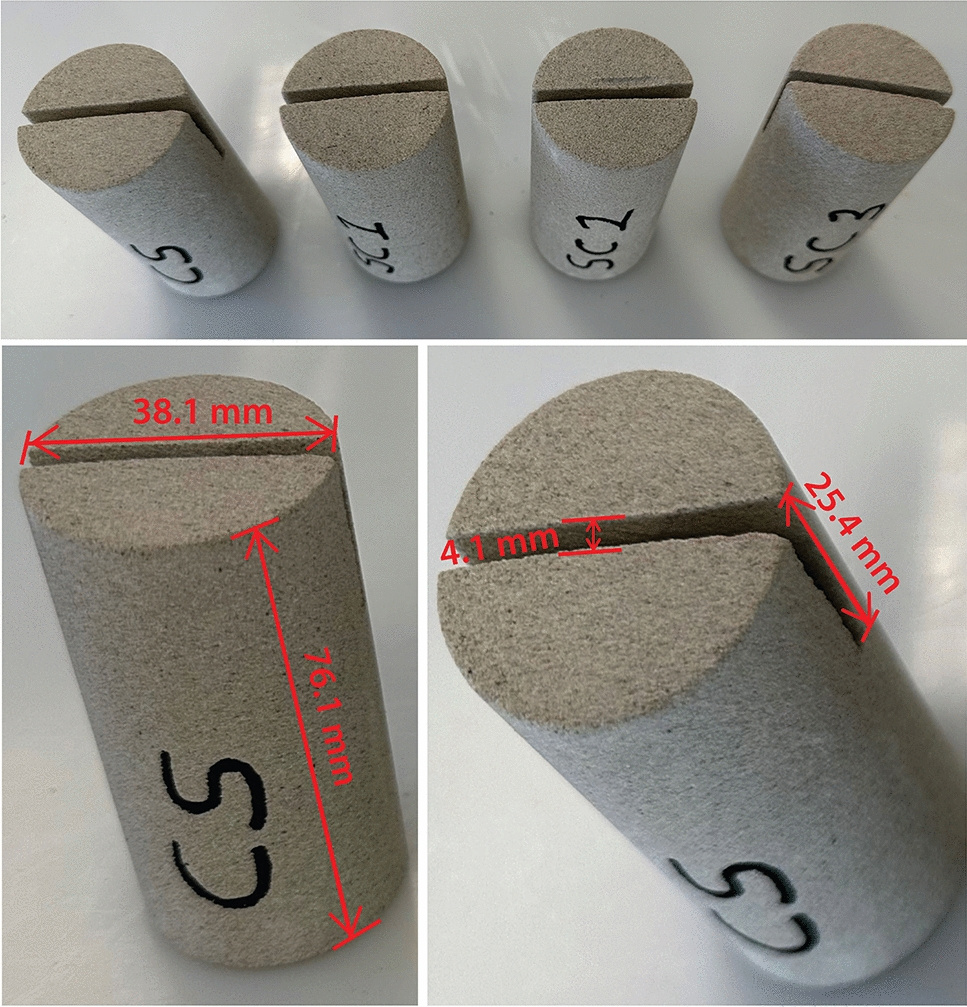

Rock crack cementing/sealing is important in earth engineering applications, where it is used to inject grout (cementitious materials) into cracks and voids in rocks (located either on the surface or in underground). This process enhances hydraulic properties, provides greater strength, reduces permeability, and improves overall rock stability. Cementitious materials can be used to fill the cracks and openings in rocks to improve their bonding/sealing efficiency, thus enhancing the overall strength of the rock and preventing anti-seepage. Currently, advancements in cementing technologies have introduced innovative methods, which include using nanoparticles, cementitious materials, and chemical cementitious materials, as effective solutions for this purpose. However, because of the limitations of traditional cementitious materials, such as limited resistance to dispersion, inadequate bonding properties, inconsistent mixture design and viscosity, injection pressure, and in-situ stress, an alternative method for in-filling of underground rocks containing cracks and openings is necessary. To address these issues, we developed and proposed a novel nanomagnetic-based cementitious material (which contains nanomagnetic powder, fly ash, and epoxy resin) and used the proposed nanomagnetic-based cementitious materials to fill cracks in rocks, and further assessed if it can seal and improve the strength of the cracked rocks for geo-engineering and underground infrastructure projects. This will inform the civil engineering community if the material has the potential to enhance the hydraulic properties, reduce permeability, and improve the overall mechanical stability of cracked rocks.
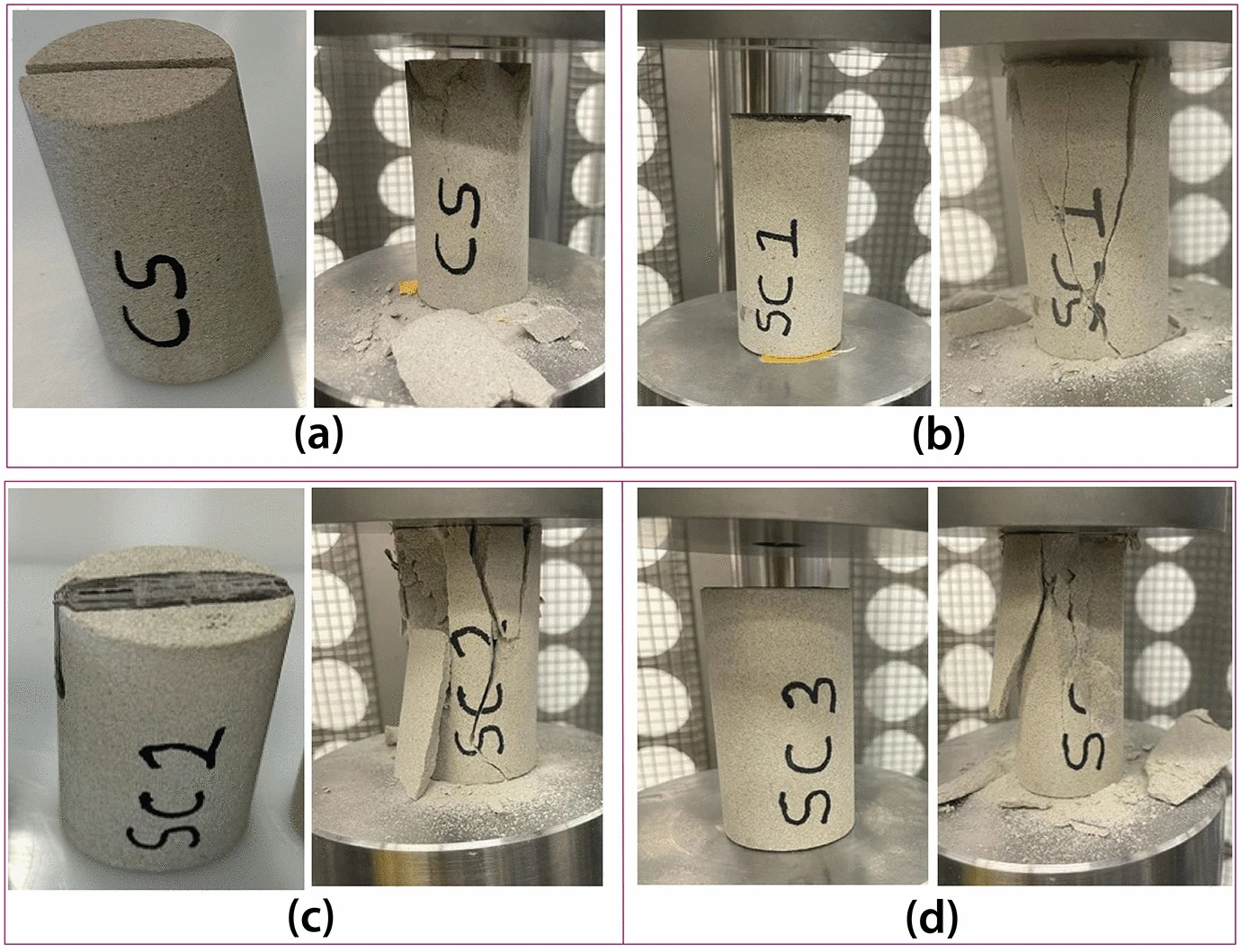
The result consists of evidence from flow performance tests, rock density, micro-scale imaging, and strength quantification. The flow performance test revealed distinct variations in the flow rates of the nanomagnetic cementitious material mixtures, highlighting the impact of different proportions of nanomagnetic powder and fly ash. The mixture with 15% nanomagnetic powder (MS1) showed an intermediate flow rate, while the mixture with 35% nanomagnetic powder (MS2) had the lowest flow rate. The mixture with 55% nanomagnetic powder (MS3) achieved the highest flow rate. These results indicate that the flowability of the nanomagnetic cementitious material is influenced by the ratio of nanomagnetic powder to fly ash in the mixture. The study also measured the rock density of both pre-treatment and post-treatment core samples. The results showed an increase in rock density after treatment, suggesting a reduction in void space within the rocks and occlusion of the cracks. This increase in density indicates that the nanomagnetic cementitious material effectively filled and bonded the cracks, creating a denser structure. Scanning Electron Microscopy (SEM) analysis was used to evaluate the microstructure of the rock samples before and after treatment. The SEM images revealed that the untreated rock samples had distinct mineral grains with capillary pore spaces. After cementing, the rock surface was covered with the hardened cementitious material, and the mineral grains were embedded within the cementitious material matrix. This observation suggests that the nanomagnetic cementitious material effectively penetrated and adhered to the crack surfaces, enhancing the bonding strength.
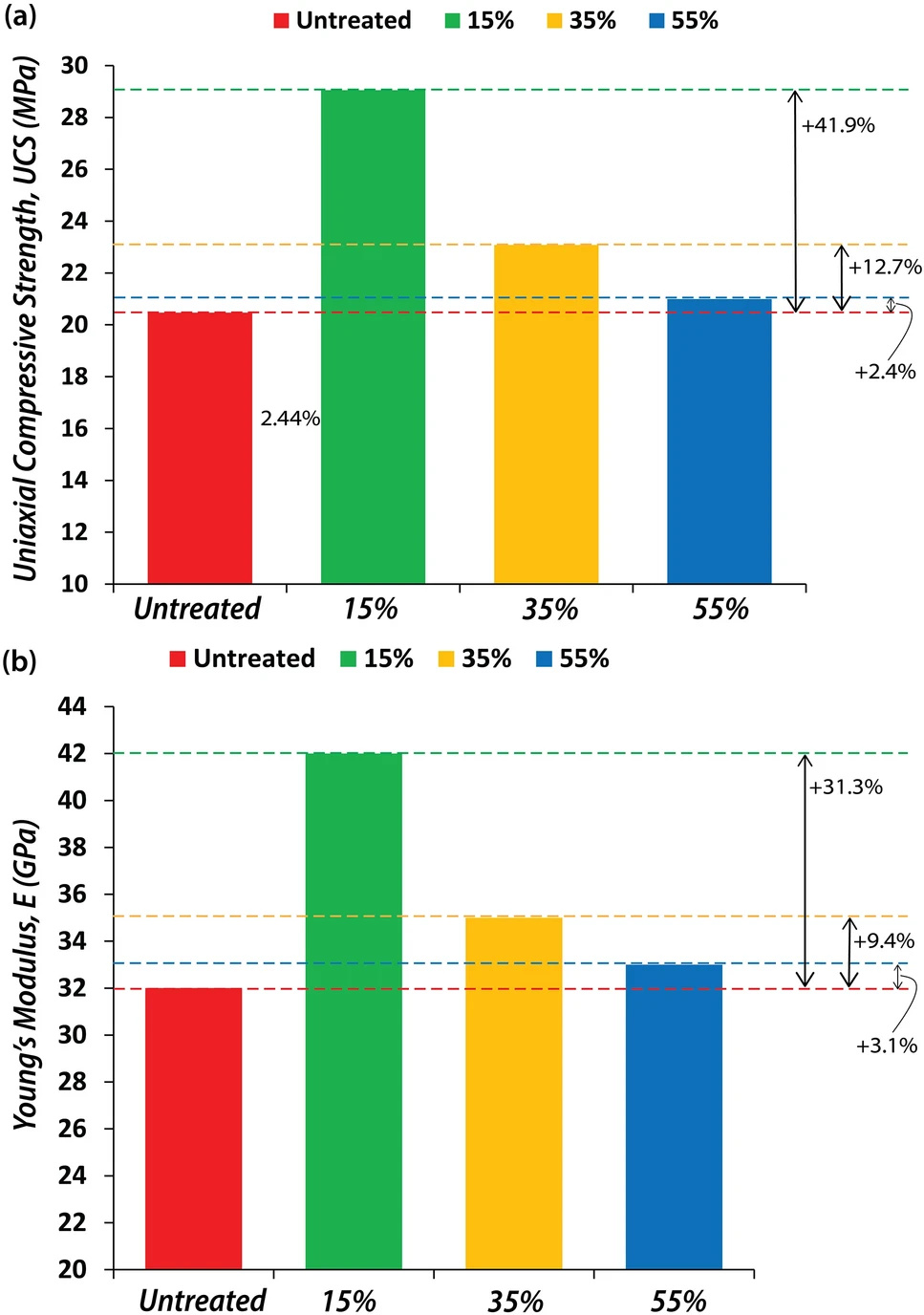
The mechanical properties of the rock samples were assessed using uniaxial compression tests. The results showed that the uniaxial compressive strength (UCS) and Young's modulus (E) of the treated rock samples improved significantly compared to the untreated samples. The mixture with 15% nanomagnetic powder (MS1) yielded the highest strength and stiffness, indicating that this composition provided the most effective reinforcement. The UCS of the treated samples increased by up to 41.9%, and the stiffness improved by up to 31.3%. The study concludes that the nanomagnetic cementitious material is an effective, eco-friendly alternative to traditional cement-based materials. The optimal mixture, containing 15% nanomagnetic material, enhances the rock's density and mechanical properties, making it more resistant to deformation and failure. The nanomagnetic cementitious material offers several advantages, including improved flowability, better bonding strength, and increased durability. Additionally, the use of nanomagnetic materials and fly ash contributes to the sustainability of the cementing process, reducing the environmental impact compared to traditional cement-based slurries.
Overall, the research provides new insights into the development of advanced rock-cementing materials for reinforcing cracked rocks. The findings suggest that the nanomagnetic cementitious material can significantly improve the stability and strength of rock formations, making it a promising solution for geo-engineering and underground infrastructure applications. The study highlights the potential of nanomagnetic cementitious material to enhance the performance of rock-binding operations, offering a sustainable and effective alternative to traditional methods.

Editorial Board Member, Discover Civil Engineering Journal, Springer Nature
Dr. Oladoyin Kolawole is an Assistant Professor of Geomechanics and Geotechnical Engineering in the Department of Civil and Environmental Engineering at New Jersey Institute of Technology (NJIT), USA. He is the founding director of the Geomechanics for Geo-Engineering and Sustainability (GGES) Lab. Prior to joining NJIT, Dr. Kolawole was a Postdoctoral Research Associate at Texas Tech University, before later working as a Faculty Fellow (Visiting Faculty) at Hope College, Michigan. He pioneered the “biogeomechanics” concept, which studies the mechanical response of rocks due to biological-induced processes. His interest is in experimental and computational studies to fundamentally understand and predict the multiscale mechanics and physical attributes of porous materials across scales. Dr. Kolawole is a recipient of the Future Leader Award and the Distinguished Service Award from the American Rock Mechanics Association (ARMA). He currently serves on the Committee on Geological and Geotechnical Engineering at the U.S. National Academies.
Follow the Topic
-
Discover Civil Engineering
This is a fully open access, peer-reviewed journal that supports multidisciplinary research and policy developments across the field of civil engineering.

Related Collections
With Collections, you can get published faster and increase your visibility.
Resilient Urban Transportation Systems: Planning, Design, Governance, and Technological Innovation
Urban transportation systems are critical components of modern cities, facilitating mobility and access while contributing to economic vitality. However, these systems face significant challenges, including climate change, population growth, and increasing urbanization, which can compromise their resilience and efficiency. As cities evolve, there is a pressing need to rethink transportation planning, design, and governance frameworks to better adapt to these challenges. Emphasizing resilience in urban transportation is essential to ensure that systems can withstand disruptions and continue to function effectively in the face of unforeseen events.
The purpose of this Collection is to provide a scholarly platform for exploring the multifaceted dimensions of resilient urban transportation systems.
Topics of interest include:
- Smart mobility and intelligent transport systems for adaptive and disruption-responsive urban movement.
- Policy and governance frameworks that promote sustainable, inclusive, and resilient mobility.
- Transportation equity and accessibility during public emergencies and urban disruptions.
- GIS and data-driven vulnerability assessment for transport infrastructure risk mitigation.
- Multi-modal transport planning integrating public transit, cycling, walking, and other sustainable modes to enhance network robustness.
- Climate-resilient transport infrastructure, including design and material innovations for roads, bridges, and transit systems under extreme weather and long-term climate change.
- Disaster preparedness and recovery frameworks for rapid restoration of mobility and logistics networks.
- Energy transition in urban transport, including electric mobility, renewable charging infrastructure, and low-carbon systems.
- Digital twins and predictive simulation for evaluating transport system performance under disruption scenarios.
- Resilient urban logistics and freight systems, including last-mile delivery during crises.
- AI and predictive analytics for incident management, including real-time monitoring and response.
- Safety and security in transport systems, addressing physical, digital, and cyber resilience.
This Collection supports and amplifies research related to: SDG 9 and SDG 11.
Keywords: Urban transport resilience; climate adaptation; intelligent transport systems; multi-modal networks; GIS and data analytics; transport equity; sustainable mobility; emergency response; digital twins; resilient logistics.
Publishing Model: Open Access
Deadline: Dec 23, 2026
Waste-Based and Sustainable Concrete Materials: Performance and Structural Applications
The construction industry is under increasing pressure to reduce its environmental impact while maintaining the safety, durability, and performance of civil infrastructure. In this context, waste-based and sustainable concrete materials have emerged as promising alternatives to conventional concrete through the incorporation of recycled aggregates, industrial by-products, agricultural wastes, supplementary cementitious materials, and other environmentally friendly constituents.
This Topical Collection aims to provide a focused platform for recent advances in the development, characterization, and application of waste-based and sustainable concrete materials. Particular emphasis is placed on material design, mechanical properties, durability performance, microstructural behavior, structural response, and practical applications in sustainable construction.
The Collection welcomes original research articles and review papers addressing experimental investigations, numerical modeling, performance assessment, durability evaluation, life-cycle considerations, and structural applications of sustainable concrete materials. Topics may include, but are not limited to, recycled aggregate concrete, waste ceramic concrete, fiber-reinforced sustainable concrete, geopolymer and alkali-activated materials, supplementary cementitious materials, low-carbon binders, durability under aggressive environments, structural strengthening, and performance-based design of sustainable concrete elements.
By bringing together contributions from researchers worldwide, this Collection seeks to advance knowledge on environmentally responsible and high-performance concrete technologies and to support the development of resilient, durable, and sustainable civil infrastructure.
This Collection supports and amplifies research related to SDG 9, and SDG 11.
Keywords: Sustainable Concrete, Fiber-Reinforced Concrete, Waste Materials, Recycled Aggregates, Cementitious Composites, Durability, Mechanical Performance, Structural Applications, Sustainable Construction, Advanced Concrete Materials
Publishing Model: Open Access
Deadline: Apr 30, 2027