Cascaded Broadband Low‑Frequency Microwave Absorption Covering P‑ to C‑Band in Ultra‑Thin Metamaterials via Synergistic Local‑Field and Loss‑Field Enhancement
Published in Electrical & Electronic Engineering, Materials, and Physics
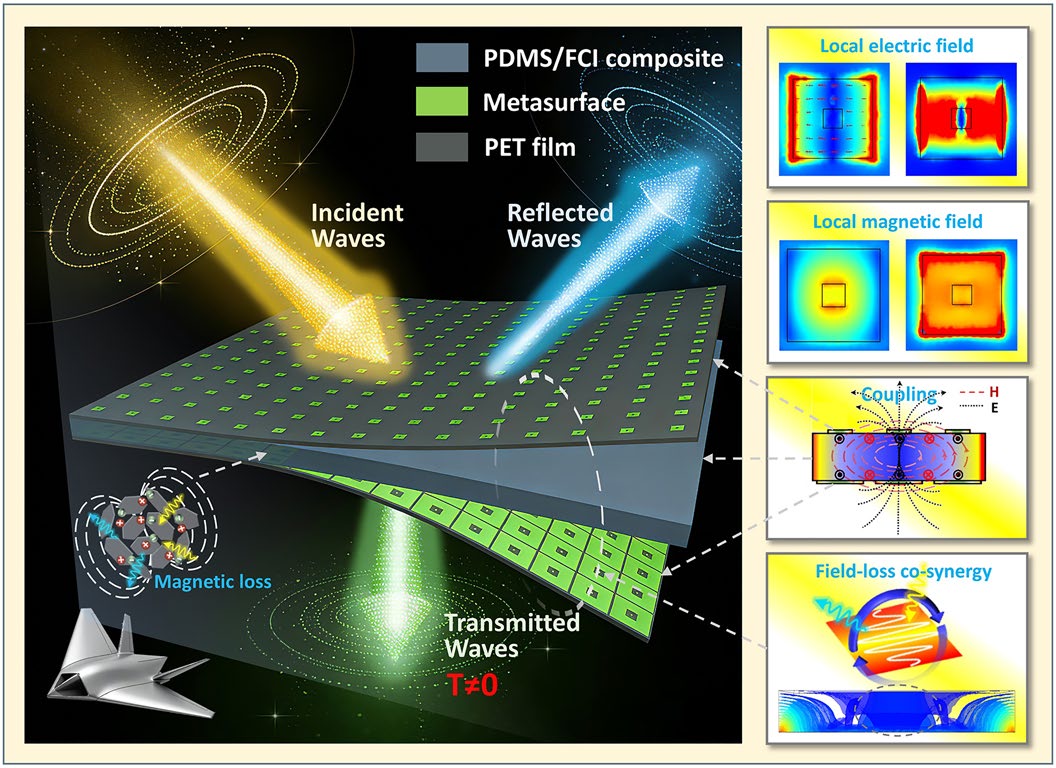

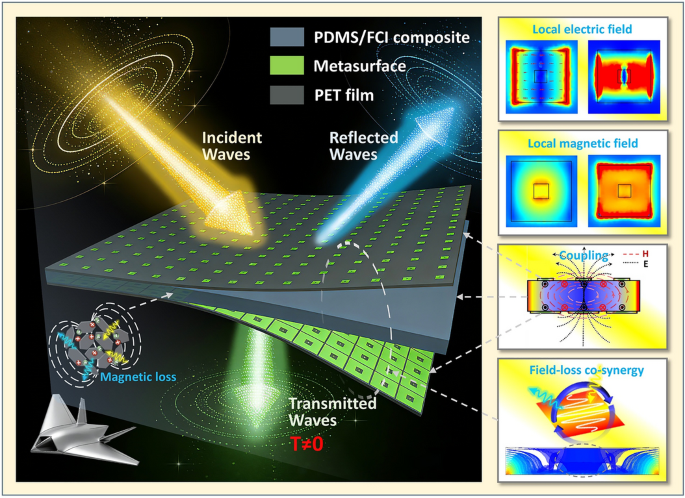

As electromagnetic interference and radar detection technology rapidly advance, the threat landscape for modern stealth aircraft has expanded from conventional high-frequency domains into the challenging low-frequency (LF) regime. Now, researchers from Southwest Jiaotong University, led by Professor Tian Yang and Professor Fanbin Meng, have presented a breakthrough cascaded metasurface flexible absorber composite (CMFAC) that overcomes the fundamental trade-offs among strong absorption, broad bandwidth, and ultra-thin thickness that have long plagued LF microwave absorption materials.
Why This Metasurface Matters
Traditional LF absorbers face a trilemma: the quarter-wavelength theory dictates impractical thicknesses (up to tens of millimeters for L- and P-bands), impedance matching remains notoriously difficult, and intrinsic loss mechanisms weaken dramatically at longer wavelengths. Prevailing metasurface designs predominantly rely on single-mode electrical resonance with insufficient exploration of multimode coupling, while most absorbers utilize low-loss dielectric substrates that limit energy dissipation to ohmic losses in metallic resonators. The novel CMFAC overcomes these limitations through a "local field enhancement" strategy based on field-loss co-design, replacing the conventional metal reflector with a functional, transmissive metasurface layer that breaks the thickness-to-wavelength constraint and enables vertical cascading of absorption performance.
Innovative Design and Mechanism
The composite integrates a flexible polydimethylsiloxane/flake carbonyl iron (PDMS/FCI) high-loss magnetic substrate with double-layer coupled metasurface arrays fabricated from PEDOT:PSS conductive ink or Ni-plated PET film. Finite element simulations and COMSOL Multiphysics analysis reveal that the subwavelength coupled metasurface structure uniquely generates significantly enhanced, highly localized electromagnetic fields within the magnetic substrate—electric field intensities increase nearly threefold and magnetic field intensities nearly fourfold compared to incident waves. This strong localized field interacts intensely with the adjacent lossy medium through synergistic dielectric polarization relaxation, magnetic hysteresis loss, conduction loss, and structural resonance losses. The near-field coupling between metasurface layers induces counter-rotating magnetic dipoles that cancel in the far field, suppressing reflection while localizing energy for efficient dissipation. By enabling controllable non-zero transmission (T ≠ 0), untrapped electromagnetic waves continue propagating through the bottom metasurface for further absorption by subsequent layers, providing new degrees of freedom for broadband optimization.
Outstanding Performance
At an ultra-thin thickness of only 3.78 mm (~0.022λ), the CMFAC achieves exceptional absorption exceeding 90% across 1.77–2.85 GHz, representing up to 165% improvement over bare substrate performance. The absorption rate within the broader 1–6 GHz range exceeds 60%, effectively covering P- through C-bands. The design demonstrates outstanding angular stability—maintaining excellent absorption within 50° for TE polarization and 70° for TM polarization—and shows negligible performance degradation after 50 bending cycles, confirming robust mechanical flexibility. Radar cross-section (RCS) simulations demonstrate >10 dB reduction at normal incidence and approximately 10 dB sidelobe suppression within ±40°, confirming omnidirectional stealth capability. Compared with 14 representative LF absorbers, the proposed design achieves superior performance at significantly reduced equivalent thickness.
Applications and Future Outlook
When conformally integrated onto a complex aircraft leading-edge structure, the CMFAC maintains excellent wide-angle absorption even on high-curvature surfaces, solving the performance degradation problem of traditional absorbers on complex geometries and showing great potential for next-generation conformal stealth technology. The use of PEDOT:PSS-based metasurfaces provides performance comparable to metal-based structures while enabling lightweight, scalable manufacturing through screen printing. This work establishes a novel "field-loss co-synergy" paradigm, offering a feasible and scalable route to advanced absorptive materials that combine LF stealth, flexibility, and system integrability—opening possibilities for multi-layer cascading architectures and efficient conformal integration on complex curved platforms.
Stay tuned for more groundbreaking research from this team at Southwest Jiaotong University!

Editor of Nano-Micro Letters, which is an Open-Access, peer-reviewed journal reported papers that have at least one dimension ranging from a few sub-nanometers to a few hundreds of micrometers. The journal is published by Springer Nature and indexed by SCI, EI, SCOPUS, Pubmed, etc. The 2025 JCR Impact Factor is 38.5. The 2025 CiteScore is 58.9.
Follow the Topic
-
Nano-Micro Letters
Nano-Micro Letters is a peer-reviewed, international, interdisciplinary and open-access journal that focus on science, experiments, engineering, technologies and applications of nano- or microscale structure and system in physics, chemistry, biology, material science, and pharmacy.