Cities around the world can learn from Toronto’s regional food system for fresh fruits and vegetables
Published in Agricultural & Food Science and Law, Politics & International Studies




At dinner, when I was a child, my grandmother used to ask my mother where the food on the table came from. My mom would name the store where she’d picked up the artichokes, or the broccoli, and invariably my grandmother would say indignantly, “But where is it from?”
My grandmother had suffered through wartime food shortages in London, England and was intuitively aware of what I now study: national food security. She knew that long distance supply chains for foods could be interrupted and that during a crisis, people like her family who had modest income, would often go hungry. For her that meant eating only what you were rationed by the government, drinking tea without the sugar she desperately craved, and making one egg stretch to feed a family of seven by using it to make French toast.
I don’t think it is a coincidence that decades later, I am a food systems researcher. My grandmother made me keenly aware of the central, and often overlooked role, food systems play in society. For more than five years, I’ve been working with a team to track produce supply chains that flow through Canada’s largest (and only) public wholesale food market called the Ontario Food Terminal. My grandmother has since passed away, but for the first time in the city’s history, our research provides an answer to her question.
A regional food system that works
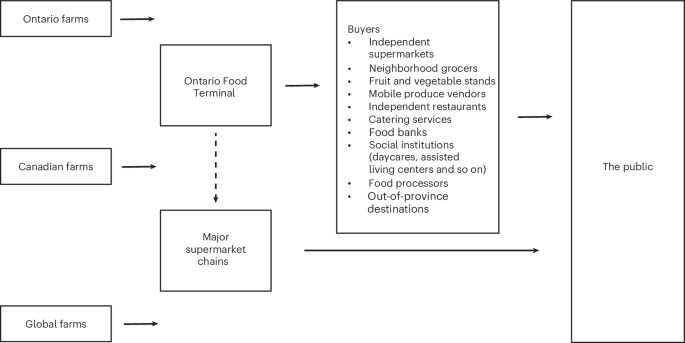
The fresh fruits and vegetables that are sold direct by farmers in our region who drive their goods to the wholesale market come from within 200 kilometres of Canada’s largest metropolis. That was surprising for us to find out from our data because urbanization has dramatically changed the areas around the city. Members of our research team have watched acres of farmers’ fields subdivided into building lots in our lifetimes. We found in our work that the food sold by farmers at the wholesale market is largely grown in farming areas that haven’t been turned into housing subdivisions. We produced a map, that we published along with our article, where you can see how the land where the fresh fruits and vegetables are grown forms a ring around the city of Toronto. You can call this our city’s foodshed for fruits and vegetables, grown nearby. In our city’s foodshed, there’s a lot of pressure to build more homes, as well as highways to connect growing suburbs to the city. So the future of these lands is not clear.
Why this matters
Our research findings are notable because, where we work, and in countries like Canada, more and more fruits and vegetables are being shipped from the land where they were grown to tables around the world. Countries are relying increasingly on distant farming regions in different climactic zones for the kinds of foods that are the foundation of a healthy diet (see Canada’s Food Guide). These supply chains mean that no matter the season, stores are stocked with foods that used to only be available in the summer in Canada such as strawberries and eggplants, as well as produce that only can grow in warmer places.
However, food systems scholars have long warned that there is risk involved in relying so heavily on long distance supply chains for food security. It has been argued that supply chains could be stopped suddenly and unexpectedly. What makes our research valuable is that we describe how a regional food system has been operating for more than 70 years to supply wholesale fresh fruits and vegetables to a wide range of business. This system is made up of hundreds of farmers, produce-related businesses, and grocers, restaurants and food service companies, with the public wholesale market operating as the central node—its heart. It’s a regional food system that operates at a large enough scale to get produce to the variety of businesses that feed millions of people in a city. It’s an example that other countries can learn from.
A model for other countries
Canada is not the only country with a public wholesale food market. There are dozens around the world, in Latin America, Africa, Asia, and Europe. This shows that the public wholesale food market can operate in different cultural and political contexts. But what any regional food system requires to operate are farmers who produce food and land to grow it. Farmland that is driving distance from the city, plus the public food system infrastructure that is the wholesale food market, are key to Toronto’s food system. Our research provides evidence to support policy that considers food and housing in tandem.
When we look at our research findings, especially in the context of disruption to global trade by U.S. tarrifs and also war, they highlight how regional food systems, including farmland near cities, is central to food security. Our research team found that to understand what supports urban food security, one can start by asking what my grandmother always wanted to know: where does the food come from?

Follow the Topic
-
Nature Cities
This journal aims to deepen and integrate basic and applied understanding of the character and dynamics of cities, including their roles, impacts and influences — past, present and future.