Cities as Melting Pots: What We Learned Studying Over 200,000 Daily Journeys
Published in Social Sciences and Mathematical & Computational Engineering Applications


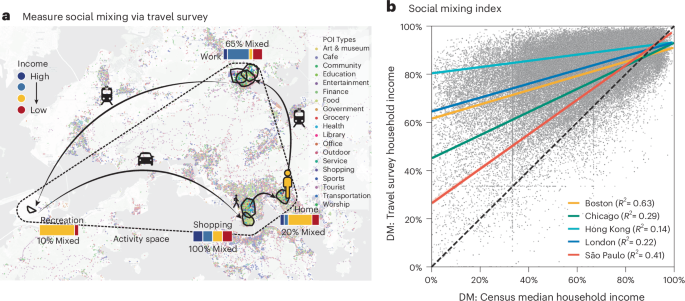

Historically, cities have been considered as melting pots – places where people of different occupations, income levels, cultures, religions, and ethnicities interact and become more alike. Social mixing isn’t just about chatting with strangers. It is about exposure to differences — seeing, hearing, and sharing space with people from other walks of life.
Research shows that these encounters can spark creativity, broaden opportunities, and even improve health. The United Nations has made “inclusive cities” a global goal. Yet segregation, both visible and invisible, stubbornly persists. The term ghetto itself originates from a neighborhood in Venice where Jewish residents were historically required to live, illustrating how urban space can simultaneously connect and divide.
To delve into the two opposing forces of integration and segregation in cities, our team set out to answer some deceptively simple questions: Where does social mixing happen? Which urban sub-groups experience it most? How do our daily movements influence the diversity of people we meet? The answers took us on a year-long journey across five very different cities — Boston, Chicago, Hong Kong, London, and São Paulo — and into the everyday routines of more than 200,000 residents.
Moving Beyond Phone Data
Modern studies have relied increasingly on mobile phone records and transit card swipes. These are great for tracking movement, but they tell us little about the people behind the trips. Income is guessed from neighborhoods. Age is inferred from school visits. Gender and caregiving responsibilities? Invisible. In places, like Hong Kong, where people of different incomes often live side by side, phone data alone can’t capture the nuance.
So, we turned to something much richer in socio-demographic information: official travel surveys. These are large-scale, government-run studies where residents record their trips alongside details about their lives — income, age, household composition, car ownership, and even trip purpose. It’s like opening a window into the daily rhythms of a city.
Behind the Numbers: The Human Side
Of course, nothing is simple. Each city has its own survey quirks – the ways that trips are defined, income categories, and spatial units of analysis. Our team argued about definitions, celebrated when models finally worked, and shared the thrill of seeing patterns emerge from messy data. We spent months standardizing the data. We mapped everything onto a common grid system. We tested over 20 different ways of measuring “social mixing” to make sure our results weren’t just artifacts of definitions. It was painstaking work — but it allowed us to compare apples to apples across continents. As we harmonized the different survey quirks and our own different disciplinary perspectives step by step, we see our own innate diversity embraced and mirrored the very mixing we were studying.
What We Found
Value of Travel Surveys
Despite the wide availability and use of big data, large-scale official travel surveys are extremely valuable in understanding social mixing. The much richer individual-level data, notably income, gender, age, work status, household composition, and trip purposes, allow us to reveal patterns that are invisible in smartphone-based studies based on socio-demographic inference from spatial data.
The “Second Youth”
One of the most surprising findings was among older adults. People over 66 years old were more socially mixed than those in late working life (55–65 years old). Retirement, it turns out, frees people from rigid commutes and opens up new destinations — parks, community centers, and markets. It’s a kind of “second youth,” a phase of renewed social engagement, happening in cities around the world. These findings challenge the common view of ageing as a period of social withdrawal or isolation.
Teenagers and Caregivers
Teenagers were consistently less socially mixed than young adults. Their worlds are bounded by schools and family routines. In most cities, students go to schools near their homes, reinforcing existing residential segregation. Women with caregiving responsibilities also showed lower social mixing than men in similar roles — a reminder of how household duties related to caregiving can quietly shape mobility and opportunity of different genders in their careers.
Transit Matters
Public transit emerged as a powerful equalizer. A one percent increase in transit trips was linked to a 0.1–0.3% rise in social mixing. Cars, by contrast, tended to isolate. In cities like Hong Kong and London, where transit is dense and accessible, mixing was less tied to income or residential location. Public transit allows users to experience higher levels of social mixing, not explainable by individual socio-demographical characteristics or the layouts of different shops and facilities in cities.
Place Exposure Rules
Perhaps the biggest takeaway: When it comes to social mixing, where people go matters more than who they are. The diversity of destinations explained most of the variation in social mixing. Demographics — income, age, and gender — played a smaller role. In other words, it’s not just about who you are, but about the places your daily journeys take you.
Why It Matters
For policymakers, the messages are clear:
- Don’t rely solely on phone data. Without socioeconomic depth, you risk underestimating social mixing by as much as 16%.
- Capitalize on retirement. Far from being socially isolated, they are engines of mixing.
- Support vulnerable groups. Teenagers and caregivers need opportunities to expand their mobility horizons.
- Invest in transit and destinations. Transit hubs and diverse public spaces foster encounters across lines of difference.
- Beware of hidden stratification. Even when mixing levels look equal, income groups may be visiting different places. Equality of exposure doesn’t mean equality of experience.
The Road Ahead
Cities are not just engineered infrastructure and buildings. Cities are about encounters. If we want inclusive and equitable cities, we need to understand — and design for — the patterns of mixing that shape everyday life.
Our study is one step in that direction. It shows that mobility is more than movement; it’s a social force. And it reminds us that behind every dataset are real people, living real days, weaving the invisible threads of urban life.
Follow the Topic
-
Nature Cities
This journal aims to deepen and integrate basic and applied understanding of the character and dynamics of cities, including their roles, impacts and influences — past, present and future.