COF Scaffold Membrane with Gate‑Lane Nanostructure for Efficient Li+/Mg2+ Separation
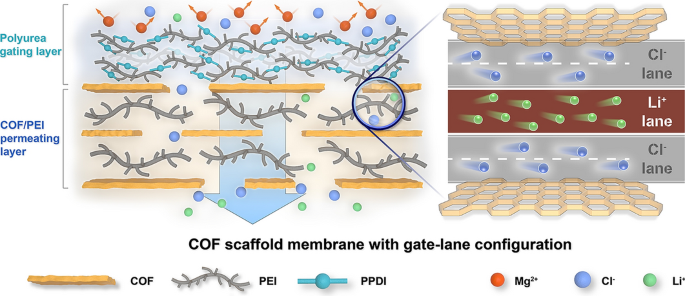

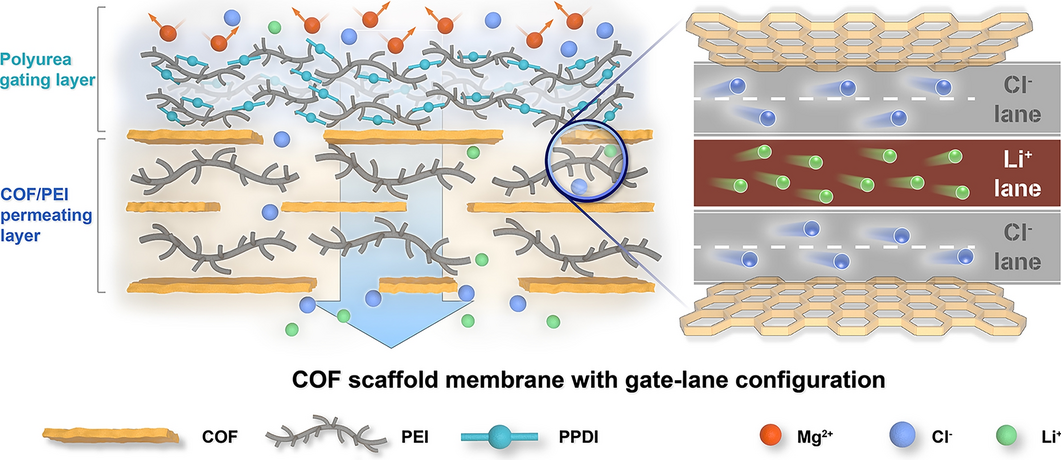

As the global shift to clean energy accelerates, securing a stable lithium supply becomes critical, yet conventional extraction methods struggle with the “permeability–selectivity” trade-off when separating Li+ from chemically similar Mg2+ in salt-lake brines. Now researchers from Tianjin University, National University of Singapore and Sichuan University—led by Prof. Zhongyi Jiang, Prof. Runnan Zhang and Prof. Sui Zhang—report a covalent-organic-framework (COF) scaffold membrane whose gate-lane architecture delivers record-high true Li+/Mg²+ selectivity together with high Li+ flux. The work offers a blueprint for next-generation ion-separation membranes that can harvest battery-grade lithium with unprecedented efficiency.
Why Gate-Lane COF Membranes Matter
- Favorable Ion-Mixing Effect: True selectivity (231.9) far exceeds ideal selectivity (80.5) at Mg2+/Li+ mass ratio 50, turning multi-ion interference into a separation booster instead of a penalty.
- High Li+ Permeability: 11.5 L m-2 h-1 bar-1 water permeance with only 135 nm thickness ensures low energy consumption and compact module design.
- Superior Stability: >99 % Mg2+ rejection is maintained for 7 days under 5 bar, 5000 ppm MgCl2, pH 3–11, demonstrating robustness for real brine processing.
Innovative Design and Features
- Gate-Lane Nanostructure: A 20 nm polyurea “gating” layer (small pores, high positive charge) rejects Mg2+, while an underlying COF/PEI “permeating” layer forms separate Li+ and Cl- nano-lanes that accelerate Li+ transport.
- Charge-Asymmetric Scaffold: Positively charged COF nanosheets attract Cl- to create “Cl- lanes”; lower-charged PEI chains provide “Li+ lanes”, achieving spatial segregation verified by in-situ MD simulations and DFT calculations.
- Tunable Architecture: Varying COF/PEI mass ratio from 0.001 to 0.1 switches the membrane from hybrid to scaffold, allowing precise control of pore size (MWCO 335 Da), surface zeta potential (+55.7 mV) and thus selectivity.
Applications and Future Outlook
- Lithium Extraction from Brines: At Mg2+/Li+ = 50 the permeate ratio drops to <0.22, cutting more than 200-fold of original Mg content and surpassing all reported positively charged nanofiltration membranes.
- Seawater & Battery Electrolyte Pretreatment: >98 % rejection of Ca2+ and Mg2+ protects downstream reverse-osmosis modules and enables high-purity electrolyte salts for Li-ion batteries.
- Modular Upscaling: Vacuum-filtration fabrication is roll-to-roll compatible; 1.54 cm2 lab cross-flow results scale linearly with pressure, indicating easy path to commercial spiral-wound elements.
- Challenges & Opportunities: Long-term fouling under natural brine, anti-scaling surface modification and cost-effective COF synthesis at tonne scale are next targets. Future work will also extend the gate-lane concept to other mono/divalent separations such as K+/Ca2+ and Na+/Mg2+.
This comprehensive study demonstrates that hierarchical, charge-asymmetric COF membranes can turn the “ion-mixing penalty” into a separation bonus, breaking the traditional permeability–selectivity ceiling. It underscores the power of integrating precise chemistry, advanced spectroscopy and molecular simulations to design membranes for sustainable metal recovery. Stay tuned for more disruptive advances from Prof. Zhongyi Jiang, Prof. Runnan Zhang and Prof. Sui Zhang and their teams!

Editor of Nano-Micro Letters, which is an Open-Access, peer-reviewed journal reported papers that have at least one dimension ranging from a few sub-nanometers to a few hundreds of micrometers. The journal is published by Springer Nature and indexed by SCI, EI, SCOPUS, Pubmed, etc. The 2025 JCR Impact Factor is 38.5. The 2025 CiteScore is 58.9.
Follow the Topic
-
Nano-Micro Letters
Nano-Micro Letters is a peer-reviewed, international, interdisciplinary and open-access journal that focus on science, experiments, engineering, technologies and applications of nano- or microscale structure and system in physics, chemistry, biology, material science, and pharmacy.