Could soil decomposer microbes determine the ecosystem response to rising atmospheric CO2?
Published in Earth & Environment and Ecology & Evolution

The Beginning
Ecosystem productivity on land is generated by the exchange of resources between the aboveground and belowground components. Plants need nutrients to grow more, and decomposers release nutrients as they seek to acquire resources for growth. To a large extent, plants provide the energy input into land ecosystems, so what limits their primary production also sets the pace for the whole ecosystem. In northern latitudes and in cool climates, primary production is limited by nitrogen. But what limits the decomposers? This question marked the beginning of my PhD.
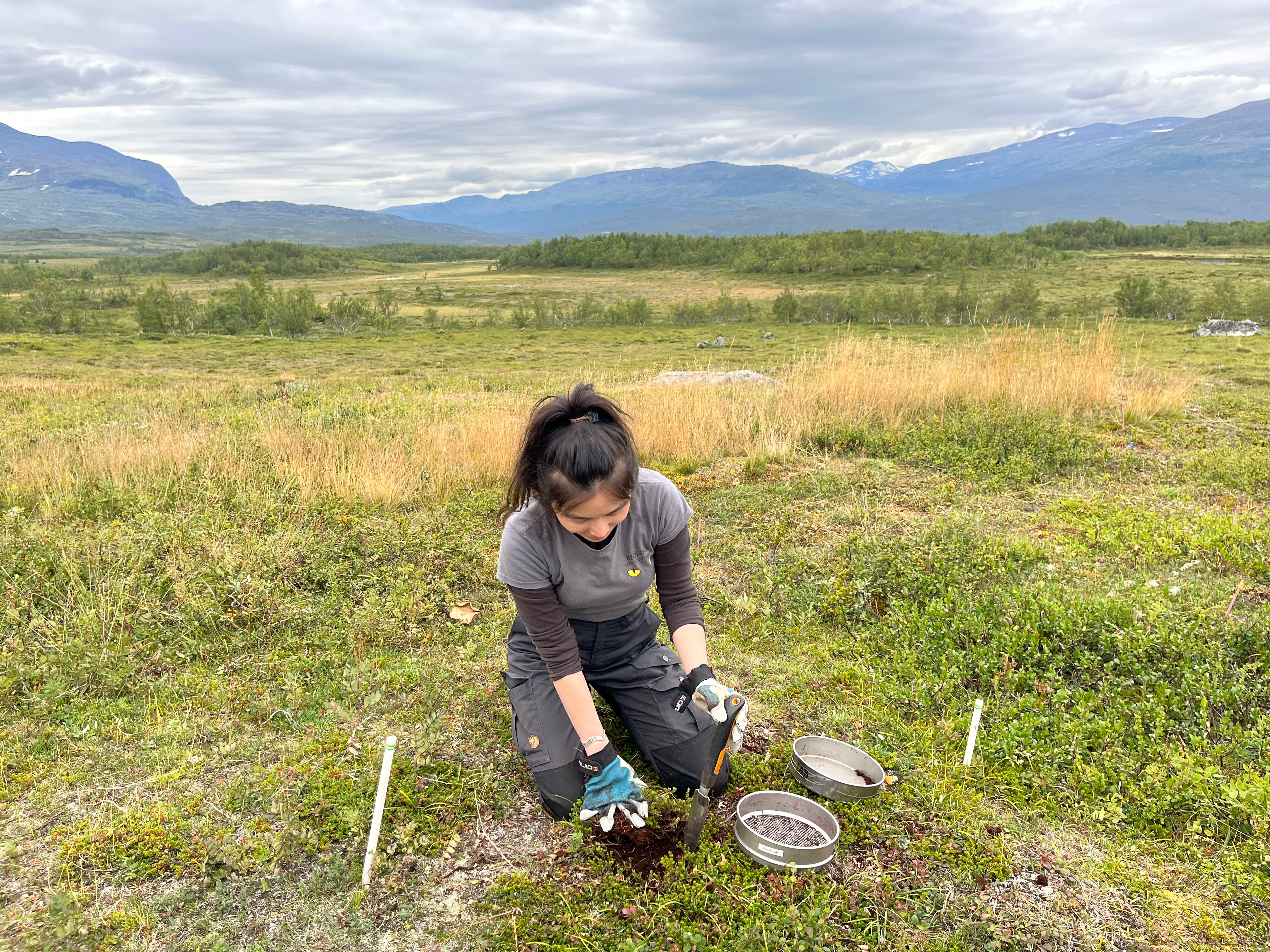
My PhD project focused on the growth limiting factors for soil microbial decomposers. During the first two years of my PhD, I mainly worked on soil samples from arctic tundra and as well as some temperate forests. Everywhere I looked in these nitrogen-limited ecosystems, the same answer came back: soil microbes were limited by carbon. I also discovered that changes in environmental resource availability would alter microbial resource limitation and consequently, microbial activity. For instance, nitrogen enrichment in arctic soil can intensify microbial carbon limitation and thereby stimulate microbial decomposition of plant litter. Such shifts facilitate interesting interactions between the ecosystem’s belowground and aboveground components, the interactions we need to understand to predict how they will respond to environmental change. However, all these examples were from ecosystems where plants were limited by nitrogen. While both carbon and nitrogen availability in ecosystems stem from release from organic matter, other nutrients have cycles that do not always pass through organic matter. Would ecosystems limited by phosphorus behave differently?
We learn from ecosystem ecology textbooks that ecosystems gradually become more phosphorus-deficient as the weathering of primary minerals and sorption of available phosphate increases, making phosphorus limitation especially common in ecosystems on geologically old landscapes, such as much of Australia. Therefore, when one our colleagues David Wårlind mentioned a research facility in Australia, we immediately thought: that’s the place we want soil from!
The Serendipity
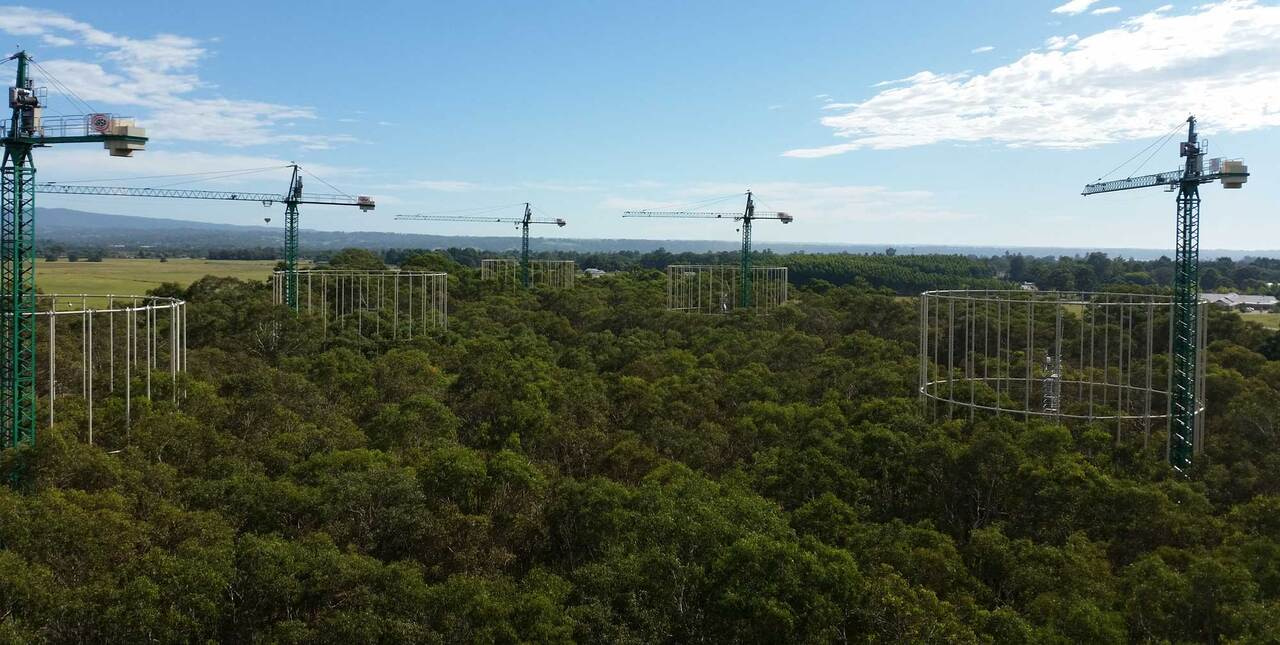
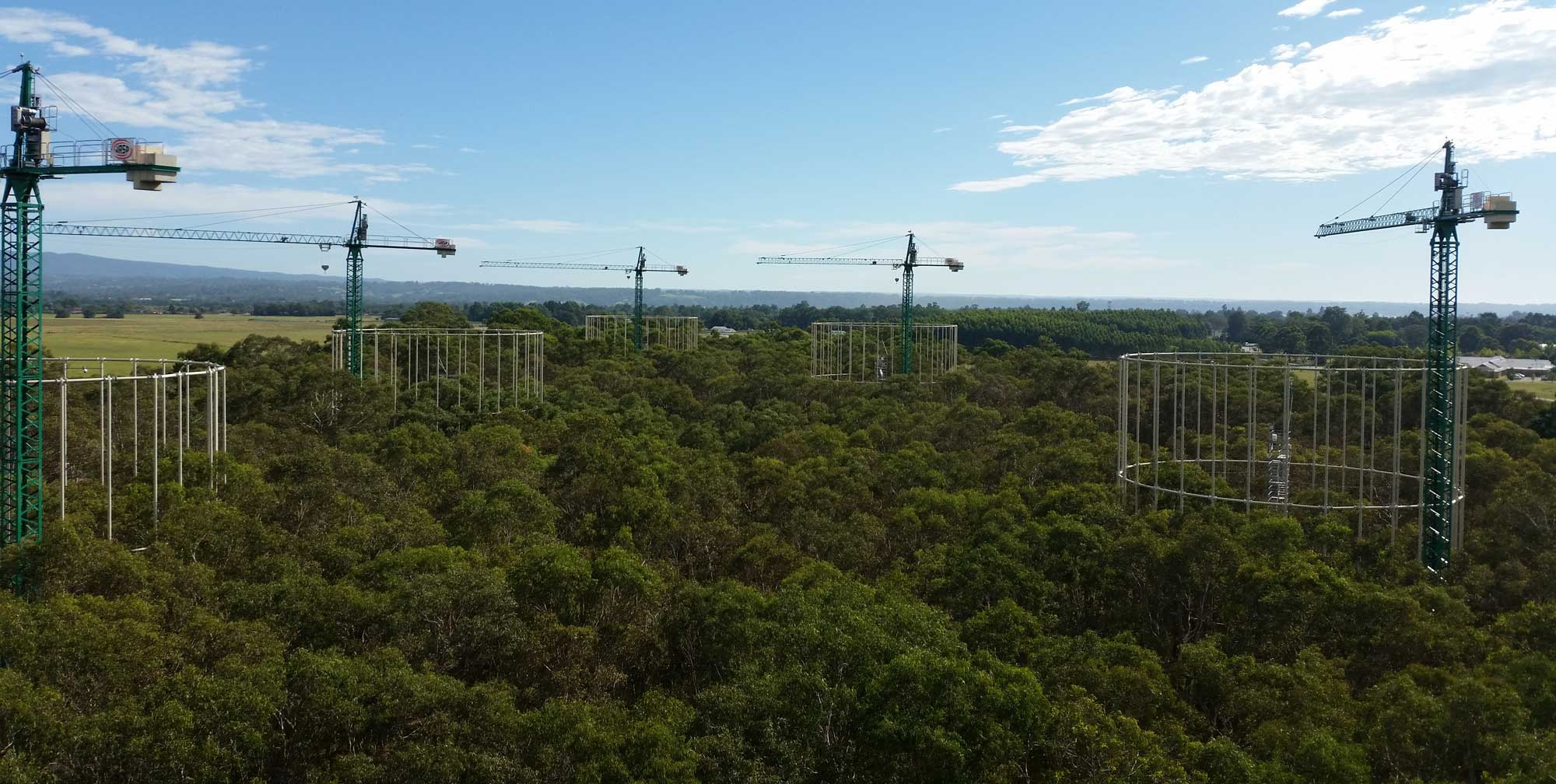
I became fascinated as soon as I started reading the publications from the EucFACE facility (Eucalyptus Free-Air Carbon Dioxide Enrichment Experiment, Australia). My previous work focused more on warming in the Arctic, but through this experiment I could explore another major, planetary-scale change - rising CO2. In addition, among all FACE facilities in the world, EucFACE is unique: it is the world’s only FACE experiment in a mature, warm temperate forest ecosystem in the Southern Hemisphere!
Primary production and its propensity to be stored at EucFACE has previously been found to be limited by phosphorus, unlike the widely reported nitrogen limitation in FACE experiments in the Northern Hemisphere. This matched our expectation for the incoming samples: strongly weathered, nutrient‑poor soils typical of old landscapes. Previous findings at EucFACE showed that rising CO₂ increased plant photosynthesis, but did not enhance net primary production, and most of the carbon taken up by plants was returned to the atmosphere—about half through soil respiration. This suggested that there was additional carbon in the soil, available for microbes.
The Rationale
Before revealing the findings, lets first take a detour to discuss about role of microbes and microbial limitation in the scenario of carbon cycling. Unlike plants, soil microbes play a dual-edged role in carbon cycling in terrestrial ecosystems: on the one hand, soil microbial respiration determines the net CO2 exchange between the atmosphere and terrestrial biosphere. On the other hand, microbial decomposition regulates soil nutrient availability for primary production, which indirectly affects the ecosystem’s capacity to sequester carbon. Resource limitation has been widely recognized as a key factor regulating microbial activity, and competition for growth-limiting resources is hypothesized to be a major regulator of plant-microbial interactions under elevated CO2. Considering the extra carbon entering the soil under elevated CO2 and the strongly phosphorus-deficient nature of the EucFACE ecosystem, we hypothesized the microbial growth would be limited by phosphorus, and that the phosphorus limitation would intensify under elevated CO2.
I was extremely confident in our hypothesis, especially when I received my heaviest-ever Christmas gifts in 2022: soil samples collected by Catriona Macdonald at EucFACE! The soil looked so sandy and brown-ish compared to my Arctic soil samples, indicating a low organic matter content. “It will definitely be phosphorus‑limited,” I thought.
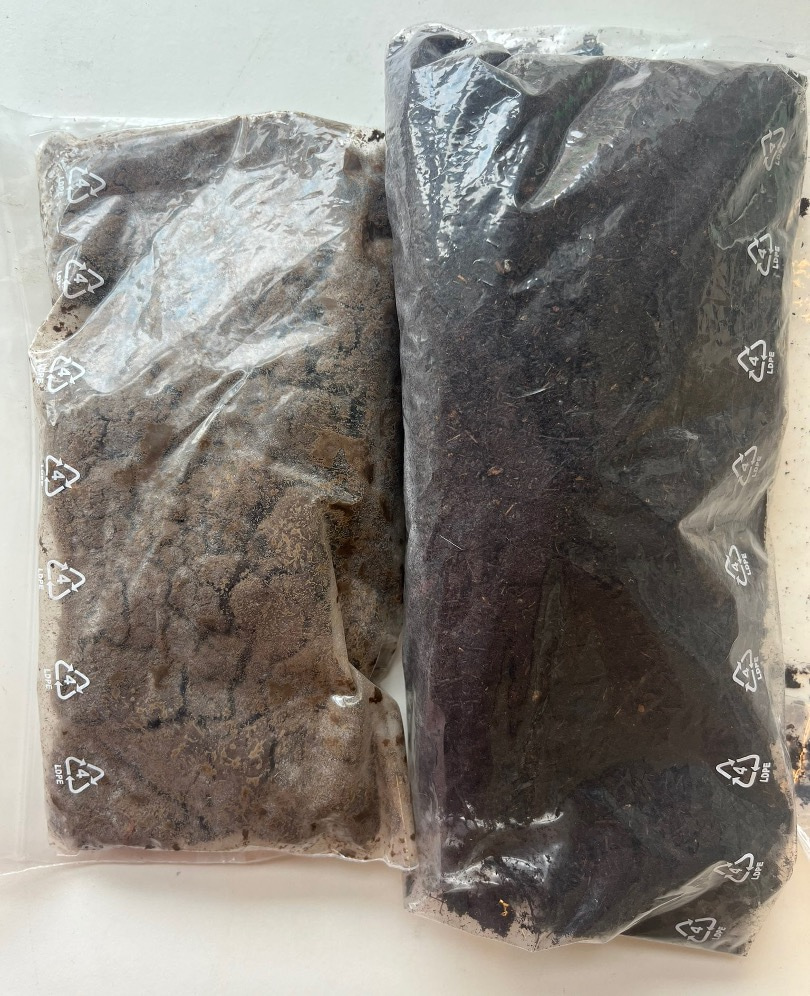
Soil samples from EucFACE, Australia (left) and an arctic tundra in Sweden (right).
The Surprise
As often happens in science, the samples gave a big surprise. Microbial growth was primarily limited by carbon! Even more astonishingly, the carbon limitation intensified under elevated CO₂! What???!!! It was counterintuitive—how could microbial carbon limitation intensify when more carbon was available? We also found that phosphorus was the secondary limiting factor for microbial growth, which was further enhanced under elevated eCO2. After checking all the parameters measured, we explained this enhanced carbon and phosphorus limitation under elevated CO2 by a shift of microbial physiology toward a more copiotrophic strategy under elevated CO2, evidenced by the observed increase in microbial growth, without being accompanied by changes in microbial community composition.
In 2024, while I was drafting the manuscript, a new EucFACE paper caught the attention of both my supervisors (Johannes Rousk and Lettice Hicks) and me in the same week. I was away on fieldwork at the time and received two emails—each containing the link to the paper—one from each supervisor. The study proposed that microbes might compete with plants for phosphorus in this ecosystem. Through our own work, we could provide experimental evidence pointing in the same direction: we found that phosphorus limitation was enhanced under elevated CO₂!
The Reflection
Global forests function as a large carbon sink, storing carbon equivalent to almost half of fossil-fuel emissions. The capacity of forests to mitigate rising CO2 is widely recognized as a key biological feedback that could help counteract climate warming. While the effects of elevated CO2 on plants have been extensively studied over the past decades, soil microbial decomposers have received far less attention. Here, we highlight that soil microbes will also play a crucial role in determining how forests respond to rising CO₂, and provide the first experimental validation that nutrient limitation is a key mechanism underpinning plant–microbe interactions in this context.
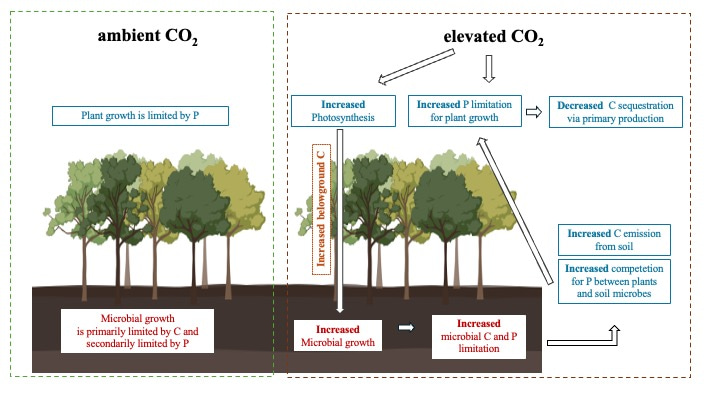
Figure. This conceptual figure illustrates how elevated CO2 (eCO2) influences microbial resource limitation and its feedback to the ecosystem response to eCO2, incorporating both previous findings and hypotheses (in blue) and new insights from the present study (in red). Under ambient CO₂, in the studied mature forest, plant growth is primarily limited by phosphorus, and the current study reveals that microbial growth is primarily limited by carbon and secondarily limited by phosphorus. Under elevated CO₂, increased photosynthesis enhances plant-derived carbon inputs to the soil, stimulating microbial growth and shifting microbial community towards a more copiotrophic regime. This acceleration leads to greater microbial demand for resources, intensifying both microbial carbon and phosphorus limitation. This also explains the intensified competition for P between plants and microorganisms. Further, the intensified phosphorus competition may reduce carbon sequestration by primary production and increase carbon emissions from the soil, potentially diminishing the long-term capacity of mature forest ecosystems to act as carbon sinks under elevated CO₂.




Please sign in or register for FREE
If you are a registered user on Research Communities by Springer Nature, please sign in