Could Your Olive Oil Be Feeding Your Brain — Through Your Gut? Celebrating World Microbiome Day with a Story from the Mediterranean
Published in Healthcare & Nursing, Microbiology, and Neuroscience


Why We Asked the Question
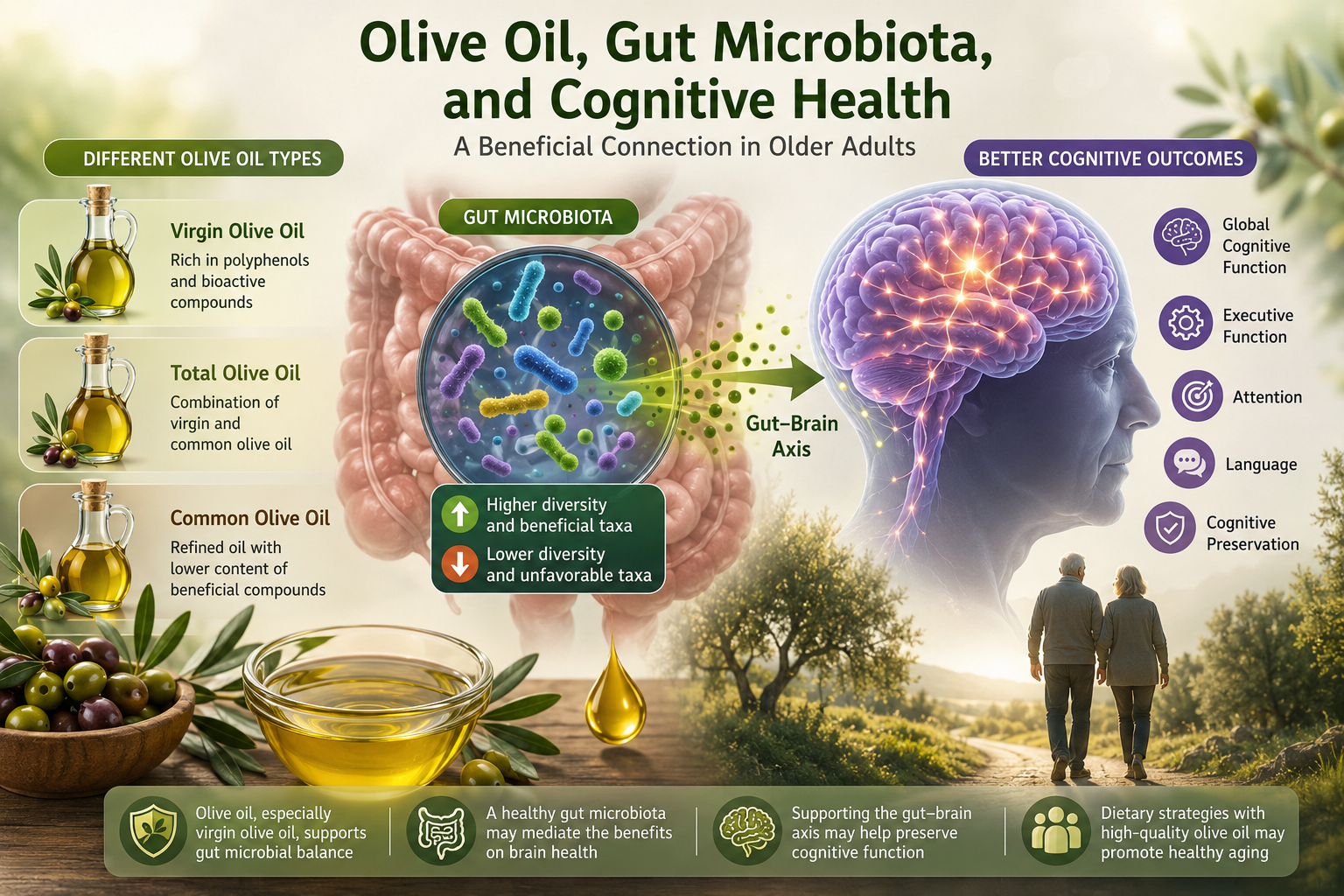
Our research group has spent years trying to understand how the Mediterranean diet protects the aging brain. Extra virgin olive oil is the crown jewel of that diet, the ingredient most closely associated with its health benefits. Yet for a long time, scientists studying olive oil and cognition were doing something rather odd: treating all olive oil as the same thing.
Walk into any supermarket in Spain, where our study is based, and you will see bottles labelled "virgin olive oil", "extra virgin olive oil", and simply "olive oil", the latter being what we call common olive oil (COO), a refined product that undergoes industrial processing and loses most of its polyphenols and other bioactive compounds along the way. These are chemically and nutritionally very different products. But most studies lumped them together.
We wanted to fix that. And we wanted to go one step further: to look not just at the brain, but at what lives between the olive oil and the brain, the gut microbiome.
The Gut as a Middleman
The idea that gut bacteria could influence brain health might sound far-fetched, but it is one of the most exciting frontiers in modern biomedical research. The so-called gut-brain axis is a two-way communication highway involving the immune system, the nervous system, and a cascade of metabolites that microbes produce when they digest what we eat.
We knew that olive oil, especially the polyphenol-rich virgin variety, had shown promising effects on gut microbiota in animal studies. But almost no human research had connected the dots: olive oil type → gut microbiota → cognitive changes. That gap is what drove our study.
What We Did
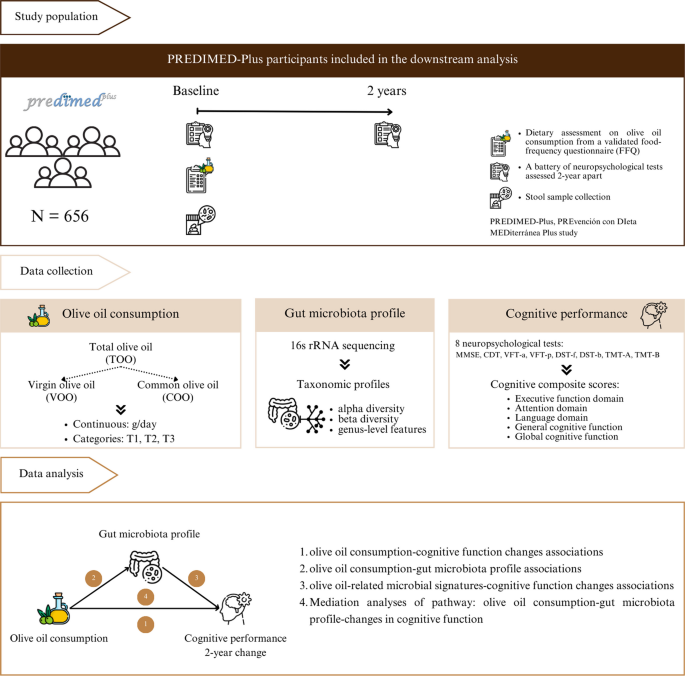
We worked within the PREDIMED-Plus cohort, a large Spanish trial involving older adults at high cardiovascular risk. From this cohort, we selected 656 participants aged 55 to 75 who had provided stool samples and completed detailed dietary questionnaires. We then followed their cognitive performance, assessed across memory, attention, executive function, and language, over two years.
Crucially, we separated virgin olive oil (VOO) consumption from common olive oil (COO) consumption, and we sequenced the gut bacteria from stool samples at baseline using 16S rRNA technology to get a detailed microbial fingerprint of each participant.
What We Found — and What Surprised Us
The results were striking, and in some ways counterintuitive.
Higher consumption of virgin olive oil was associated with better cognitive performance over the two-year follow-up across multiple domains. It was also linked to a more diverse, richer gut microbiome. That part was broadly consistent with what we had hoped to find.
But common olive oil told the opposite story. Higher COO consumption was associated with accelerated cognitive decline and lower microbial diversity. Two oils with near-identical fat profiles, yet with starkly different effects on both the gut and the brain. The likely culprit: the polyphenols. Virgin olive oil retains compounds like hydroxytyrosol and oleuropein that are stripped away during the refining process that produces common olive oil. These molecules appear to nourish the microbiome in ways that then benefit the brain.
The most intriguing finding came from our mediation analysis. We identified a bacterial genus called Adlercreutzia as a significant mediator — meaning that part of the cognitive benefit from virgin olive oil appeared to travel through changes in this specific microbe. Adlercreutzia accounted for roughly 20% of the total effect of VOO on general cognitive function. This is, to our knowledge, the first time this taxon has been identified as a potential player in the olive oil–brain relationship in humans.
Why This Matters for World Microbiome Day — and for SDG 3
World Microbiome Day exists to remind us how profoundly the invisible world of microbes shapes our health. Our study is a vivid illustration of that message: the trillions of bacteria in your gut are not passive bystanders. What you eat changes who they are, and who they are may change how well you think.
This connects directly to the UN's Sustainable Development Goal 3 — Good Health and Well-Being — and particularly to the challenge of healthy aging. Dementia affects tens of millions of people worldwide, and that number is projected to nearly triple by 2050. Prevention strategies that work at the population level, that are affordable, culturally embedded, and enjoyable, are desperately needed. Dietary guidance that is specific and actionable "choose virgin olive oil over others" could be one such strategy, though we are careful to note that our observational study cannot prove causation.
What Comes Next
We are under no illusions about the limitations of this work. Our participants are older Spanish adults who already consume a lot of olive oil , the most common oil in their kitchens. Generalizability to other populations remains an open question. The exposure (diet) and mediator (gut microbiota) were measured at the same time point, which limits our ability to establish a clean temporal sequence. And while we adjusted for many confounders, residual confounding can never be ruled out entirely.
What we hope this study does is open a door. The 'olive oil–gut–brain' axis is real, biologically plausible, and now supported by human data. Future work should examine polyphenol content directly, compare olive oil to other commonly consumed fats globally, and ideally, test these associations in controlled dietary intervention trials.
A Personal Note
Our team is based at the Universitat Rovira i Virgili in Reus, Spain — deep in the heart of olive oil country. For many of us, olive oil is not just a research subject; it is the smell of our grandmothers' kitchens. There is something moving about science that starts with a drizzle of oil on a plate and ends with questions about memory, aging, and the extraordinary inner world of the gut.
On World Microbiome Day, we celebrate the fact that those trillions of microbes are not just fascinating — they may be among our most powerful allies in the quest for a healthier, longer, and cognitively richer life.
Read the full paper: Ni et al. "Total and different types of olive oil consumption, gut microbiota, and cognitive function changes in older adults." Microbiome (2026) 14:68. https://doi.org/10.1186/s40168-025-02306-4
Follow the Topic
-
Microbiome
This journal hopes to integrate researchers with common scientific objectives across a broad cross-section of sub-disciplines within microbial ecology. It covers studies of microbiomes colonizing humans, animals, plants or the environment, both built and natural or manipulated, as in agriculture.

Related Collections
With Collections, you can get published faster and increase your visibility.
Oncobiome
This collection of papers delves into the burgeoning field of oncobiome research, exploring the intricate relationship between cancer and the microbiome. The oncobiome encompasses the diverse microbial communities residing in and on the human body, which influence cancer development, progression, and treatment responses. By examining these interactions, our aim is to unravel the complex mechanisms through which the microbiome impacts oncogenesis and therapeutic outcomes.
This compilation highlights cutting-edge research, offering insights into potential diagnostic markers and novel therapeutic strategies, thereby advancing our understanding of cancer biology and paving the way for innovative, microbiome-targeted cancer treatments.
This is a cross-journal collection between:
Experimental Hematology and Oncology
Articles will undergo the standard peer-review process of the journal to which they are submitted and are subject to either the BMC editorial policies or those of BJC Reports. Articles will be added to the Collection as they are published. The Editors have no competing interests with the submissions which they handle through the peer review process. The peer review of any submissions for which the Editors have competing interests is handled by another Editorial Board Member who has no competing interests.
Publishing Model: Open Access
Deadline: Ongoing
Animal Gut Nutrition and Greenhouse Gas Mitigation
Animal Microbiome, Journal of Animal Science and Biotechnology and Microbiome call for submissions to the collection on Animal Gut Nutrition and Greenhouse Gas Mitigation.
Efforts to reduce greenhouse gas emissions from livestock systems increasingly hinge on innovations in animal gut nutrition. The dynamic relationship between the gut microbiome and nutrient utilization plays a pivotal role in shaping methane output, feed efficiency, and overall sustainability. Advances in microbial ecology—particularly in understanding the role of gut microbiome in nutrient metabolism—are opening new pathways for mitigating emissions while enhancing productivity. These developments support the implementation of climate-smart agricultural strategies to address climate change and its impacts.
Looking ahead, continued research in this field has the potential to yield innovative solutions such as targeted probiotic supplementation, which could further optimize gut function and enhance nutrient absorption. These advancements may lead to reduced greenhouse gas emissions while improving animal health and productivity. By deepening our understanding of the animal gut microbiome, we can contribute significantly to sustainable agricultural practices that benefit both the environment and food security.
We invite researchers to contribute to this special Collection on Animal Gut Nutrition and Greenhouse Gas Mitigation. Topics of interest include but are not limited to:
- Animal Gut Microbiome and Feed Efficiency
- Greenhouse Gas Mitigation Strategies
- Rumen Fermentation Dynamics
- Nutrient Utilization in Livestock
- Probiotic Supplementation Effects
- Sustainable Livestock Production Practices
- Climate-Smart Agriculture Innovations
This Collection supports and amplifies research related to SDG 13, Climate action.
All submissions in this collection undergo the relevant journal’s standard peer review process. Similarly, all manuscripts authored by a Guest Editor(s) will be handled by the Editor-in-Chief of the relevant journal. As an open access publication, participating journals levy an article processing fee (Animal Microbiome fees, Journal of Animal Science and Biotechnology fees, Microbiome fees). We recognize that many key stakeholders may not have access to such resources and are committed to supporting participation in this issue wherever resources are a barrier. For more information about what support may be available, please visit OA funding and support, or email OAfundingpolicy@springernature.com or the Editor-in-Chief of the journal where the article is being submitted.
Publishing Model: Open Access
Deadline: Dec 05, 2026