Deciphering the impact of COVID‑19 pandemic on food security across different socioeconomic strata in Chile
Published in Agricultural & Food Science and Economics





Chile, classified as a developing country, is considered as one of the strongest states in Latin America, despite its relatively low levels of income redistribution. Over the period spanning from 1964 to 2017, household income dynamics in Chile reveal a trend of subdued growth in the lower quintiles in contrast to the more pronounced expansion of household income within the top 1%, as evidenced by fiscal income series. As inflation rose during the pandemic of COVID-19, a differential impact over food security was expected across different socioeconomic strata.
Key findings
- Raw food spending dominates low-income diets. On average, restaurant expenditures constituted a larger share of total food expenditure in the highest-income households (26.7%) compared to the lowest-income households (8.6%). In contrast, raw & processed foods made up 51.9% of highest-income households’ food expenditure, but 74.3% of the lowest-income households. This suggests that assessing food security should focus on raw & processed foods, particularly in lower-income households.
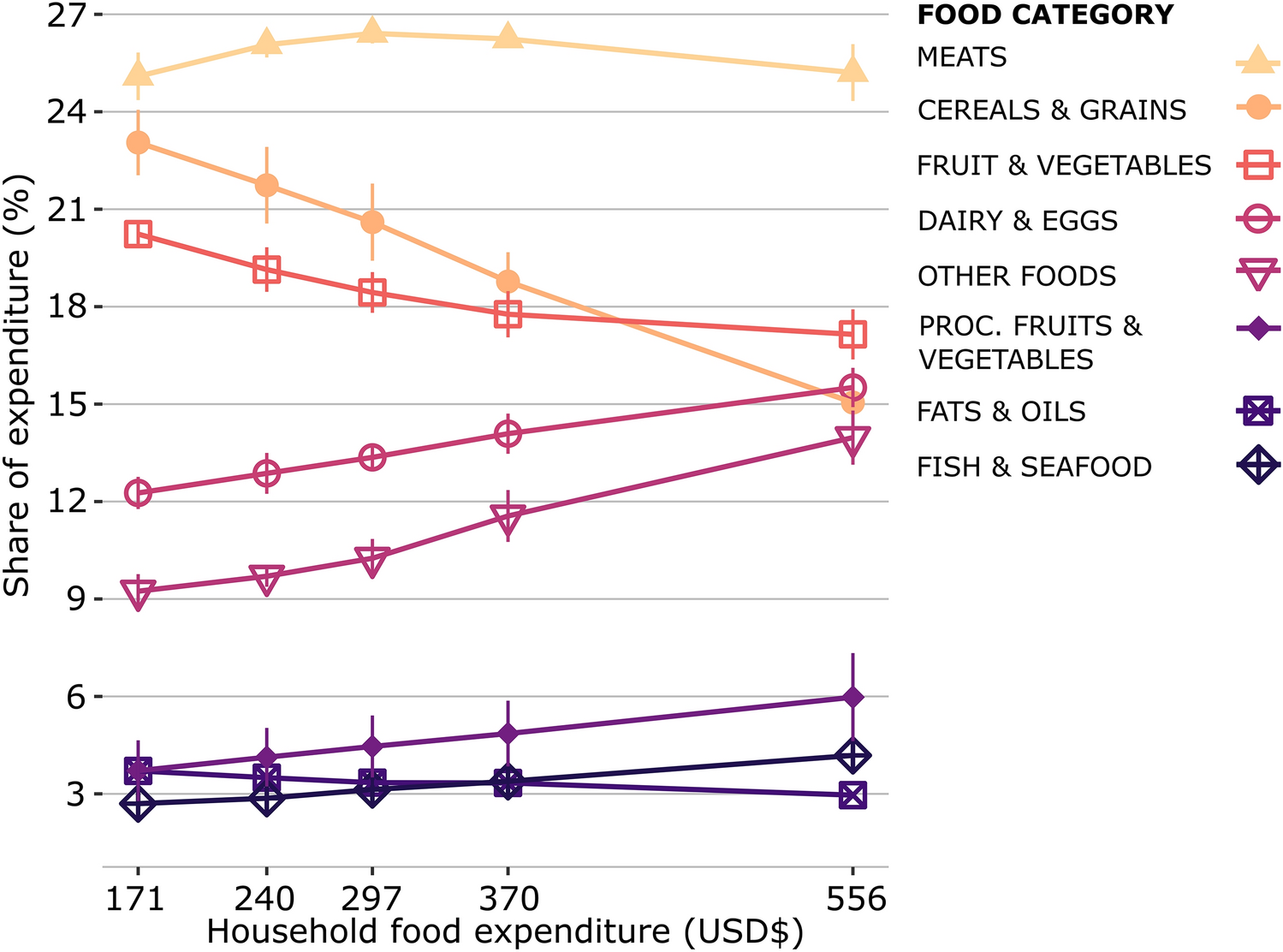
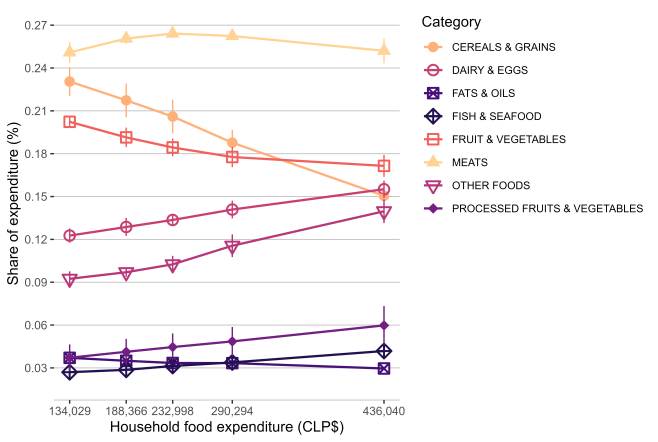
-Meat dominates budgets across all incomes. Monthly expenditures on raw and processed foods by income quintile from 2006 to 2021 showed stable purchasing patterns (Fig. 1), where Meats consistently commanded the largest share of households food budgets regardless of income quintile, ranging from 25.1% to 26.4%.
As household income increased, there was a noticeable reduction in the proportion of budget allocated to Cereals & grains (p-value = 0.0073), and, to a lesser extent, Fruits and vegetables (p-value = 0.0071). In contrast, higher-income households allocated a larger share to Dairy and eggs (p-value = 0.0089), Other foods (p-value = 0.0073), Processed fruits and vegetables (p-value = 0.0076), and Fish & seafood (p-value = 0.0105). These differences suggest
that higher-income households purchase a broader diversity of foods. Nevertheless, Meats, Cereals & grains, and Fruits & vegetables remain the primary components of food expenditures, regardless of household income.
-Post-pandemic, spending gap narrowed under strain. Generally, lower-income households spent less across all categories (p-value < 0.0001), but the spending gap between lower- and higher-income households narrowed post-pandemic. Pre-pandemic, quintile I spent 44% of what quintile V spent on raw & processed foods, rising to 50% post-pandemic. It was observed that was due to households experiencing a greater price increase, contributing to narrowing the expenditure gap, as lower-income households had to pay disproportionately more to access similar quantities of food post-pandemic.
-Reduced nutrient acquisition per household, but per capita kilocalories rose. Analysis of nutrients from household monthly acquisitions pre- and post-pandemic revealed a trend of reduced acquisition across all income levels after the pandemic. However, due to smaller household sizes, kilocalorie availability per person has increased, a narrowing of the gap between quintiles I and V was observed.
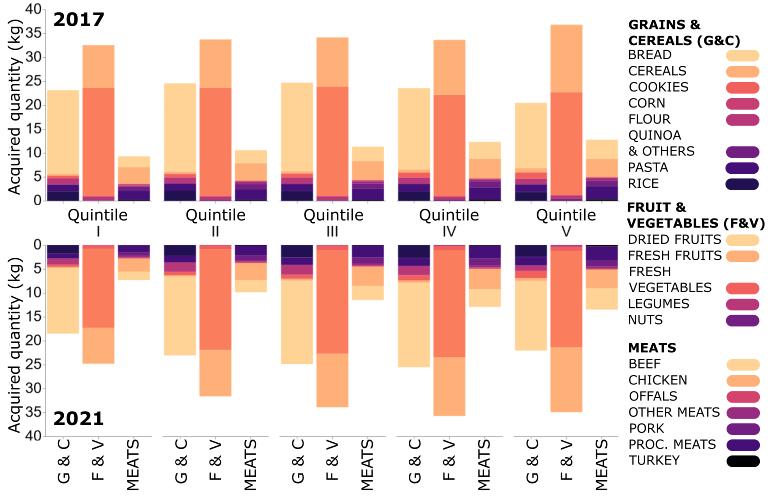
-Stable food preferences where income influences specific choices. Comparison of food subcategories (Fig. 2) showed consistent acquisition patterns both pre- and post-pandemic, with fresh vegetables, bread, fresh fruits, chicken and beef being the top items, in that order. Prices increases did not disrupt these trends. Interestingly, higher-income households allocate more to beef and processed meats, while lower-income households prioritize chicken. In the Fruit & Vegetables category, higher-income households showed a
preference for fresh fruits over fresh vegetables, whereas lower-income households opt for more fresh vegetables.
In conclusion
Overall, significant disparities in household food expenditure and economic access to food are evident across incomes quintiles in Chile. Lower-income households allocate a larger proportion of their budgets to staple foods like cereals, meats and fruits & vegetables, while higher-income households spend more on non-essential foods. Post-pandemic, lower-income households experienced greater price increases, narrowing the spending gap but without improving dietary diversity, despite government financial support. These findings highlight the importance of targeted policies that address both economic access to essential foods and the persistent nutritional challenges faced by vulnerable populations in Chile. Agricultural production and prices of cereals, meats and fresh fruits & vegetables likely play a critical role in influencing food security. Public policies that integrate agrarian, food and nutritional security have the potential to contribute to reducing poverty in its classical interpretation.
Read the full paper at https://rdcu.be/eeqHj

Follow the Topic
-
Discover Food
This is a transdisciplinary, open access journal that provides a leading platform for the rapid dissemination of knowledge and advances covering the research and innovation that is taking place across the food sector.

Related Collections
With Collections, you can get published faster and increase your visibility.
Advancing the Understanding of Food Structure and Processing in Sensory Perception, Eating Behaviour, and Nutrient Retention
The structure and processing of food are critical in shaping sensory perception, influencing satiety, guiding eating behaviour, and determining nutrient retention. As global food systems evolve, understanding these complex interactions is crucial for developing products that are not only appealing to consumers but also promote health and well-being. This area of study is increasingly significant in the context of personalised nutrition, where tailoring food structures and processing techniques can optimise health outcomes.
This topical collection invites researchers, scholars, and industry professionals to contribute their latest findings on the interplay between food structure, oral processing, and their effects on sensory perception, eating behavior, and nutrient retention. To differentiate this collection and ensure it provides fresh and valuable insights, we encourage submissions that focus on specific emerging trends, innovative approaches, and cutting-edge methodologies. Topics of interest include, but are not limited to:
• The potential use of artificial intelligence and machine learning to optimise food structure and processing for enhanced sensory experiences, satiety, and nutrient retention.
• Application of state-of-the-art imaging (e.g., MRI, CT, and electron microscopy) and analytical methods to study food microstructures and their transformations during food processing as well as oral processing.
• Novel approaches to creating food matrices that modulate sensory properties, digestion, and nutrient release.
• Exploration of the role of texture and rheology in oral processing and its impact on sensory perception and satiety.
• Investigations into how emerging processing methods (e.g., pulsed electric field, high-pressure processing) influence nutrient retention, bioaccessibility, and functional properties of foods.
• Research focused on food structures and formulations tailored for demographic groups with unique nutritional needs, such as elderly populations or individuals with specific metabolic conditions.
Through highlighting novel approaches and innovative technologies in the study of food structure and processing, this collection aims to provide a platform for groundbreaking research that pushes the boundaries of current knowledge. We encourage contributions that explore these cutting-edge areas and offer new perspectives that are not widely covered in existing literature.
Keywords:
• Food structure
• Sensory perception
• Oral processing
• Nutrient bioavailability
• Satiety
• Eating behaviour
• Food matrix design
• Texture and rheology
Publishing Model: Open Access
Deadline: Dec 31, 2026
Innovations in Food Fermentation for Nutrition, Sustainability and Health
Fermentation is a cornerstone of food innovation, now revitalized by cutting-edge science and technology. This Collection will showcase advances in precision fermentation, novel microbial consortia, and omics-driven design, with a strong focus on health, nutrition, and sustainability. Particular emphasis will be given to innovations linking fermentation to microbiome modulation, valorization of agricultural by-products, and the exploration of underutilized substrates such as new legumes, mushrooms, and alternative protein sources. Together, these perspectives highlight how fermentation can contribute to resilient food systems and global health.
Keywords:
Fermentation; Precision fermentation; Microbiome; Sustainable proteins; Food innovation; Valorization; Functional foods; Omics technologies; Alternative substrates; Nutrition and health
This Collection supports and amplifies research related to SDG 2, SDG 3, and SDG 12.
Publishing Model: Open Access
Deadline: Feb 28, 2027