Decolonising Public Health through Praxis
Published in Social Sciences and Biomedical Research

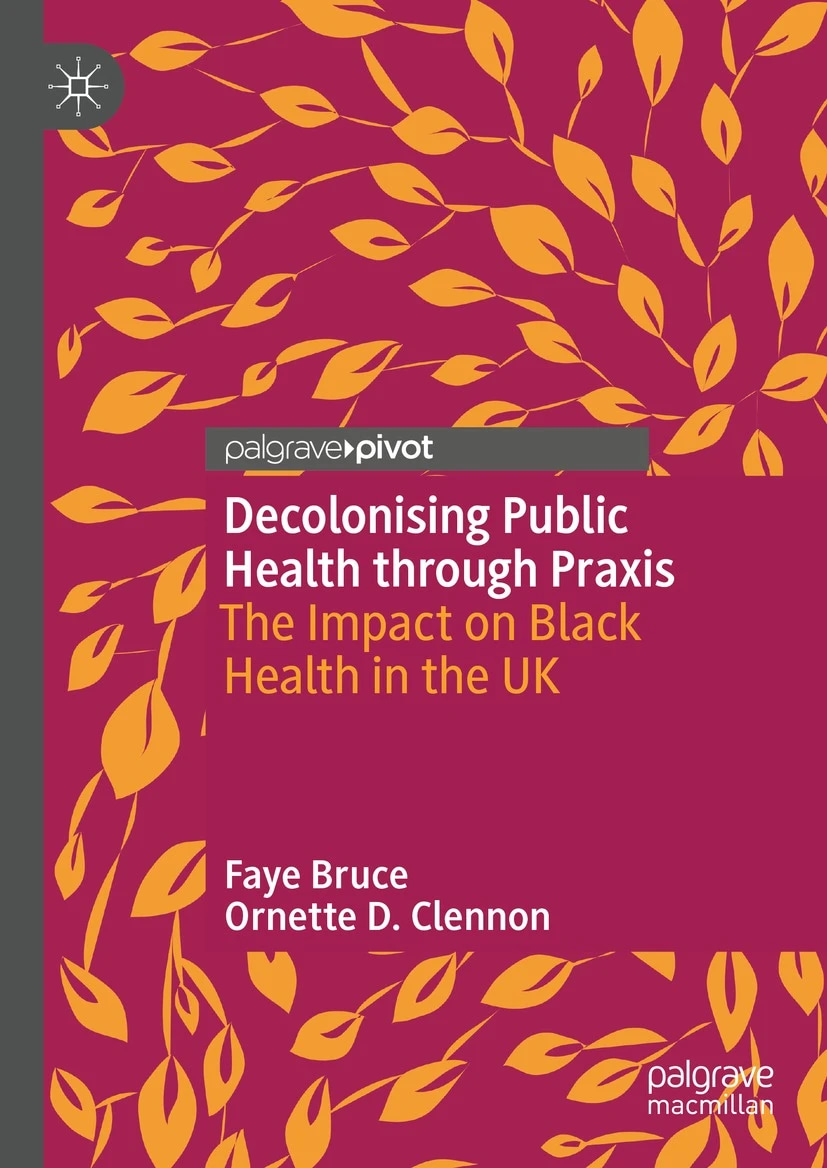

This book provides an interdisciplinary analysis of UK African Diaspora health seekers and their sustained health inequalities in the health market. It translates their often-silenced voices into a decolonial praxis, where their experiences illuminate the hidden factors that have blighted change in health outcomes for these communities. The book excavates and breaks down the nature of these hidden factors, as historical patterns of behaviour that comprise whiteness over the longue durée. Using the lenses of decolonial and critical race studies, the book places whiteness within an ethical and moral framework in order to examine the hidden factors behind health inequalities. The book also looks at intersectionality and discusses whether it is actually fit for purpose as an analytical framework for discussing the health seeking behaviours of both Black men and Black women in relation to their unequal access to the health markets
Taken from here
Background
This volume is the inspiration for the Palgrave Studies in Decolonisation and Grassroots Black Organic Intellectualism
But how did we get here?
It all started with a serendipitous encounter with a then Faye Bruce (now Professor Faye Ruddock) in around 2015 at Manchester Metropolitan University. Faye had just started on her doctoral research journey with her first supervisory team. She wanted to explore what the hidden factors were behind the lower health outcomes recorded by Black health seekers. This area was already of major interest for her as her Master's also began to address this problem. However, because Faye's background was in Nursing and increasingly in public health, she wanted guidance in exploring the some of the (new to her) sociological factors and literature at play in this area for Black health seekers. At this time, I was already developing my scholarship in interdisciplinary critical race studies. So, Faye invited me onto her supervisory team to offer my critical race studies perspective.
After some institutional hiccups, I became her principal supervisor across her by then, three different supervisory teams. During those challenging times, I introduced Faye to post colonial theory and encouraged her to embrace an interdisciplinary lens through which to interrogate the health economics she was researching. Eventually, Faye was indeed able to trace the "coloniality of power" running through the UK's health sector which underpinned the observed health inequalities. You can read her thesis here.
Research as Social Intervention: Impact
Guiding Faye towards creating social and policy impact for her research became my principal contribution after the scholarship. We both deemed her research far too important to remain confined to a thesis, languishing in a university repository. So, I mentored her in setting up a community health enterprise that directly transformed the theories and policies that she was researching for her doctorate into tangible community outcomes. Initially, using my consortium Making Education a Priority (MEaP) as an organisational template, CAHN, the Caribbean and African Health Network was born. Directors from MEaP served as early Directors in CAHN to help it formalise and embed itself in the local African-diaspora communities in Manchester. It was also at this time that I set up the Critical Race and Ethnicity Research Cluster at the University to provide her with wider scholarly support during the early years of her community enterprise CAHN. The research cluster also acted as an archive for her public engagement and policy contributions whilst she wrote her thesis. From consulting with Black Churches, mosques and other faith groups via the former Greater Manchester Health and Social Care Partnership now the Greater Manchester Integrated Care Partnership, to meeting with Sir Michael Marmot and advocating for social determinants of health to be taken into consideration for his health review, Faye ensured that the findings of her research as they were generated made an immediate impact on health policy and wider stakeholders before her thesis was published.
Why Decolonising Public Health and what does that even mean?
After Faye passed her viva voce with flying colours, she approached me about writing a book based on her thesis. Since I was her supervisor that had been with her on her entire PhD journey, she felt it fitting that we write a book together, since in our own ways, we had learned so much from the whole process.
For me, it was important that we revisited the "coloniality of power" themes from Faye's original thesis and drilled much deeper into where those themes actually came from, in the first place. We embarked on an exploration of "whiteness" over the longue durée. We wanted to understand what the historical patterns of behaviour were that were still present in the health markets today and in the current experiences of Black health seekers. We could see that today's health market was an expression of "whiteness" that had underlying and centuries-old beliefs and patterns of behavior. So, we sought to illuminate the epochal development of whiteness in order to trace its remnants in today's health market. This was us, in effect, decolonising whiteness and making visible its invisible governing structures (the decolonial process in health research).
However, since Faye's original thesis also majorly elevated the voices of Black health seekers, it was important to showcase community solutions to the challenges identified by her original research. In this volume, we were able to explore much more deeply African metaphysics and its relationship to holistic models of health that many elders in African diaspora faith communities were following. Platforming traditional heritage knowledges from our grassroots communities and envisioning how they could become part of a solution towards community preventative health was very exciting and formed a major part of the decolonisation process in the volume.
So, taking all of this together, we, in effect ended up writing a manifesto for a decolonial praxis of Public Health that provides real benefits and advocacy for local grassroots communities of colour, in addition to forging partnerships with wider stakeholders in the health sector.
Follow the Topic
Introducing: Social Science Matters
Social Science Matters is a campaign from the team at Palgrave Macmillan that aims to increase the visibility and impact of the social sciences
Continue reading announcement