Deep Below, Far Beyond: The Reach of Antarctic Sea-Ice Loss
Published in Earth & Environment



The discovery we weren't looking for
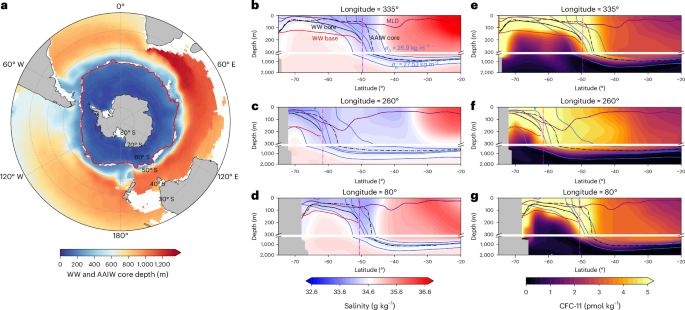
Scientific discoveries do not always begin with the questions we set out to answer. Sometimes, they begin with something unexpected in the data. Our research started with an investigation into the flow of Antarctic Intermediate Water (AAIW) into the Indian Ocean. AAIW is an important water mass that forms in the Southern Ocean, sinks to depths of around 700–1,200 meters, and spreads northward into the Atlantic, Indian, and Pacific Oceans.
We were examining long-term records to understand how this water mass had evolved over time. As we looked at the salinity of its core, something unusual caught our attention. For decades, AAIW had been becoming progressively fresher. But around 2016, the trend appeared to flip. Instead of continuing to freshen, the water was becoming saltier.
This immediately raised a question: Was this simply a short-term fluctuation, or were we witnessing a fundamental change in one of the ocean's major water masses? That curiosity became the starting point of a much larger investigation.
Following the trail of an unexpected reversal
To understand why this observation mattered, it helps to know how Antarctic Intermediate Water forms.
Every year, Antarctic sea ice grows during winter and melts during summer. When sea ice melts, it releases freshwater into the surrounding ocean, influencing the salinity and density of surface waters. These processes contribute to the formation and properties of AAIW, which subsequently spreads far beyond Antarctica. For several decades, observations had shown that AAIW was becoming fresher, lighter, and shallower. This long-term freshening was consistent with an increasing freshwater influence in the Southern Ocean.
But our observations suggested that something had changed around 2016.
We extended our investigation beyond the Indian Ocean, examining multiple observational datasets and the evolution of AAIW across the Southern Hemisphere. The reversal was not confined to a single region or an isolated observational product. Across independent datasets, we found a consistent change: AAIW had shifted from becoming fresher, lighter, and shallower to becoming saltier, denser, and deeper.
The next challenge was understanding what could have triggered such a widespread change.
Connecting the dots with Antarctic sea ice
One of the most remarkable changes in the Southern Ocean over the past decade has been the rapid decline in Antarctic sea ice. Until around 2015, Antarctic sea-ice coverage had shown a modest long-term increase. But this pattern changed abruptly in 2016, followed by several years of exceptionally low sea-ice coverage.
The timing was strikingly similar to the reversal we had identified in AAIW.
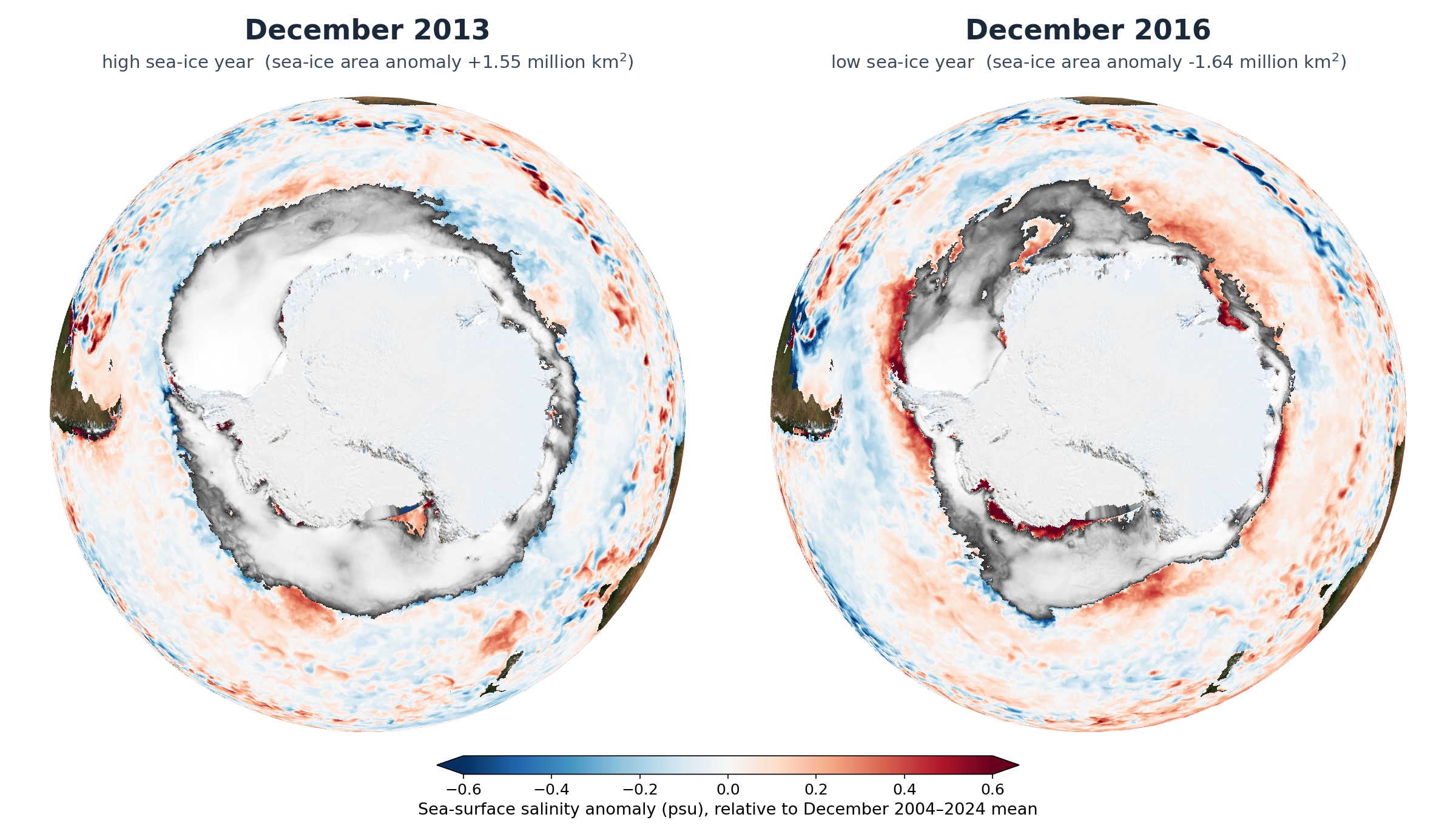
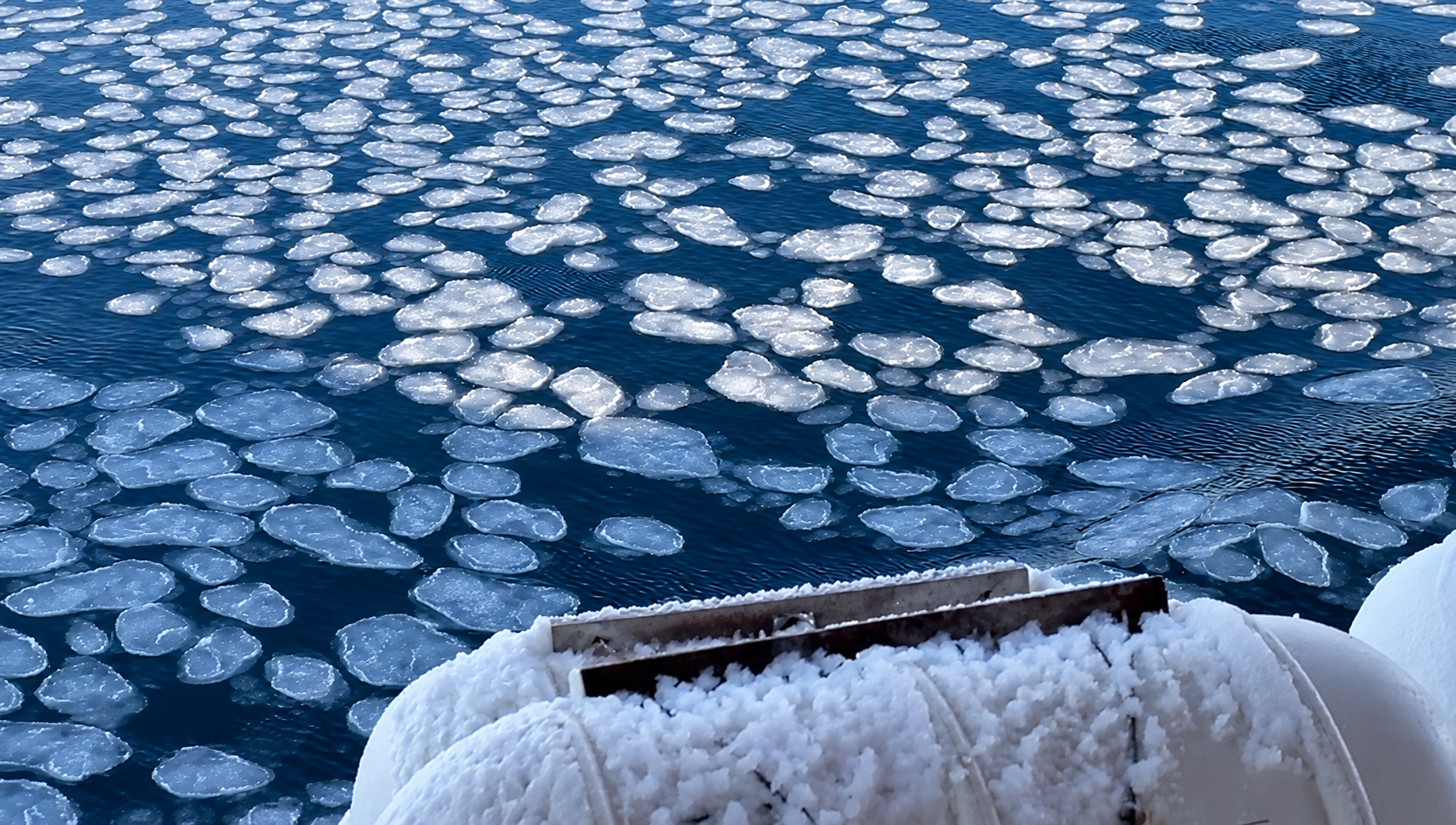
This led us to investigate whether the two changes were connected. Antarctic sea ice plays an important role in the ocean's freshwater cycle. During summer, melting sea ice releases large quantities of freshwater into the upper ocean. When sea-ice coverage declines, the amount and distribution of this freshwater input can change substantially.
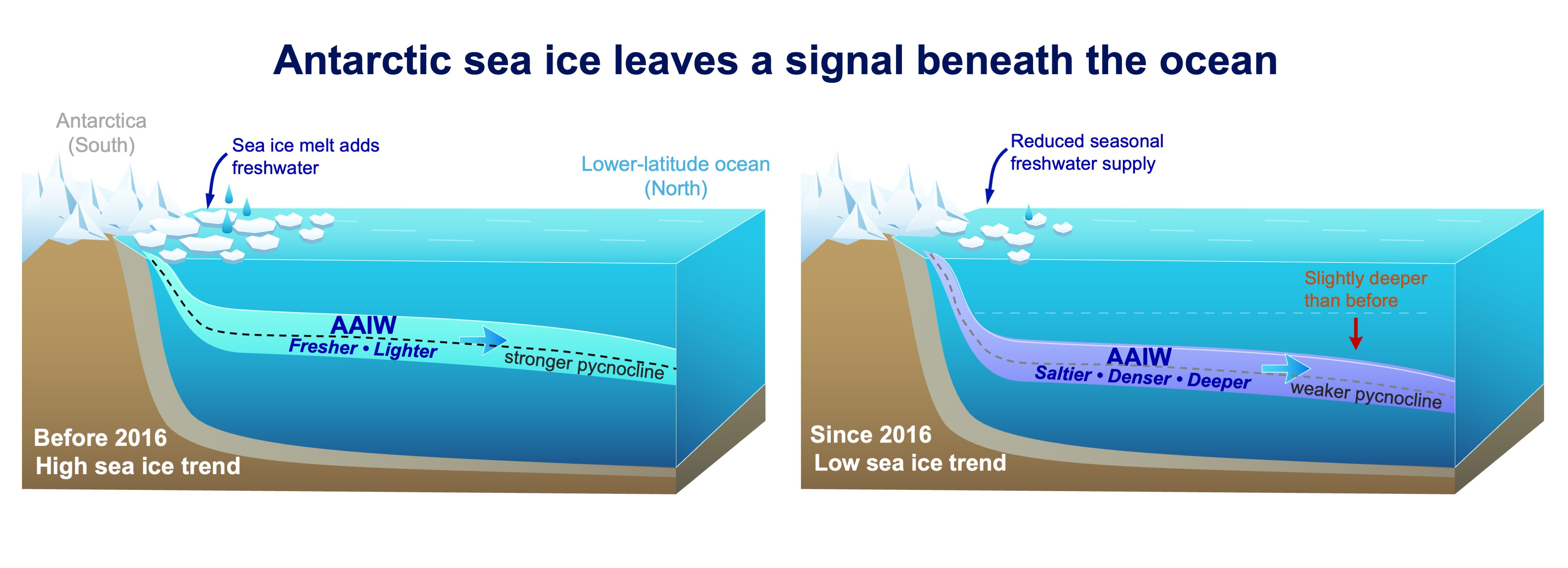
Our analysis showed that the post-2015 decline in Antarctic sea ice reduced the freshwater supplied through seasonal melting, while changes in ocean circulation and the upwelling of warmer, saltier deep waters further influenced the properties of AAIW. Together, these processes help explain why AAIW has been becoming saltier and denser since 2016.
What initially appeared to be an unexpected change in a salinity time series was emerging as evidence of a much broader reorganization of the Southern Ocean.
Why a change hundreds of meters below the surface matters
The ocean is not a uniform body of water. It consists of layers with different temperatures and salinities, which together determine seawater density. AAIW plays an important role in maintaining this layered structure, particularly the permanent pycnocline — a region where ocean density increases rapidly with depth.
This density structure influences how heat and other properties are exchanged between the upper and deeper ocean. The ocean absorbs more than 90% of the excess heat trapped by greenhouse gases. Understanding where this heat is stored, and how it moves between ocean layers, is therefore essential for understanding Earth's changing climate.
As AAIW becomes saltier, denser, and deeper, the ocean's density structure may also change, potentially affecting how heat penetrates into deeper waters and how large-scale ocean circulation evolves. These possible consequences extend far beyond Antarctica because AAIW spreads into three major ocean basins.
Our study does not establish exactly how these downstream climate impacts will unfold, but it identifies an important change in the ocean's physical structure that warrants further investigation.
A remarkably rapid transformation
Perhaps the most surprising aspect of our findings is the speed at which this reversal has emerged. Past changes in Antarctic Intermediate Water associated with glacial–interglacial climate transitions occurred over thousands of years. Yet the reversal documented in our study has emerged within less than a decade.
This does not mean that the modern changes are identical to those in Earth's distant past. However, it highlights how quickly a major ocean water mass can respond to changes in the Antarctic climate system.
What began as a curious feature in an observational time series has revealed a potentially important shift in the way the Southern Ocean is evolving.
Looking ahead
This study has been a collaborative effort involving researchers from the Indian Institute of Science, the University of Melbourne, and the University of Southampton. Bringing together different observational datasets, perspectives, and expertise helped us investigate a finding that initially emerged from a much narrower research question.
Many questions remain. Will the salinification of AAIW continue? How will its changing density affect ocean stratification and circulation? And what might these changes mean for the ocean's ability to store and redistribute heat in the coming decades?
These are questions we hope future observations and modeling studies will help answer.
For me, one of the most rewarding aspects of this research has been seeing how an unexpected feature in the data can lead to an entirely new scientific question.
Sometimes, the most interesting discoveries begin when the ocean does something we weren't expecting.
About the research
This article discusses our study, Reversal of Antarctic Intermediate Water trends triggered by sea ice decline, published in Nature Climate Change.
Authors: Kaushik Mishra, Bishakhdatta Gayen, and Alberto C. Naveira Garabato.
Read the paper: https://doi.org/10.1038/s41558-026-02758-y
Follow the Topic
-
Nature Climate Change
A monthly journal dedicated to publishing the most significant and cutting-edge research on the nature, underlying causes or impacts of global climate change and its implications for the economy, policy and the world at large.