Deep scuba diving and spontaneous resolution of vitreomacular traction: could barometric pressure influence vitreoretinal dynamics?
Published in Biomedical Research
Explore the Research
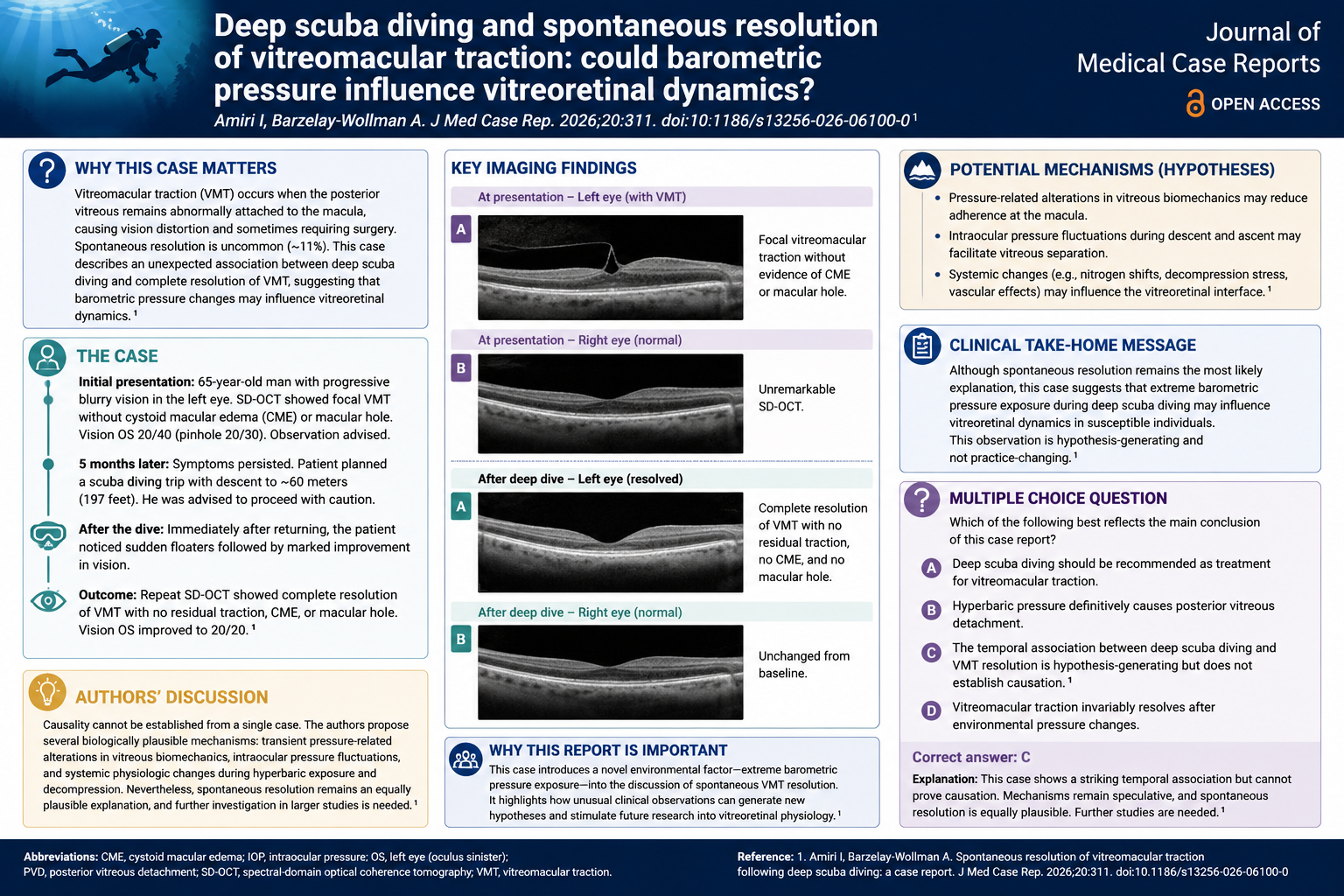
Spontaneous resolution of vitreomacular traction following deep scuba diving: a case report
Why this case matters
Vitreomacular traction (VMT) typically results from incomplete posterior vitreous detachment and may require surgery when vision deteriorates. Although spontaneous resolution occurs in a minority of patients, triggers remain poorly understood. This report describes an unexpected temporal association between deep scuba diving and complete anatomical and functional resolution of VMT, suggesting that environmental barometric pressure changes may influence vitreoretinal biomechanics.
The case
A 65-year-old Caucasian patient presented with progressive blurry vision in the left eye. Spectral-domain optical coherence tomography (SD-OCT) demonstrated focal vitreomacular traction without cystoid macular edema or macular hole. Because visual acuity remained relatively preserved, observation was recommended rather than surgery.
Five months later, symptoms persisted. Before planned surgical intervention, the patient undertook recreational scuba diving to approximately 60 meters (197 feet). Immediately after the dive, the patient experienced sudden floaters followed by marked improvement in vision. Repeat SD-OCT demonstrated complete release of vitreomacular traction without residual traction, cystoid macular edema, or macular hole, and visual acuity improved to 20/20.
Authors' discussion
The authors emphasize that causality cannot be established from a single observation. They propose several biologically plausible mechanisms, including transient pressure-related alterations in vitreous biomechanics, intraocular pressure fluctuations, and systemic physiologic changes associated with hyperbaric exposure and decompression. While spontaneous VMT resolution remains an equally plausible explanation, this case raises an intriguing hypothesis deserving further investigation in larger studies.
Why this report is important
This case expands the differential considerations surrounding spontaneous VMT resolution and introduces an environmental factor not previously associated with untreated VMT. It illustrates how careful observation of unusual clinical events can generate new hypotheses regarding ocular physiology and may stimulate future research into the effects of hyperbaric environments on the vitreoretinal interface.
Clinical Take-Home Message
Although spontaneous resolution remains the most likely explanation, this case suggests that extreme barometric pressure exposure during deep scuba diving may influence vitreoretinal dynamics in susceptible individuals. Clinicians should recognize this observation as hypothesis-generating rather than practice-changing.
Multiple Choice Question
Which of the following best reflects the main conclusion of this case report?
A. Deep scuba diving should be recommended as treatment for vitreomacular traction.
B. Hyperbaric pressure definitively causes posterior vitreous detachment.
C. The temporal association between deep scuba diving and VMT resolution is hypothesis-generating but does not establish causation.
D. Vitreomacular traction invariably resolves after environmental pressure changes.
Correct answer: C
Explanation: This case documents a striking temporal association between a 60-meter scuba dive and spontaneous VMT resolution. However, as a single case report, it cannot establish causality. The proposed mechanisms remain speculative, and spontaneous resolution independent of diving remains an equally plausible explanation. Further controlled studies are required before any clinical recommendations can be made.
Journal of Medical Case Reports is the world's first international, PubMed-listed medical journal devoted to publishing case reports from all medical disciplines and will consider any original case report that expands the field of general medical knowledge, and original research relating to case reports. The journal is open access and strongly endorses the CARE guidelines for case reports, requiring authors to submit populated CARE checklists with submissions to improve transparency in reporting.

Richard Alan Rison is the interim Editor-in-Chief of Journal of Medical Case reports. He is also an associate neurology editor (editorial board) for BMC Neurology, and the former lead editor for case reports of BMC Research Notes (currently on the editorial board). His scholarly work focuses on medical case reporting, reporting standards, and editorial methodology. Dr. Rison participated in the development and dissemination of the CARE guidelines for clinical case reporting and has authored numerous publications addressing both neurological disorders and the role of case reports in advancing medical knowledge. Dr. Rison practices general neurology and served as the founding medical director of the PIH Health Hospital-Whittier Stroke Program and the PIH Health Hospital-Whittier Non-Invasive Vascular Laboratory, is a clinical assistant professor of neurology at the University of Southern California Keck School of Medicine and Los Angeles County Medical Center, and is a Fellow of the American Academy of Neurology, the American Neurological Association, and the American Association of Neuromuscular and Electrodiagnostic Medicine. Dr Rison is board-certified by the American Board of Psychiatry and Neurology in neurology and vascular neurology, and neurocritical care and neuroimaging by the United Council of Neurologic Subspecialties. He is also board-certified by the American Board of Electrodiagnostic Medicine in electrodiagnostic medicine. Dr. Rison is a former president of the Los Angeles Neurological Society.
Follow the Topic
-
Journal of Medical Case Reports
This journal will consider any original case report that expands the field of general medical knowledge, and original research relating to case reports.




Please sign in or register for FREE
If you are a registered user on Research Communities by Springer Nature, please sign in