Designing Better Hydrogen Catalysts—One Atom at a Time


Hydrogen is often hailed as the fuel of the future—but unlocking its full potential requires catalysts that are not only efficient but also affordable and scalable. Platinum has long been the gold standard for the hydrogen evolution reaction (HER), but its scarcity and cost pose major barriers to widespread adoption.
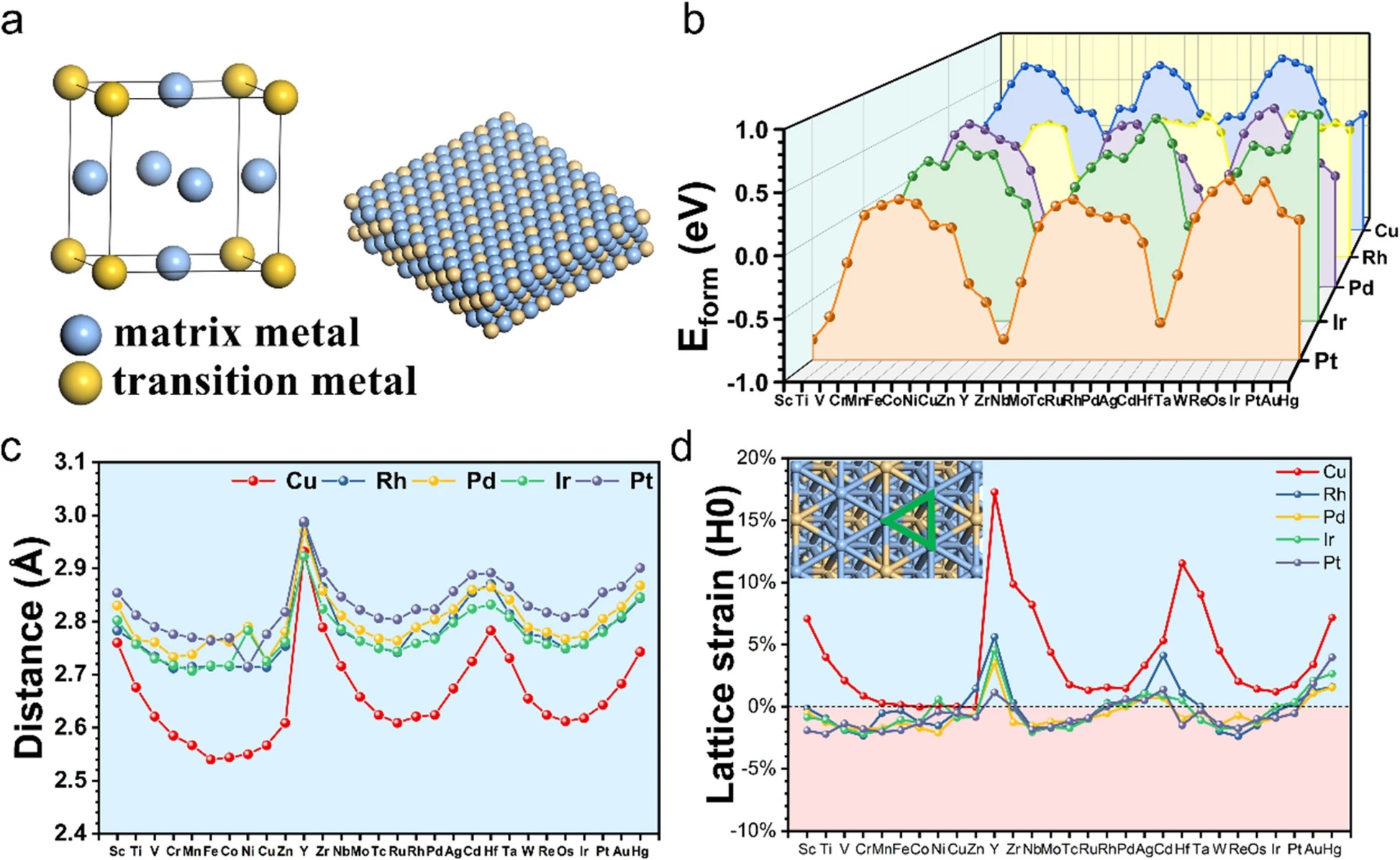
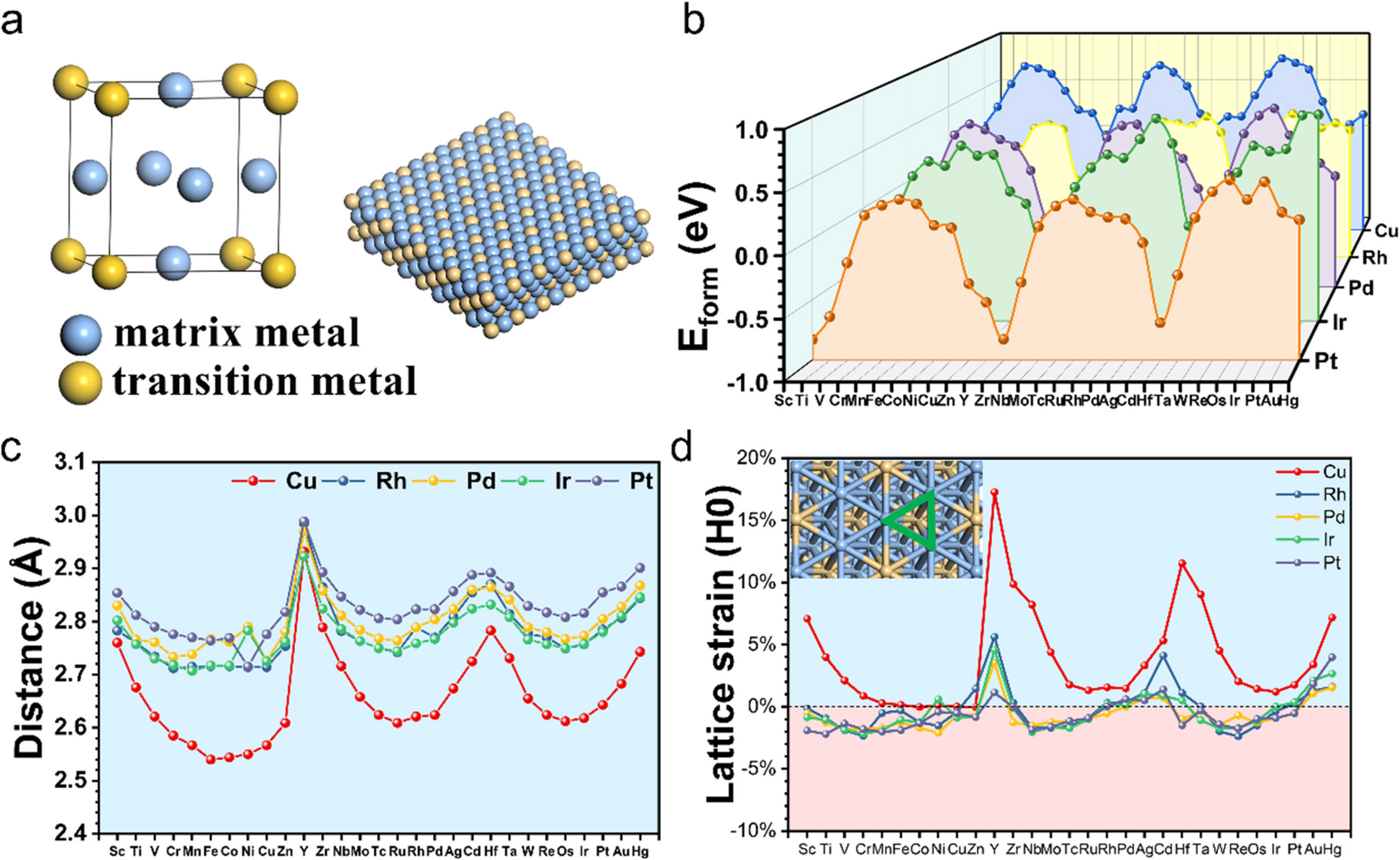
In our latest study, we set out to explore whether intermetallic compounds (IMCs)—specifically those doped with transition metals—could offer a viable alternative. Using density functional theory (DFT) calculations, we systematically screened 145 L1₂-type IMCs, combining noble metals like Rh, Pd, Ir, and Pt with a wide range of 3d, 4d, and 5d transition metals.
What we found was both surprising and exciting.
Key Insights
-
Noble metals still matter—but not in the way we thought.
Over 70% of the optimal active sites were dominated by noble metal atoms, while the doped transition metals primarily acted as electronic modulators, tuning the catalytic behavior without directly participating in the reaction. -
The volcano-shaped trend is predictive.
We observed a volcano-shaped relationship between hydrogen adsorption free energy and catalytic activity, confirming the Sabatier principle and offering a roadmap for identifying high-performance materials. -
14 IMC catalysts outperformed platinum.
Among the 145 candidates, 14 IMCs—including Pt₃H, Pd₃Zr, and Rh₃Cr—showed superior HER activity and thermal stability compared to conventional Pt catalysts. -
The d-band center theory holds up—even in complex systems.
Our results extend the applicability of d-band center theory to multi-metal environments, revealing how orbital hybridization and lattice strain influence HER performance at the atomic level.
This work is more than a computational exercise—it’s a step toward rational catalyst design, where atomic-scale insights guide the development of materials that are not only effective, but also economically viable.
We hope our findings will inspire further experimental validation and accelerate the transition to a hydrogen-powered future.
Follow the Topic
-
Catal
Catal is an open access journal covering full spectrum of catalysis critical advances. From biocatalysts to heterogeneous catalysts, it integrates fundamental and applied sciences. Catal offers a primary platform for researchers and practitioners in the field.

Related Collections
With Collections, you can get published faster and increase your visibility.
Porous Materials for Sustainable Green Catalysis
The advancement of our collective understanding in the field of porous materials for sustainable green catalysis is crucial as we face urgent environmental challenges and the need for sustainable energy solutions. The integration of porous materials into catalytic processes has opened new avenues for improving efficiency, selectivity and stability while minimizing waste. Significant advances have been made, including the development of zeolites, mesoporous materials, metal-organic frameworks (MOFs) and covalent organic frameworks (COFs), which have demonstrated remarkable catalytic performance in various reactions.
Future research holds immense potential, with speculations ranging from the design of novel porous materials with tailored properties to their application in industrial catalysis, biocatalysis, H2 production and carbon capture technologies. By continuing this research, we can drive progress toward achieving Sustainable Development Goals (SDGs), particularly in clean energy (SDG 7) and climate action (SDG 13), ultimately fostering a sustainable future for our planet.
We invite researchers to contribute to this special Collection by submitting research articles, brief communications, perspectives, reviews, and analyses.
Topics of interest include but are not limited to:
- Synthesis of porous materials
- Catalytic performance evaluation
- Green synthesis methods
- Application in environmental remediation
- CO2 conversion technologies
- Biocatalysis in porous matrices
- Design of multifunctional porous catalysts
- Mechanistic studies of catalysis
Publishing Model: Open Access
Deadline: Dec 31, 2026
National Catalysis Conference 2025
The 22nd National Catalysis Conference, held in December 2025 in Xiamen, China, stands as the largest national academic event in the field of catalysis, bringing together leading scientists from academia and industry to discuss frontier research and emerging technologies across catalytic science.
In collaboration with several internationally recognized researchers from Xiamen University - the main organizer of the conference - Catal will publish a Special Issue featuring selected contributions from the meeting. This joint effort ensures high academic standards and showcases the scientific breadth and excellence presented at the conference.
Potential topics include, but are not limited to:
• Catalytic materials
• Thermocatalysis
• Electrocatalysis
• Biomass and CO₂ conversion
• Industrial catalysis
• Theoretical and computational catalysis
Publishing Model: Open Access
Deadline: Dec 31, 2026